Question
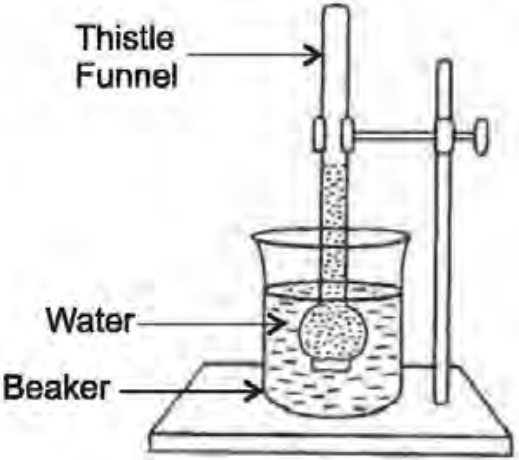
Given diagram represents an apparatus set-up to study a very important physiological process.
(i) Name the process being studied.
(ii) Explain the process.
(iii) What change would you observe in the thistle funnel containing sugar Thistle Funnel solution after about 10 minutes?
Image

Answer

(i) Osmosis is being studied in the given set up.
(ii) Osmosis is defined as the net movement of water molecules from a region of their higher concentration to a region of their lower concentration through a semipermeable membrane.
(iii) After 10 minutes, the level of sugar solution rises in the tube of thistle Water Beaker funnel, whereas water level in the beaker falls.

Need a full question paper?

Generate a complete, print-ready paper with questions like this in minutes — across 16+ boards, with answer keys.

Start Generating Free

Similar questions

(i) What is meant by artificial insemination?
(ii) What are test-tube babies?
Differentiate between voluntary and involuntary actions.
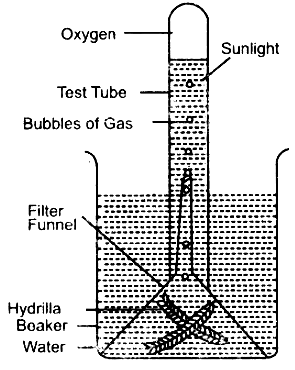
The figure below represents an experiment set up to study a physiological process in plants:

(i) Name the physiological process being studied.
(ii) Explain the process.
(iii) What is the aim of the experiment?
(iv) Give a well-balanced equation to represent the process.
Explain the Term: Loop of Henle
Enumerate the steps involved in testing a green leaf for the presence of starch.
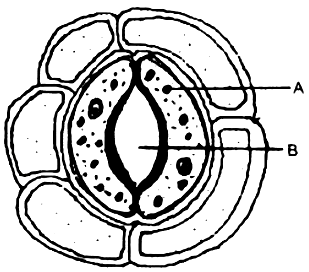
The diagram below represents a structure found in a leaf.

Study the same and answer the questions that follow:
(i) Name the pis labeled A and B.
(ii) What is the biological term for the above structure?
(iii) What is the function of the part labeled A?
(iv) Mention two structural features of A, which help in the function mentioned in (iii) above.
(v) Where is this structure likely to be found in a leaf?
(vi) The above structure helps in the process of transpiration. Explain the term transpiration.
(vii) How many other cells are found surrounding this structure as seen in the diagram?
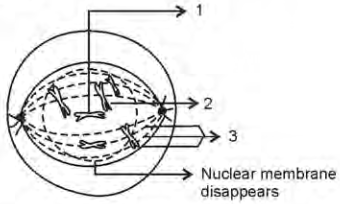
Given below is a diagram representing a stage during mitotic cell division in an animal cell. Examine it carefully and answer the questions which follow.
Image
(i) Identify the stage. Give one reason in support of your answer.
(ii) Name the cell organelle that forms the 'aster'.
(iii) Name the parts labelled as 1, 2, and 3.
(iv) Name the stage that follows the one shown here. How is that stage identified?
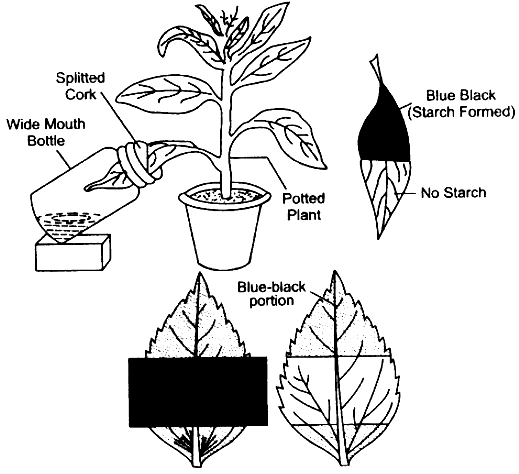
The figure given below is for performing an experiment on photosynthesis.

Answer the following:
(i) What is the aim of this experiment?
(ii) Describe an experiment to show that light is necessary for photosynthesis.
(iii) What do you conclude from this experiment?
(iv) What is the role of light in photosynthesis?
Explain briefly the relationship between poverty and population and how one affects the other.
How do non-green plants such as fungi and bacteria obtain their nourishment?