Question
Explain the terms Inductive and Electromeric effects. Which electron displacement effect explains the following correct orders of acidity of the carboxylic acids?
  1. $Cl_3CCOOH > Cl_2CHCOOH > ClCH_2COOH$.
  2. $CH_3CH_2COOH > (CH_3)_2CHCOOH > (CH_3)_3C.COOH$.

Answer

Inductive Effect: The inductive effect refers to the polarity produced in a molecule as a result of higher electronegativity of one atom compared to another.Atoms or groups which lose electron towards a carbon atom are said to have +1 Effect.
Those atoms or groups which draw electron away from a carbon atom are said to have -I Effect.
Common examples of -I effect are:
$NO_2, F, Cl, Br, I, OH$ etc.
Examples of +1 effect are (Electron releasing)
$(CH_3)_2C- , (CH_3)_2CH-, CH_3CH_2- CH_3-$ etc.
Electromeric effect: The electromeric effect refers to the polarity produced in a multiple bonded compound as it is approached by a reagent.

The atom A has lost its share in the electron pair and B has gained this share.
As a result A acquires a positive charge and B a negative charge. It is a temporary effect and takes place only in the presence of a reagent.
  1. -I-effect as shown below: As the number of halogen atoms decreases, the overall -I- effect decreases and the acid strength decreases accordingly.
  1. +I-effect as shown below: As the number of alkyl groups increases, the +I-effect increases and the acid strength decreases accordingly.

Need a full question paper?

Generate a complete, print-ready paper with questions like this in minutes — across 16+ boards, with answer keys.

Start Generating Free

Similar questions

What is photoelectric effect? Explain with diagram.
Balance the following equations in basic medium by ion-electron method and oxidation number methods and identify the oxidising agent and the reducing agent. $Cl_2O_7(g) + H_2O_2(aq) \rightarrow ClO_2^-(aq) + O_2(g) + H^+$
  1. Show that the circumference of Bohr's orbit for the H-atom is an integral multiple of the de-Broglie wavelength of electron revolving around the orbit.
  2. Explain that the effect of the Heisenberg uncertainty principle is significant only for motion of microscopic objects and is negligible for that of macroscopic objects. $[h = 6.626 \times 10^{-34}Js$, Mass of electron $= 9.1 \times 10^{-31}kg]$.
  3. State Hund's Rule of maximum multiplicity.
  1. Calculate the wavelength and frequency of limiting line of Lyman series (Rydberg constant = $109677 \mathrm{~cm}^{-1}$)
  2. Give quantum numbers for electrons with highest energy in sodium atom (Z = 11)
  3. Which of the following sets of quantum numbers are not possible? Give reasons:
  1. $\text{n} =1,1=0,\text{m}_1=0,\text{m}_\text{s}=-\frac{1}{2}$
  2. $\text{n}=0,1=0,\text{m}_1=0,\text{m}_\text{s}=-\frac{1}{2}$
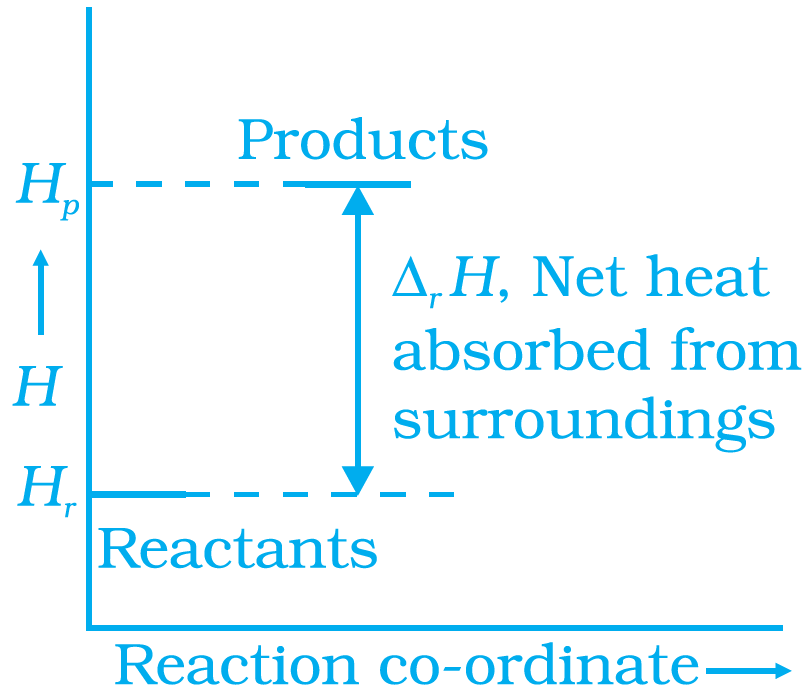
Enthalpy diagram for a particular reaction is given in Fig. Is it possible to decide spontaneity of a reaction from given diagram. Explain.
Explain the following in contrast to alkynes: (i) Polymerisation (ii) Isomerisation (iii) Oxidation (iv) Ozonolysis
Write the electronic configurations of the following ions:
Which of the following are isoelectronic species i.e., those having the same number of electrons?
$\text{Na}^+,\text{K}^+,\text{Mg}^{2+},\text{Ca}^{2+},\text{S}^{2-},\text{Ar}.$
Calculate the mass percent of different elements present in sodium sulphate $\left(\mathrm{Na}_2 \mathrm{SO}_4\right)$.
Give three points of differences between inductive effect and resonance effect.