Question
Balance the following equations in basic medium by ion-electron method and oxidation number methods and identify the oxidising agent and the reducing agent. $Cl_2O_7(g) + H_2O_2(aq) \rightarrow ClO_2^-(aq) + O_2(g) + H^+$
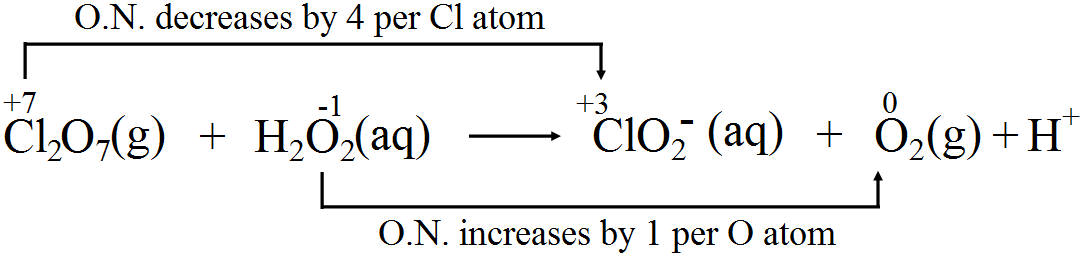
Answer


Thus, $Cl_2O_7$(g) acts an oxidising agent while $H_2O_2$(aq) as the reducing agent.
Oxidation number method:
Total decrease in O.N. of $Cl_2O_7 = 4 \times 2 = 8$
Total increase in O.N. of $H_2O_2 = 2 \times 1 = 2$
$\therefore$ To balance increase/ decrease in O.N. multiply $H_2O_2$ and $O_2$ by 4, we have,
$\text{Cl}_2\text{O}_7(\text{g})+4\text{H}_2\text{O}_2(\text{aq})\rightarrow\text{ClO}_2^-(\text{aq})+4\text{O}_2(\text{g})$
To balance Cl atoms, multiply $ClO_2^-$ by 2, we have,
$\text{Cl}_2\text{O}_7(\text{g})+4\text{H}_2\text{O}_2(\text{aq})\rightarrow2\text{ClO}_2^-(\text{aq})+4\text{O}_2(\text{g})$
To balance O atoms, add $3H_2O$ R.H.S., we have,
$\text{Cl}_2\text{O}_7(\text{g})+4\text{H}_2\text{O}_2(\text{aq})\rightarrow2\text{ClO}_2^-(\text{aq})+4\text{O}_2(\text{g})+3\text{H}_2\text{O(l)}$
To balance H atoms, add $2H_2O$ to R.H.S. and $2OH^-$ to L.H.S., we have,
$\text{Cl}_2\text{O}_7(\text{g})+4\text{H}_2\text{O}_2(\text{aq})+2\text{OH}^-(\text{aq})\rightarrow\\2\text{ClO}_2^-(\text{aq})+4\text{O}_2(\text{g})+5\text{H}_2\text{O(l)}$
This represents the balanced redox equation.
Ion electron method
Oxidation half reaction:
$\stackrel{\ \ \ \ \ \ \ \ {-1}}{\ \ \ \ \ \ \ \ \ \ \ \hbox{H}_2\text{O}_2(\text{aq})}\rightarrow\stackrel{{0}}{\ \ \ \ \ \ \ \ \hbox{O}_2{(\text{g})}}$
Balance O.N. by adding electrons,
$\text{H}_2\text{O}_2(\text{aq})\rightarrow\text{O}_2(\text{g})+2\text{e}^{-}$
Balance charge by adding $2OH^-$ ions,
$\text{H}_2\text{O}_2(\text{aq})+2\text{OH}^-(\text{aq})\rightarrow\text{O}_2(\text{g})+2\text{e}^{-}$
Balance O atoms by adding $2H_2O$,
$\text{H}_2\text{O}_2(\text{aq})+2\text{OH}^-(\text{aq})\rightarrow\text{O}_2(\text{g})+2\text{H}_2\text{O(l)}+2\text{e}^{-}$
Reduction half reaction:
$\stackrel{{+7}}{\ \ \ \ \ \ \ \ \ \ \ \hbox{Cl}_2\text{O}_7(\text{g})}\rightarrow\stackrel{{+3}}{\ \ \ \ \ \ \ \ \ \ \ \ \ \ \ \text{Cl}\hbox{O}_2^-{(\text{aq})}}$
Balance Cl atoms; $\text{Cl}_2\text{O}_7(\text{g})\rightarrow2\text{ClO}_2^-(\text{aq})$
Balance O.N. by adding electrons,
$\text{Cl}_2\text{O}_7(\text{g})+8\text{e}^{-}\rightarrow2\text{ClO}_2^-(\text{aq})$
Add $6OH^-$ ions to balance charge:
$\text{Cl}_2\text{O}_7(\text{g})+8\text{e}^{-}\rightarrow2\text{ClO}_2^-(\text{aq})+6\text{OH}^-$
Balance O atoms by adding $3H_2O$ to L.H.S., we have,
$\text{Cl}_2\text{O}_7(\text{g})+3\text{H}_2\text{O(l)}+8\text{e}^{-}\rightarrow2\text{ClO}_2^-(\text{aq})+6\text{OH}^-(\text{aq})\ .....(\text{ii})$
To cancel out electrons, multiply eq. (i) by 4 and add it to eq. (ii), we have,
$4\text{H}_2\text{O}_2(\text{aq})+8\text{OH}^{-}(\text{aq})+\text{Cl}_2\text{O}_7(\text{g})+3\text{H}_2\text{O(l)}\rightarrow\\2\text{ClO}_2^-(\text{aq})+6\text{OH}^{-}(\text{aq})+4\text{O}_2(\text{g})+8\text{H}_2\text{O(l)}$
Or $\text{Cl}_2\text{O}_7(\text{g})+4\text{H}_2\text{O}_2(\text{aq})+2\text{OH}^{-}(\text{aq})\rightarrow\\2\text{ClO}_2^-(\text{aq})+4\text{O}_2(\text{g})+5\text{H}_2\text{O(l)}$

Need a full question paper?

Generate a complete, print-ready paper with questions like this in minutes — across 16+ boards, with answer keys.

Start Generating Free

Similar questions

A liquid with high boiling point decomposes on simple distillation but it can be steam distilled for its purification. Explain how is it possible?
1. Describe the effect of
a. addition of $H _2$
b. addition of $CH _3 OH$
c. removal of CO
d. removal of $CH _3 OH$ on the equilibrium of the reaction,
$
2 H_2(g)+CO(g) \rightleftharpoons CH_3 OH(g)
$
2. What happens to an equilibrium in a reversible reaction if a catalyst is added to it?
Give reasons for the following:
  1. $[\text{SiF}_6]^{2-}$ is known whereas $[\text{SiCl}_6]^{2-}$ is not known.
  2. Diamond is covalent, yet has high melting point.
  3. Boric acid is considered as a weak acid.
  4. Boron is unable to form $\text{BF}^{3-}_6$ ion.
  5. $\text{BF}_{3}$ behaves as a Lewis acid.
  1. Name the element which forms maximum number of compound.
  2. How is nascent hydrogen prepared?
  3. What is ratio of $\frac{\text{C}_\text{P}}{\text{C}_\text{V}}$ for hydrogen andwhy?
  4. What is half life of tritium? How is it obtained?
  5. If we electrolyse 2000 litres of $H_2O_2$ how much heavy water will be formed?
Although geometries of $\mathrm{NH}_3$ and $\mathrm{H}_2 \mathrm{O}$ molecules are distorted tetrahedral, bond angle in water is less than that of ammonia. Discuss.
Complete the following reactions:
  1. $\text{NH}_3+\text{CO}_2+\text{H}_2\text{O}\xrightarrow{\ \ \ \\ \ }$
  2. $\text{Mg}(\text{NO}_3)_2\xrightarrow{ \ \ \\ \Delta\ \ \ }$
  3. $\text{BeCl}_2+\text{LiAlH}_4\xrightarrow{\ \ \ \ \ }$
  4. $\text{MgO}+\text{P}_4\text{O}_{10} \xrightarrow{\ \ \ \ \ }$
  5. $\text{Ca(OH)}_2+\text{SO}_2 \xrightarrow{\ \ \ \ \ }$
Match the species in Column I with the type of hybrid orbitals in Column II.
 
Column I
 
Column II
i.
$H_3O^+$
a.
Linear
ii.
$HC = CH$
b.
Angular
iii.
$\text{ClO}^{-}_{2}$
c.
Tetrahedral
iv.
$\text{NH}^{+}_{4}$
d.
Trigonal bipyramidal
 
 
e.
Pyramidal
 The ionization constant of $HF , HCOOH$ and HCN at 298 K are $6.8 \times 10^{-4}, 1.8 \times 10-4$ and $4.8 \times 10^{-9}$ respectively. Calculate the ionization constants of the corresponding conjugate base.
Extensive properties depend on the quantity of matter but intensive properties do not. Explain whether the following properties are extensive or intensive. Mass, internal energy, pressure, heat capacity, molar heat capacity, density, mole fraction, specific heat, temperature and molarity.
Derive the formula required to find the energy of the electron in Bohr orbital.