The distance between the centres of carbon and oxygen atoms in carbon monoxide gas molecules is $=1.13\mathring{\text{A}}.$ Locate the centre of mass of the molecules relative to carbon atom.
Download our app for free and get started
Here, distance between carbon and oxygen atoms $=1.13\mathring{\text{A}}$ Mass of carbon atom $m_1 = 14$ Mass of oxygen atom $m_2 = 16$ Let COM of molecule be at a distance x from carbon atom.
$\therefore \text{r}_1 = \times \mathring{\text{A}}, \text{ r}_2 = (1.13 - \times)\mathring{\text{A}}$ As $m_1r_1 = m_2r_2$
$\therefore14\text{x}=16(1.13-\text{x})$ $\text{ or }30\text{x}=16\times1.13$ $\text{x}=\frac{16\times1.13}{30}=0.602\mathring{\text{A}}.$
$\therefore \text{r}_1 = \times \mathring{\text{A}}, \text{ r}_2 = (1.13 - \times)\mathring{\text{A}}$ As $m_1r_1 = m_2r_2$
$\therefore14\text{x}=16(1.13-\text{x})$ $\text{ or }30\text{x}=16\times1.13$ $\text{x}=\frac{16\times1.13}{30}=0.602\mathring{\text{A}}.$

Download our appand get started for free
Experience the future of education. Simply download our apps or reach out to us for more information. Let's shape the future of learning together!No signup needed.*
Similar Questions
- 1Two blocks of masses $400g$ and $200g$ are connected through a light string going over a pulley which is free to rotate about its axis. The pulley has a moment of inertia $1.6 \times 10^{-4}kg-m^2$ and a radius 2.0cm. Find:View Solution
- The kinetic energy of the system as the $400g$ block falls through $50cm$.
- The speed of the blocks at this instant.
- 2Two masses $M_1$ and $M_2$ are separated by a distance r. Find the moment of inertia of this arrangement about an axis passing through the centre of mass and perpendicular to the line joining them.View Solution
- 3Calculate the angular momentum and rotational kinetic energy of earth about its own axis. How long could this amount of energy supply one kilowatt power to each of the $3.5 \times 10^9$ persons on earth? (Mass of earth = $6.0 \times 1024kg$ and radius = $6.4 \times 10^{24}km)$.View Solution
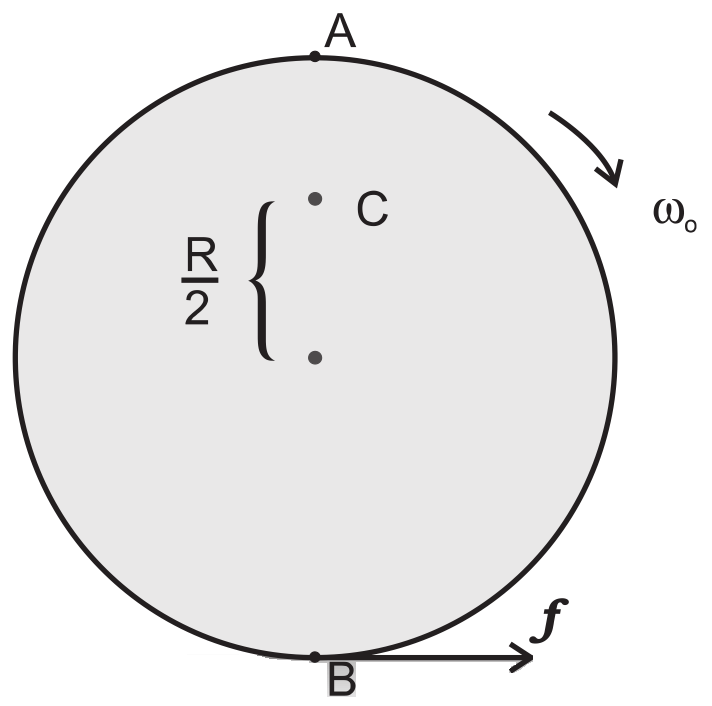
- 4A disc rotating about its axis with angular speed $\omega_0$ is placed lightly (without any translational push) on a perfectly frictionless table. The radius of the disc is R. What are the linear velocities of the points A, B and C on the disc shown in will the disc roll in the direction indicated?View Solution
- 5View SolutionTorques of equal magnitude are applied to a hollow cylinder and a solid sphere, both having the same mass and radius. The cylinder is free to rotate about its standard axis of symmetry, and the sphere is free to rotate about an axis passing through its centre. Which of the two will acquire a greater angular speed after a given time.
- 6A uniform cube of mass m and side a is placed on a frictionless horizontal surface. A vertical force F is applied to the edge as shown in match the following (most appropriate choice):View Solution
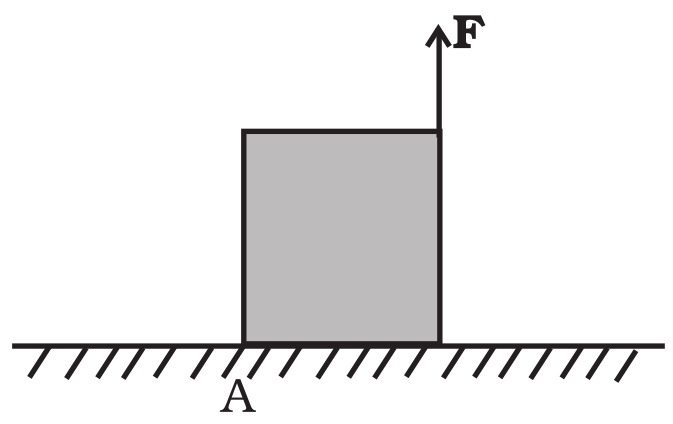
a. $\frac{\text{mg}}{4}<\text{F}<\frac{\text{mg}}{2}$ i. Cube will move up. b. $\text{F}>\frac{\text{mg}}{2}$ ii. Cube will not exhibit motion. c. $\text{F}>\text{mg}$ iii. Cube will begin to rotate and slip at A. d. $\text{F}=\frac{\text{mg}}{4}$ iv. Normal reaction effectively at $\frac{\text{a}}{3}$ - 7Two cylindrical hollow drums of radii R and 2R, and of a common height h, are rotating with angular velocities $\omega$ (anti-clockwise) and $\omega$ (clockwise), respectively. Their axes, fixed are parallel and in a horizontal plane separated by $(3\text{R}+\delta).$ They are now brought in contact $(\delta\rightarrow0){:}$View Solution
- Show the frictional forces just after contact.
- Identify forces and torques external to the system just after contact.
- What would be the ratio of final angular velocities when friction ceases?
- 8An isolated particle of mass m is moving in a horizontal plane (x - y), along the x-axis at a certain height about the ground. It explodes suddenly into two fragments of masses $\frac{\text{m}}{4}$ and $3\frac{\text{m}}{4}.$ An instant later, the smaller fragment is at y = + 15 cm. What is the position of larger fragment at this instant?View Solution
- 9Two discs of moments of inertia $I_1$ and $I_2$ about their respective axes (normal to the disc and passing through the centre), and rotating with angular speeds $\omega_1$ and $\omega_2$ are brought into contact face to face with their axes of rotation coincident.View Solution
- What is the angular speed of the two-disc system?
- Show that the kinetic energy of the combined system is less than the sum of the initial kinetic energies of the two discs. How do you account for this loss in energy? Take $\omega_1\neq\omega_2$
- 10The moment of inertia of a solid flywheel about its axis is $0.1kg-m^2$. A tangential force of $2kg/ wt$ is applied round the circumference of the flywheel with the help of a string and mass arrangement as shown in Fig. If the radius of the wheel is $0.1m$, find the acceleration of the mass.View Solution