Figure shows a small spherical ball of mass m rolling down the loop track. The ball is released on the linear portion at a vertical height H from the lowest point. The circular part shown has a radius R.
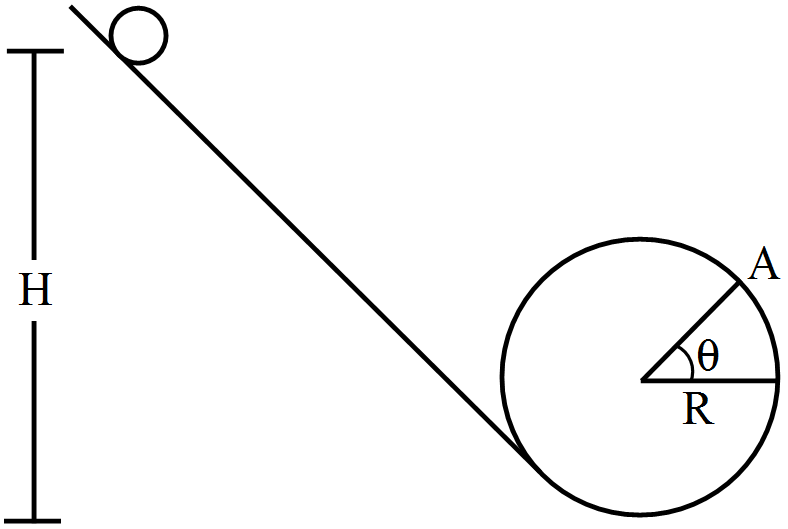
- Find the kinetic energy of the ball when it is at a point A where the radius makes an angle $\theta$ with the horizontal.
- Find the radial and the tangential accelerations of the centre when the ball is at A.
- Find the normal force and the frictional force acting on the ball if H = 60cm, R = 10cm, $\theta=0 $ and m = 70g.
Download our app for free and get started
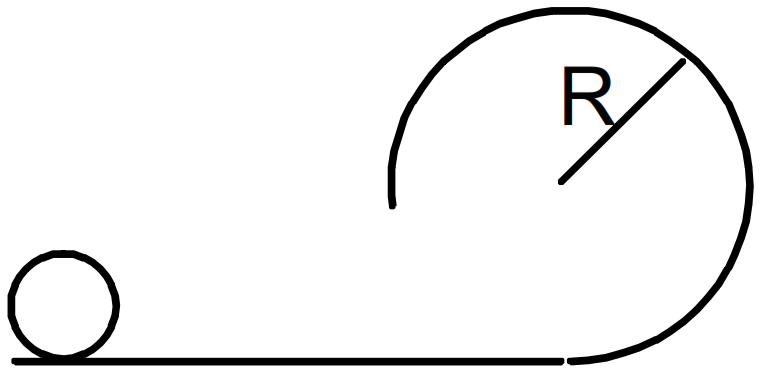
- Total kinetic energy $\text{y}=\Big(\frac{1}{2}\Big)\text{mv}^2+\Big(\frac{1}{2}\Big)\text{l}\omega^2$
$\text{mgH}=\Big(\frac{1}{2}\Big)\text{mv}^2+\Big(\frac{1}{2}\Big)\text{l}\omega^2+\text{mgR}(1+\cos\theta)$
$\Rightarrow\text{mgH}-\text{mgR}(1+\cos\theta)=\Big(\frac{1}{2}\Big)\text{mv}^2+\Big(\frac{1}{2}\Big)\text{l}\omega^2$
$\Rightarrow\Big(\frac{1}{2}\Big)\text{mv}^2+\Big(\frac{1}{2}\Big)\text{l}\omega^2=\text{mg}(\text{H}-\text{R}-\text{R}\sin\theta)$
- To find the acceleration components
$\Rightarrow\frac{7}{10}\text{mv}^2=\text{mg}(\text{H}-\text{R}-\text{R}\sin\theta)$
$\frac{\text{v}^2}{\text{R}}=\frac{10}{7}\text{g}\Big[\Big(\frac{\text{H}}{\text{R}}\Big)-1-\sin\theta\Big]\rightarrow$ radical acceleration
$\Rightarrow\text{v}^2=\frac{10}{7}\text{g}(\text{H}-\text{R})-\text{R}\sin\theta$
$\Rightarrow\text{2v}\frac{\text{dv}}{\text{dt}}=-\frac{10}{7}\text{g}\text{R}\cos\theta\frac{\text{d}\theta}{\text{dt}}$
$\Rightarrow\omega\text{R}\frac{\text{dv}}{\text{dt}}=-\frac{5}{7}\text{g}\text{R}\cos\theta\frac{\text{d}\theta}{\text{dt}}$
$\Rightarrow\frac{\text{dv}}{\text{dt}}=-\frac{5}{7}\text{g}\cos\theta\rightarrow$ tangential acceleration
Normal force at $\theta=0$
$\Rightarrow\frac{\text{mv}^2}{\text{R}}=\frac{70}{1000}\times\frac{10}{7}\times\Big(\frac{0.6-0.1}{0.1}\Big)=5\text{N}$
- Frictional force:
$=\text{m}\Big(10-\frac{5}{7}\times10\Big)=0.07\Big(\frac{70-50}{7}\Big)$
$=\frac{1}{100}\times20=0.2\text{N}$

Download our appand get started for free
Experience the future of education. Simply download our apps or reach out to us for more information. Let's shape the future of learning together!No signup needed.*
Similar Questions
- 1View SolutionA 3m long ladder weighing 20 kg leans on a frictionless wall. Its feet rest on the floor 1 m from the wall as shown in Fig.6.27. Find the reaction forces of the wall and the floor.
- 2A uniform square plate S(side c) and a uniform rectangular plate R(sides b, a) have identical areas and masses:View Solution
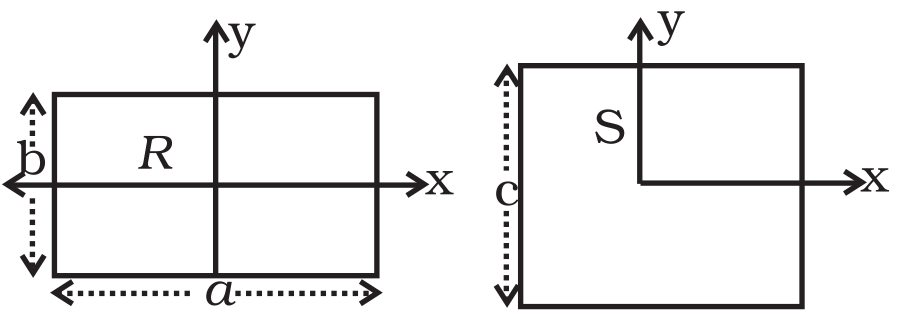
Show that:- $\frac{\text{I}_\text{xR}}{\text{I}_\text{xS}}<1$
- $\frac{\text{I}_\text{ys}}{\text{I}_\text{ys}}>1$
- $\frac{\text{I}_{2\text{R}}}{\text{I}_{2\text{s}}}>1$
- 3Two particles of mass $2kg$ and $1kg$ are moving along the same line with speeds $2ms-1$ and $5ms^{-1}$ respectively. What is the speed of the centre of mass of the system if both the particles are moving (a) in same direction (b) in opposite direction?View Solution
- 4A disc of radius R is rotating with an angular speed $\omega_\text{o}$ about a horizontal axis. It is placed on a horizontal table. The coefficient of kinetic friction is $\mu_\text{k}{:}$View Solution
- What was the velocity of its centre of mass before being brought in contact with the table?
- What happens to the linear velocity of a point on its rim when placed in contact with the table?
- What happens to the linear speed of the centre of mass when disc is placed in contact with the table?
- Which force is responsible for the effects in (b) and (c).
- What condition should be satisfied for rolling to begin?
- Calculate the time taken for the rolling to begin.
- 5A uniform sphere of mass m and radius R is placed on a rough horizontal surface. The sphere is struck horizontally at a height h from the floor. Match the following:View Solution
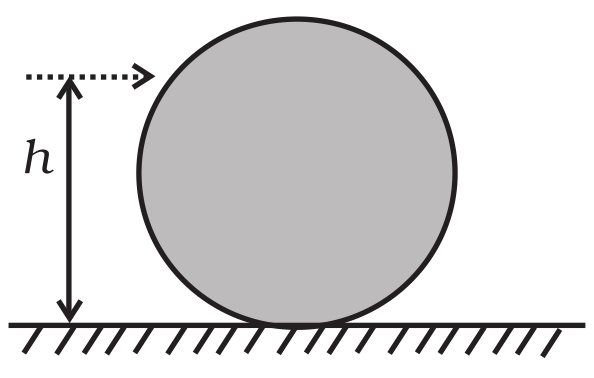
a. $\text{h}=\frac{\text{R}}{2}$ i. Sphere rolls without slipping with a constant velocity and no loss of energy. b. $\text{h}=\text{R}$ ii. Sphere spins clockwise, loses energy by friction. c. $\text{h}=\frac{3\text{R}}{2}$ iii. Sphere spins anti-clockwise, loses energy by friction. d. $\text{h}=\frac{7\text{R}}{5}$ iv. Sphere has only a translational motion, looses energy by friction. - 6View SolutionFind the components along the x, y, z axes of the angular momentum l of a particle, whose position vector is r with components x, y, z and momentum is p with components px, py and pz. Show that if the particle moves only in the x-y plane the angular momentum has only a z-component.
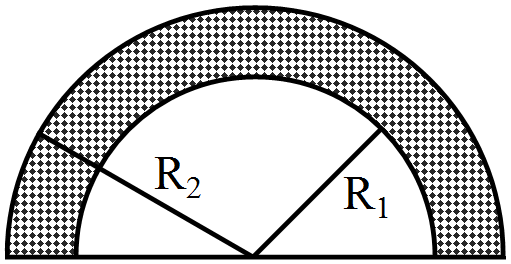
- 7Find the centre of mass of a uniform plate having semicircular inner and outer boundaries of radii $R_1$ and $R_2$.View Solution
- 8A uniform cube of mass m and side a is placed on a frictionless horizontal surface. A vertical force F is applied to the edge as shown in match the following (most appropriate choice):View Solution
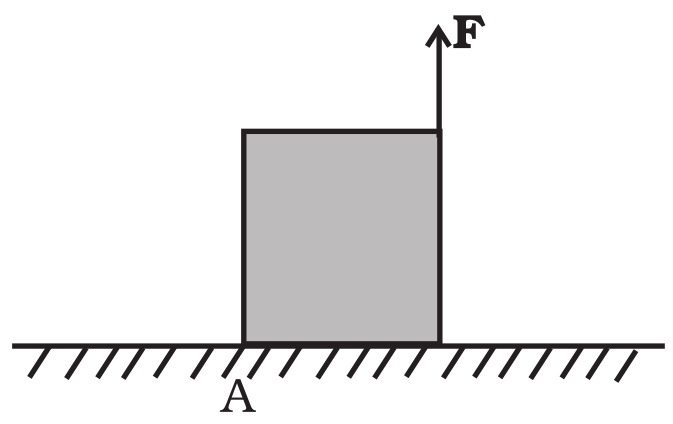
a. $\frac{\text{mg}}{4}<\text{F}<\frac{\text{mg}}{2}$ i. Cube will move up. b. $\text{F}>\frac{\text{mg}}{2}$ ii. Cube will not exhibit motion. c. $\text{F}>\text{mg}$ iii. Cube will begin to rotate and slip at A. d. $\text{F}=\frac{\text{mg}}{4}$ iv. Normal reaction effectively at $\frac{\text{a}}{3}$ - 9A circular hole of radius $1m$ is cut off from a disc of radius $6m$. The centre of the hole is $3m$ from the centre of the disc. Find the centre of mass of the remaining disc.View Solution
- 10View SolutionA solid cylinder of mass M and radius R has a light flexible rope wound around it. The rope carries a mass m at its free end. The mass is rest at a height h above the floor. Find the angular velocity of the cylinder at the instant the mass m, after release, strikes the floor. Assume friction to be absent and the cylinder to rotate about its own axis.