Question
Explain Van't Hoff factor.
Answer

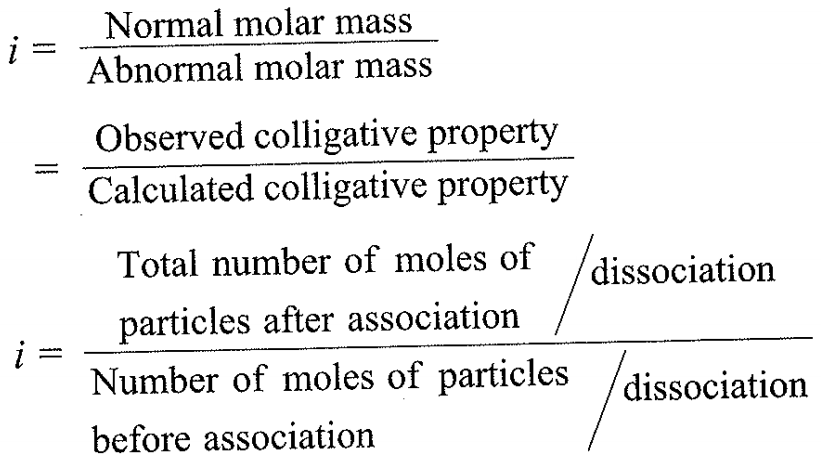
→ Van't Hoff introduced a factor i, known as the Van't Hoff factor, to account for the extent of dissociation or association. This factor i is defined as:
Image
→ Here abnormal molar mass is the experimentally determined molar mass and calculated colligative properties are obtained by assuming that the non-volatile solute is neither associated nor dissociated.
→ In case of association, value of i is less than unity while for dissociation it is greater than unity.
→ Inclusion of van't Hoff factor modifies the equations for colligative properties as follows:
→Relative lowering of vapour pressure of solvent,
$\frac{p_1^0-p_1}{p_1^0}= i \cdot \frac{n_2}{n_1}$
Elevation of Boiling point, $\Delta T_b=i K_b m$
Depression of Freezing point, $\Delta T_f=i K_f m$
Osmotic pressure of solution, $\pi=i n_2 R T / V$
→ $i$ for several strong electrolytes. For $KCI , NaCl$ and $MgSO _4, i$ values approach 2 as the solution becomes very dilute. As expected, the value of $i$ gets close to 3 for $K _2 SO _4$.
Salt* Values of i van't Hoff Factor
i for complete
dissociation of
solute
0.1 m0.01 m0.001 m
NaCl1.871.941.972.00
KCl1.851.941.982.00
$MgSO_{4}$1.211.531.822.00
$K_{2}SO_{4}$2.322.72.843.00

Need a full question paper?

Generate a complete, print-ready paper with questions like this in minutes — across 16+ boards, with answer keys.

Start Generating Free

Similar questions

Match the items of column $I$ with items of column $II$.
 
Column $I$
 
Column $II$
$(i)$
Antifreeze used in car engine
$(a)$
Neutral ferric chloride
$(ii)$
Solvent used in perfumes
$(b)$
Glycerol
$(iii)$
Starting material for picric acid
$(c)$
Methanol
$(iv)$
Wood spirit
$(d)$
Phenol
$(v)$
Reagent used for detection of phenolic group
$(e)$
Ethleneglycol
$(vi)$
By product of soap industry used in cosmetics
$(f)$
Ethanol.
Write the Nernst equation and emf of the following cells at $298\ K:$
$Pt(s) | Br_2(l) | Br^– (0.010 M) || H^+ (0.030 M) | H_2(g) (1\ bar)|Pt(s).$
Give the formula of each of the following coordination entities:
  1. $Co^{3+}$ ion is bound to one $Cl^–,$ one $NH_3$ molecule and two bidentate ethylenediamine $($en$)$ molecules.
  2. $Ni^{2+}$ ion is bound to two water molecules and two oxalate ions.
Write the name and magnetic behaviour of each of the above coordination entities$.($At. nos. $Co = 27, Ni = 28).$
Indicate the steps in the preparation of:
$K_2Cr_2O_7$​​​​​​​ from chromite ore.
  1. What is the basis of formation of the spectro $-$ chemical series?
  2. Draw the structures of geometrical isomers of the following coordination
  3. complexes:$\ce{[Co(NH_3)_3Cl_3]}$ and $\ce{[CoCl_2(en)_2]^+}.$
  4. $($ en $=$ ethylenediamine and atomic number of $Co$ is $27).$
Write the reactions involved when $D\ -$ glucose is treated with the following reagents:
  1. $\ce{Br_2}$ water
  2. $\ce{H_2N-OH}$
  3. $\ce{(CH_3CO)_2O}$
A first order gas reaction $\ce{A_2B_2(g) \rightarrow 2A(g) + 2B(g)}$ at the temperature $400^\circ C$ has the rate constant $K = 2.0 \times 10^{-4}s^{-1}$ . What percentage of $A_2B_2$ is decomposed on heating for $900$ seconds.
Write down rules for $\text{IUPAC}$ naming of Co ordination entities.
Predict the products formed when cyclohexanecarbaldehyde reacts with following reagents.
$i.\ PhMgBr$ and then $H_3O^+$
$ii.$ Tollens' reagent
$iii.$ Semicarbazide and weak acid
$iv.$ Excess ethanol and acid
$v.$ Zinc amalgam and dilute hydrochloric acid
  1. What type of isomerism is shown by the complex $\ce{[Co(NH_3)_6] [Cr(CN)_6]}$?
  2. Why a solution of $\ce{[Ni(H_2O)_6]^{2+}}$ is green while a solution of $\ce{[Ni(CN)_4]^{2–}}$ is colourless? $($At. no. of $Ni = 28)$
  3. Write the $\text{IUPAC}$ name of the following complex: $\ce{[Co(NH_3)_5(CO_3)]Cl}$.