Question
Explain volume charge density.

Answer

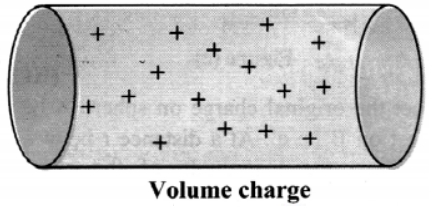
$i.$ Consider a charge $q$ uniformly distributed throughout a volume $V,$ then the volume charge density $\rho$ is given as
$\rho=\frac{q}{V}$
For example, charge on a plastic sphere or a plastic cube. If the charge is not distributed uniformly over the volume of a material, then charge $dq$ over small volume element $dV$ can be written as $dq = \rho dV.$
Image
$ii. \ S.I.$ unit of $p$ is $(C/m^3)$
$[$Note: Electric field due to a continuous charge distribution can be calculated by adding electric fields due to all these small charges.$]$

Need a full question paper?

Generate a complete, print-ready paper with questions like this in minutes — across 16+ boards, with answer keys.
Start Generating Free

Similar questions

If the angular speed of the Earth is $7.26 \times 10^{-5} \ rad/s$ and radius of the Earth is $6,400 \ km,$ calculate the change in weight of $1 \ kg$ of mass taken from equator to pole.
At what temperature would the resistance of a copper conductor be double its resistance at $0^{\circ} C ?$
$($a for copper $=3.9 \times 10^{-3} /{ }^{\circ} C )$
Find 'a' if $\overrightarrow{ A }=3 \hat{ i }-2 \hat{ j }+4 \hat{ k }$ and $\overrightarrow{ B }= a \hat{ i }+2 \hat{ j }-\hat{ k }$ are perpendicular to one another.
Are there any situations in which we cannot apply Newton’s laws of motion? Is there any alternative for it?
Derive expression for specific resistance of a material.
Calculate the wavelength of a microwave of frequency $8.0\ GHz.$
A body of mass $0.5 \ kg$ travels in a straight line with velocity $y = ax^{3/2},$ where $a = 5 m^{1/2}s^{-1}.$ What is the work done by the net force during its displacement from $x = 0$ to $x = 2m$? 
In a conical pendulum, a string of length $120 \ cm$ is fixed at rigid support and carries a mass of $150 g$ at its free end. If the mass is revolved in a horizontal circle of radius $0.2 m$ around a vertical axis, calculate tension in the string. $(g = 9.8 m/s^2)$
What is the specific heat of a metal if 50 cal of heat is needed to raise 6 kg of the metal from 20°C to 62 °C ?
Nuclear radius $R$ has a dependence on the mass number $( A )$ as $R=1.3 \times 10^{-16} A ^{\frac{1}{3}} m$. For a nucleus of mass number $A=125$, obtain the order of magnitude of $R$ expressed in metre.