Question
Explain what is quantization of charge and conservation of charge?

Answer

SELF

Need a full question paper?

Generate a complete, print-ready paper with questions like this in minutes — across 16+ boards, with answer keys.
Start Generating Free

Similar questions

Suppose that the radius of cross-section of the wire used in the previous problem is r. Find the increase in the radius of the loop if the magnetic field is switched off. Young's modulus of the material of the wire is Y.
The temperature and pressure at Simla are $15.0^\circ C$ and $72.0\ cm$ of mercury and at Kalka these are $35.0^\circ C$ and $76.0\ cm$ of mercury. Find the ratio of air density at Kalka to the air density at Simla.
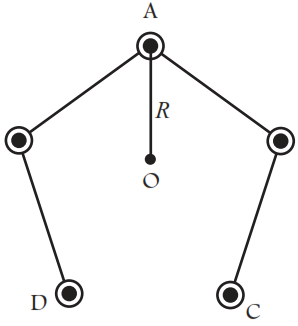
Five long wires A, B, C, D and E, each carrying current I are arranged to form edges of a pentagonal prism as shown in Fig. Each carries current out of the plane of paper.
  1. What will be magnetic induction at a point on the axis O? Axis is at a distance R from each wire.
  2. What will be the field if current in one of the wires (say A) is switched off?
  3. What if current in one of the wire (say) A is reversed?
A long straight horizontal cable carries a current of $2.5 A$ in the direction $10^\circ$ south of west to $10^\circ$ north of east. The magnetic meridian of the place happens to be $10^\circ$ west of the geographic meridian. The earth’s magnetic field at the location is $0.33 G,$  and the angle of dip is zero. Locate the line of neutral points $($ignore the thickness of the cable$). ($At neutral points, magnetic field due to a current $-$ carrying cable is equal and opposite to the horizontal component of earth’s magnetic field.$)$
Two large conducting plates are placed parallel to each other with a separation of $2.00\ cm$ between them. An electron starting from rest near one of the plates reaches the other plate in $2.00$ microseconds. Find the surface charge density on the inner surfaces.
Two wires carrying equal currents i each, are placed perpendicular to each other, just avoiding a contact. If one wire is held fixed and the other is free to move under magnetic forces, what kind of motion will result?
A pin of length $2.00\ cm$ is placed perpendicular to the principal axis of a converging lens. An inverted image of size $1.00\ cm$ is formed at a distance of $40.0\ cm$ from the pin. Find the focal length of the lens and its distance from the pin.
A magnetic field $B$ is confined to a region $ r \leq$ a and points out of the paper $($the $z-$ axis$), r = 0$ being the centre of the circular region. $A$ charged ring $ ($charge $= Q)$ of radius $b, b > a$ and mass m lies in the $x-y$ plane with its centre at the origin. The ring is free to rotate and is at rest. The magnetic field is brought to zero in time $\triangle t$. Find the angular velocity $\omega$ of the ring after the field vanishes.
A disc of radius R is cut out from a larger disc of radius 2R in such a way that the edge of the hole touches the edge of the disc. Locate the centre of mass of the residual disc.
Draw a ray diagram to show the formation of real image of the same size as that of the object placed in front of a converging lens. Using this ray diagram establish the relation between u, v and f for this lens.