Question
Two wires carrying equal currents i each, are placed perpendicular to each other, just avoiding a contact. If one wire is held fixed and the other is free to move under magnetic forces, what kind of motion will result?

Answer

The magnetic force on a wire carrying an electric current i is $\overrightarrow{\text{F}}=\text{i}.\big(\overrightarrow{\text{l}}\times\overrightarrow{\text{B}}\big),$ where l is the length of the wire and B is the magnetic field acting on it. Suppose we have one wire in the horizontal direction (fixed) and other wire in the vertical direction (free to move). If the horizontal wire is carrying current from right to left is held fixed perpendicular to the vertical wire, which is free to move, the upper portion of the free wire will tend to move in the left direction and the lower portion of the wire will tend to move in the right direction, according to Fleming's left hand rule, as the magnetic field acting on the wire due to the fixed wire will point into the plane of paper above the wire and come out of the paper below the horizontal wire and the current will flow in upward direction in the free wire. Thus, the free wire will tend to become parallel to the fixed wire so as to experience maximum attractive force.

Need a full question paper?

Generate a complete, print-ready paper with questions like this in minutes — across 16+ boards, with answer keys.
Start Generating Free

Similar questions

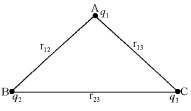
Write the definition of electrostatic at any point. Also write its S.I. units. As shown in the figure, three points charges $q_1$, $q _2$ and $q _3$ are placed at points $A, B$ and $C$ respectively. Drive an expression for the electrostatic potential energy of this system.

Image
Consider the situation of the previous problem. A charges of $-2.0 \times 10^{-4}C$ is moved from the point $A$ to the point $B$. Find the change in electrical potential energy ${U_B - U_A}$ for the cases $(a), (b)$ and $(c).$
  1. Plot a graph showing variation of voltage vs the current drawn from the cell. How can one get information from this plot about the emf of the cell and its internal resistance?
  2. Two cells of emf’s $E_1$ and $E_2$ and internal resistance $r_1$ and $r_2$ are connected in parallel. Obtain the expression for the emf and internal resistance of a single equivalent cell that can replace this combination?
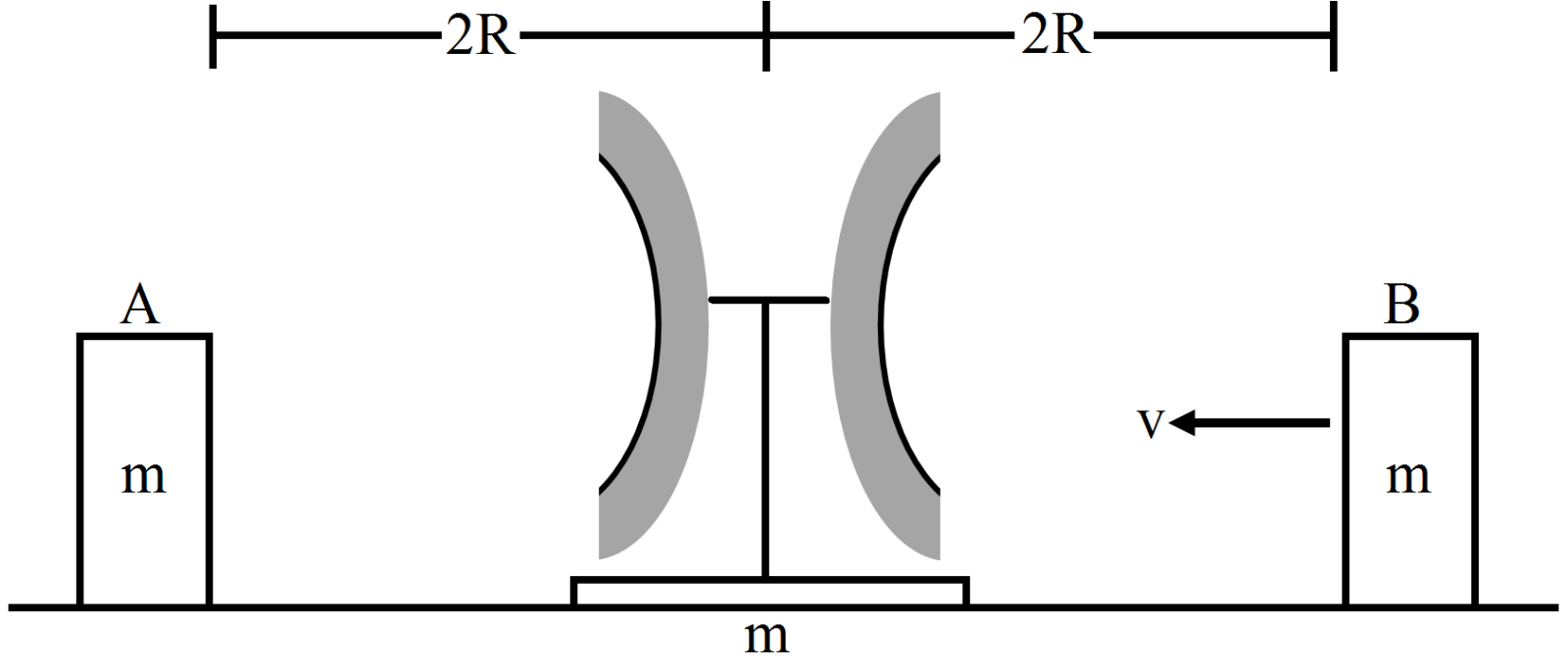
Two concave mirrors of equal radii of curvature R are fixed on a stand facing opposite directions. The whole system has a mass m and is kept on a frictionless horizontal table.

Two blocks A and B, each of mass m, are placed on the two sides of the stand. At t = 0, the separation between A and the mirrors is 2 R and also the separation between B and the mirrors is 2 R. The block B moves towards the mirror at a speed v. All collisions which take place are elastic. Taking the original position of the mirrors-stand system to be x = 0 and X-axis along AB, find the position of the images of A and B at t =
  1. $\frac{\text{R}}{\text{v}}$
  2. $\frac{3\text{R}}{\text{v}}$
  3. $\frac{5\text{R}}{\text{v}}$
A parallel plate capacitor is charged by a battery. After some time the battery is disconnected and a dielectric slab with its thickness equal to the plate separation is inserted between the plates. What change, in any will take place in
i. charge on the plates
ii. electric field intensity between the plates
iii. the capacitance of the capacitor,
iv. a potential difference between the plates and
v. the energy stored in the capacitor? Justify your answer in each case. OR
Three equal masses m are placed at the three corners of an equilateral triangle of side a. Find the force exerted by this system on another particle of mass m placed at,
  1. The mid-point of a side,
  2. At the centre of the triangle.
  1. Obtain lens makers formula using the expression
  1. $\frac{\text{n}_{2}}{\text{v}} - \frac{\text{n}_{1}}{\text{u}} = \frac{(\text{n}_{2} - \text{n}_{1})}{\text{R}}$
    Here the ray of light propagating from a rare medium of refractive index $(n_1)$ to a denser medium of refractive index $(n_2)$ is incident on the convex side of spherical refracting surface of radius of curvature $R.$
  2. Draw a ray diagram to show the image formation by a concave mirror when the object is kept between its focus and the pole. Using this diagram, derive the magnification formula for the image formed.
A neutron star has a density equal to that of the nuclear matter. Assuming the star to be spherical, find the radius of a neutron star whose mass is $4.0 \times 10^{30}kg ($twice the mass of the sun$).$
A block of weight 100N is slowly slid up on a smooth incline of inclination 37° by a person. Calculate the work done by the person in moving the block through a distance of 2.0m, if the driving force is:
  1. Parallel to the incline.
  2. In the horizontal direction.
One end of a $10\ cm$ long silk thread is fixed to a large vertical surface of a charged nonconducting plate and the other end is fastened to a small ball having a mass of $10g$ and a charge of $4.0 \times 10^{-5}C.$ In equilibrium, the thread makes an angle of $60^\circ$ with the vertical. Find the surface charge density on the plate.