Question
Explain why: A brass tumbler feels much colder than a wooden tray on a chilly day.

Answer

Brass is a good conductor of heat. When one touches a brass tumbler, heat is conducted from the body to the brass tumbler easily. Hence, the temperature of the body reduces to a lower value and one feels cooler. Wood is a poor conductor of heat. When one touches a wooden tray, very little heat is conducted from the body to the wooden tray. Hence, there is only a negligible drop in the temperature of the body and one does not feel cool. Thus, a brass tumbler feels colder than a wooden tray on a chilly day.
Need a full question paper?

Generate a complete, print-ready paper with questions like this in minutes — across 16+ boards, with answer keys.

Start Generating Free

Similar questions

Consider the situation of the previous problem. Define displacement resistance $\text{R}_\text{d}=\frac{\text{V}}{\text{i}_\text{d}}$ of the space between the plates, where V is the potential difference between the plates and $i_d$ is the displacement current. Show that $R_d$ varies with time as $\text{R}_\text{d}=\text{R}\big(\text{e}^{\text{t}/\tau}-1\big)$
A hollow sphere of radius R lies on a smooth horizontal surface. It is pulled by a horizontal force acting tangentially from the highest point. Find the distance travelled by the sphere during the time it makes one full rotation.
One end of a steel rod $(\text{K}=46\text{Js}^{-1}\text{m}^{-1}{^{\circ}}\text{C}^{-1})$ of length 1.0m is kept in ice at 0°C and the other end is kept in boiling water at 100°C. The area of cross section of the rod is $0.04cm^2$. Assuming no heat loss to the atmosphere, find the mass of the ice melting per second. Latent heat of fusion of ice $=3.36\times10^5\text{Jkg}^{-1}.$
A flywheel of moment of inertia $5.0kg-m^2$ is rotated at a speed of 60rad/s. Because of the friction at the axle, it comes to rest in $5.0$ minutes. Find:
  1. The average torque of the friction.
  2. The total work done by the friction.
  3. The angular momentum of the wheel $1$ minute before it stops rotating.
A thin spherical shell lying on a rough horizontal surface is hit by a cue in such a way that the line of action passes through the centre of the shell. As a result, the shell starts moving with a linear speed v without any initial angular velocity. Find the linear speed of the shell after it starts pure rolling on the surface.
A particle of mass $100mg$ is moving in a circular vertical path of radius $2m$. The particle is just 'looping the loop'. What is the speed of particle and the tension in the string at the highest point of the circular path? ($g = 10ms^{-2}$)
Establish a relation between angular momentum and moment of inertia of a rigid body. Define moment of inertia in terms of it.
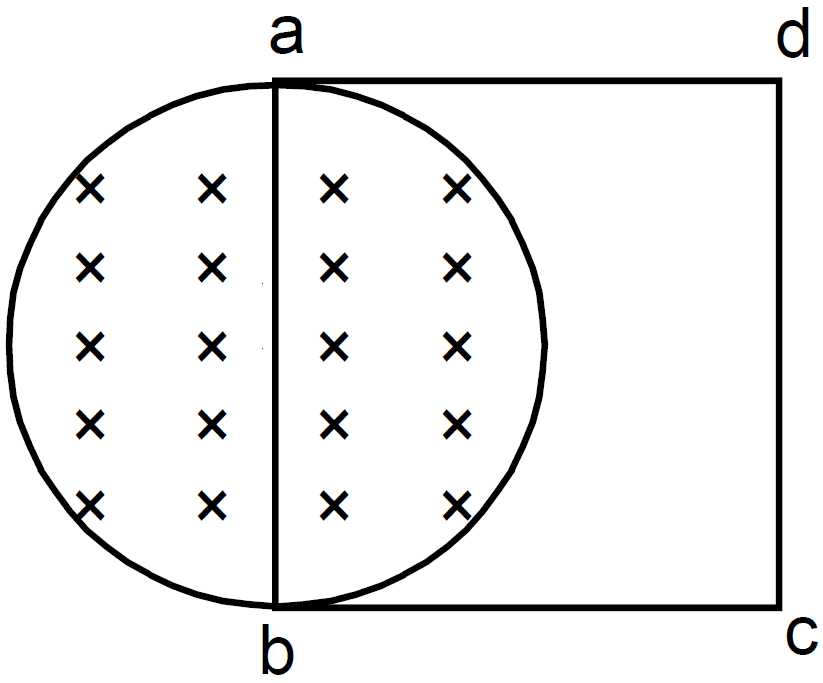
A uniform magnetic field B exists in a cylindrical region of radius 10cm as shown in figure. A uniform wire of length 80cm and resistance $4.0\Omega$ is bent into a square frame and is placed with one side along a diameter of the cylindrical region. If the magnetic field increases at a constant rate of 0.010T/s, find the current induced in the frame.
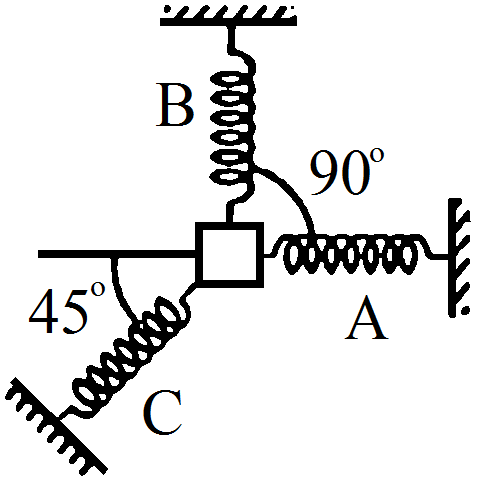
A particle of mass in is attatched to three springs A, B and C of equal force constants k as shown in figure If the particle is pushed slightly against the spring C and released, find the time period of oscillation.
If the unit of force is 100N, unit of length is 10m and unit of time is 100s, what is the unit of mass in this system of units?