Question
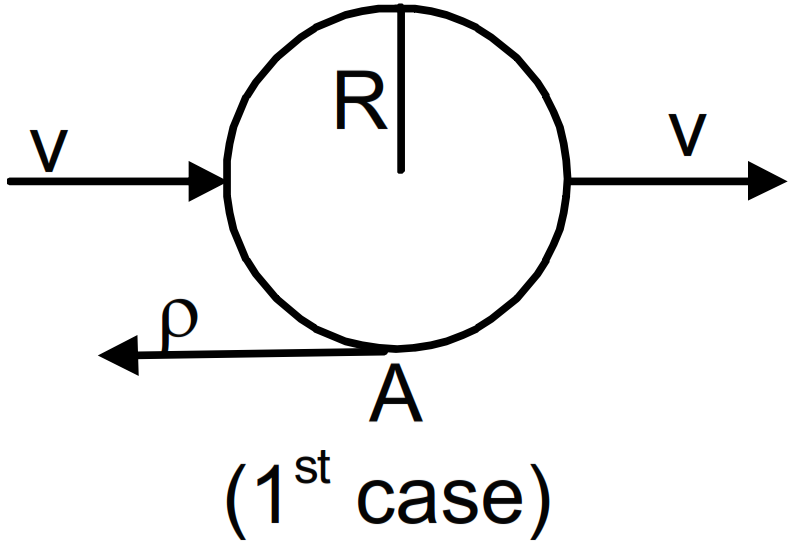
A thin spherical shell lying on a rough horizontal surface is hit by a cue in such a way that the line of action passes through the centre of the shell. As a result, the shell starts moving with a linear speed v without any initial angular velocity. Find the linear speed of the shell after it starts pure rolling on the surface.
Answer


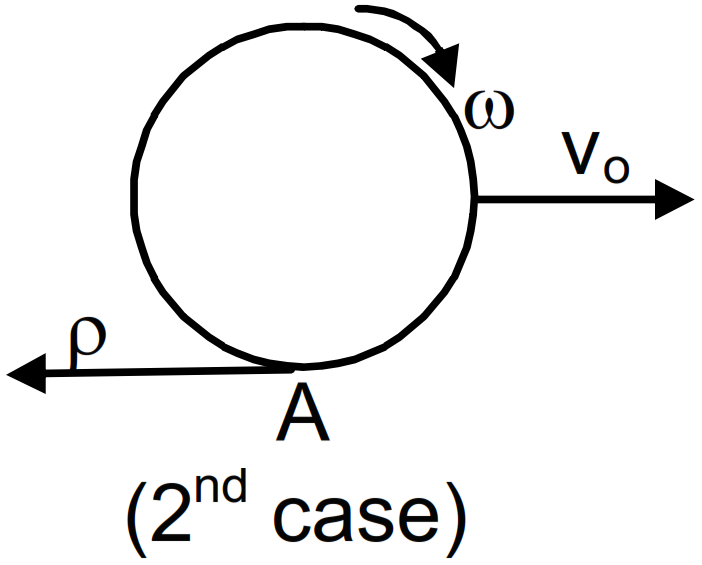
The shell will move with a velocity nearly equal to v due to this motion a frictional force well act in the background direction, for which after some time the shell attains a pure rolling. If we consider moment about A, then it will be zero.

Therefore, Net angular momentum about A before pure rolling = net angular momentum after pure rolling.
Now, angular momentum before pure rolling about A = M(V × R) and angular momentum after pure rolling:
$\Big(\frac{2}{3}\Big)\text{MR}^2\times\Big(\frac{\text{V}_0}{\text{R}}\Big)+\text{MV}_0\text{R}$
($V_0$ = velocity after pure rolling)
$\Rightarrow\text{MVR}=\frac{2}3{}\text{MV}_0\text{R}+\text{MV}_0\text{R}$
$\Rightarrow\Big(\frac{5}{3}\Big)\text{V}_0=\text{V}$
$\Rightarrow\text{V}_0=\frac{3\text{V}}{5}$

Need a full question paper?

Generate a complete, print-ready paper with questions like this in minutes — across 16+ boards, with answer keys.

Start Generating Free

Similar questions

Calculate the change in energy of a $500kg$ satellite when it falls from an altitude of $200km$ to $199km$. If this change takes place during one orbit, calculate the retarding force on the satellite. [Given : mass of earth = $6 \times 10^{24}kg$ and radius of earth = $6400km$]
A man can swim at the rate of $5km/ h$ in still water. A river $1km$ wide flows at the rate of $3km/ h$. A swimmer wishes to cross the river straight.
  1. Along what direction must he strike?
  2. What should be his resultant velocity?
  3. How much time he would take to cross?
A flywheel of moment of inertia $5.0kg-m^2$ is rotated at a speed of 60rad/s. Because of the friction at the axle, it comes to rest in $5.0$ minutes. Find:
  1. The average torque of the friction.
  2. The total work done by the friction.
  3. The angular momentum of the wheel $1$ minute before it stops rotating.
A bat emitting an ultrasonic wave of frequency $4.5 \times 10^4Hz$ flies at a speed of 6m/s between two parallel walls. Find the two frequencies heard by the bat and the beat frequency between the two. The speed of sound is 330m/s.
A healthy youngman standing at a distance of $7m$ from a $11.8m$ high building sees a kid slipping from the top floor. With what speed (assumed uniform) should he run to catch the kid at the arms height $(1.8m)$?
What is the temperature of the steel-copper junction in the steady state of the system shown in Fig. 10.15. Length of the steel rod $=15.0 cm$, length of the copper rod $=10.0 cm$, temperature of the furnace $=300^{\circ} C$, temperature of the other end $=0{ }^{\circ} C$. The area of cross section of the steel rod is twice that of the copper rod. (Thermal conductivity of steel $=50.2 J s ^{-1} m ^{-1} K ^{-1}$; and of copper $\left.=385 J s ^{-1} m ^{-1} K ^{-1}\right)$.
Image
A particle executes the motion described by $\text{x}(\text{t})=\text{x}_0(1-\text{e}^{-\gamma\text{t}});\text{t}\ge0,\text{x}_0>0.$ Where does the particle start and with what velocity?
Show that the Reynold's number represents the ratio of the inertial force per unit area to the viscous force per unit area.
Show that the projection angle $\theta_0$ for a projectile launched from the origin is given by, $\theta_0=\tan^{-1}\Big(\frac{4\text{H}}{\text{R}}\Big)$ where, H is the maximum height attained by the projectile and R is the range of the projectile.
Answer the following questions:The motion of a simple pendulum is approximately simple harmonic for small angle oscillations. For larger angles of oscillation, a more involved analysis shows that T is greater than $2\pi\sqrt{\frac{\text{l}}{\text{g}}}.$ Think of a qualitative argument to appreciate this result.