Question
Explain why
A drop of liquid under no external forces is always spherical in shape.

Answer

A liquid tends to acquire the minimum surface area because of the presence of surface tension. The surface area of a sphere is the minimum for a given volume. Hence, under no external forces, liquid drops always take spherical shape.

Need a full question paper?

Generate a complete, print-ready paper with questions like this in minutes — across 16+ boards, with answer keys.
Start Generating Free

Similar questions

State whether the statement given below is true or false giving reason in brief. A ring of mass 0.3kg and radius 0.1m and a solid cylinder of mass 0.4kg and of the same radius are given the same kinetic energy and released simultaneously on a flat horizontal surface such that they begin to roll as soon as released towards a wall which is at the same distance from the ring and cylinder. The rolling friction in both the cases is negligible. The cylinder will reach the wall first.
Prove that the horizontal range is same when angle of projection is:
  1. Greater than 45° by certain value.
  2. Less than 45° by the same value.
What is the ratio of frequencies of fundamental tone and various overtones formed in a vibrating string?
During an experiment, an ideal gas is found to obey an additional law pV2 = constant. The gas is initially at a temperature T and volume V. Find the temperature when it expands to a volume 2V.
The mean value of period of oscillation of a simple pendulum in an experiment is 2.62s. The arithmetic mean of all the absolute errors is 0.11s. Round off the period of simple pendulum to appropriate number of significant figures with reasons.
Give the magnitude and direction of the net force acting on a stone of mass 0.1kg, (Neglect air resistance throughout.)
Just after it is dropped from the window of a stationary train.
In a car lift compressed air exerts a force $F$ on a small piston having a radius of $5.0 cm$. This pressure is transmitted to a second piston of radius $15 cm$ (Fig 9.7). If the mass of the car to be lifted is $1350 kg$, calculate $F_1$. What is the pressure necessary to accomplish this task? $\left(g=9.8 ms ^2\right)$
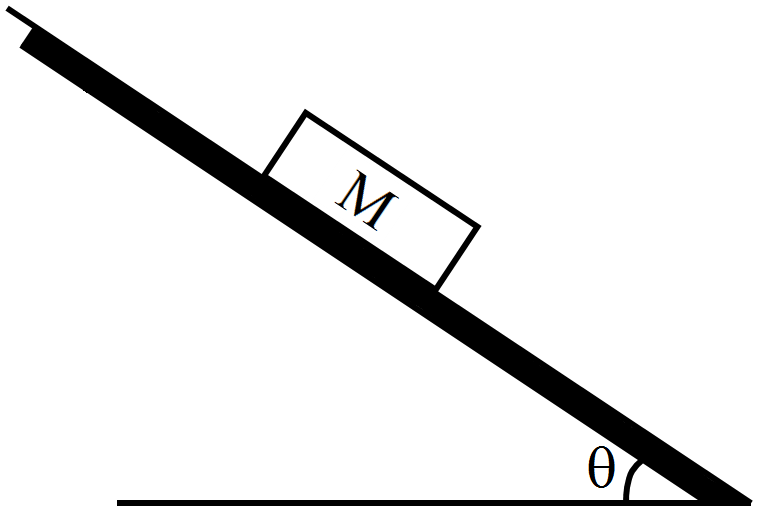
A block of mass M is placed on a frictionless, inclined plane of angle $\theta,$ as shown in the figure. Determine the acceleration of the block after it is released. What is force exerted by the incline on the block?

The force with which the earth attracts an object is called the weight of the object. Calculate the weight of the moon from the following data: The universal constant of gravitation G = 6.67 × 10⁻¹¹N-m2/kg2, mass of the moon = 7.36 × 10²²kg, mass of the earth = 6 × 1024kg and the distance between the earth and the moon = 3.8 × 10⁵km.
A rocket is fired with a velocity 0.6 times the escape velocity on the surface of earth. How high will it go from the surface?