Question
Explain why carbon forms compounds mainly by covalent bond. Explain in brief two main reasons for carbon forming a large number of compounds. Why does carbon form strong bonds with most other elements?

Answer

Carbon has 4 electrons in its outermost shell, and needs to gain or lose 4 electrons to attain noble gas configuration. Losing or gaining 4 electrons is not possible due to energy, considerations; hence it shares electrons to form covalent bonds.Two reasons for large number of carbon compounds:
  1. Catenation: The unique ability of carbon to form bonds with other atoms of carbon giving rise to long chains of different types of compounds.
  2. Tetravalency: Since carbon has a valency of 4, it is capable of bonding with four other atoms of carbon or atoms of elements like oxygen, hydrogen, nitrogen, sulphur, chlorine, etc.
Carbon forms strong bonds with most other elements because of its small size which enables the nucleus to hold on to the shared pairs of electrons strongly.

Need a full question paper?

Generate a complete, print-ready paper with questions like this in minutes — across 16+ boards, with answer keys.
Start Generating Free

Similar questions

What is an electromagnet? Describe the construction and working of an electromagnet with the help of a labelled diagram.
Draw a labelled diagram of the human digestive system. With the help of this diagram, describe the process of digestion of food in man (humans).
Explain the structure and functioning of Human eye. How are we able to see nearby as well as distant objects?
Breathing cycle is an essential process for the exchange of gases’. Justify this statement.
Describe the construction and working of a biogas plant with the help of a labelled diagram.
Two metals X and Y form the salts $XSO _4$ and $Y _2 SO _4$, respectively. The solution of salt $XSO _4$ is blue in colour whereas that of $Y _2 SO _4$ is colourless. When barium chloride solution is added to $XSO _4$ solution, then a white precipitate Z is formed alongwith a salt which turns the solution green. And when barium chloride solution is added to $Y _2 SO _4$ solution, then the same white precipitate Z is formed alongwith colourless common salt solution.
a. What could the metals $X$ and $Y$ be?
b. Write the name and formula of salt $XSO _4$.
c. Write the name and formula of salt $Y _2 SO _4$.
d. What is the name and formula of white precipitate Z ?
e. Write the name and formula of the salt which turns the solution green in the first case.
The metal M reacts vigorously with water to form a solution S and a gas G. The solution S turns red litmus to blue whereas gas G, which is lighter than air, burns with a pop sound. Metal M has a low melting point and it is used as a coolant in nuclear reactors.
  1. What is metal M?
  2. What is solution S? Is it acidic or alkaline?
  3. What is gas G?
  4. Write a balanced chemical equation for the reaction which takes place when metal M reacts with water.
  5. Is this reaction exothermic or endothermic?
What is the environment? What type of substances are the major pollutants of the environment?
What is a solenoid? Draw the pattern of magnetic field lines of:
  1. A current carrying solenoid.
  2. A bar magnet. List two distinguishing features between the two fields.
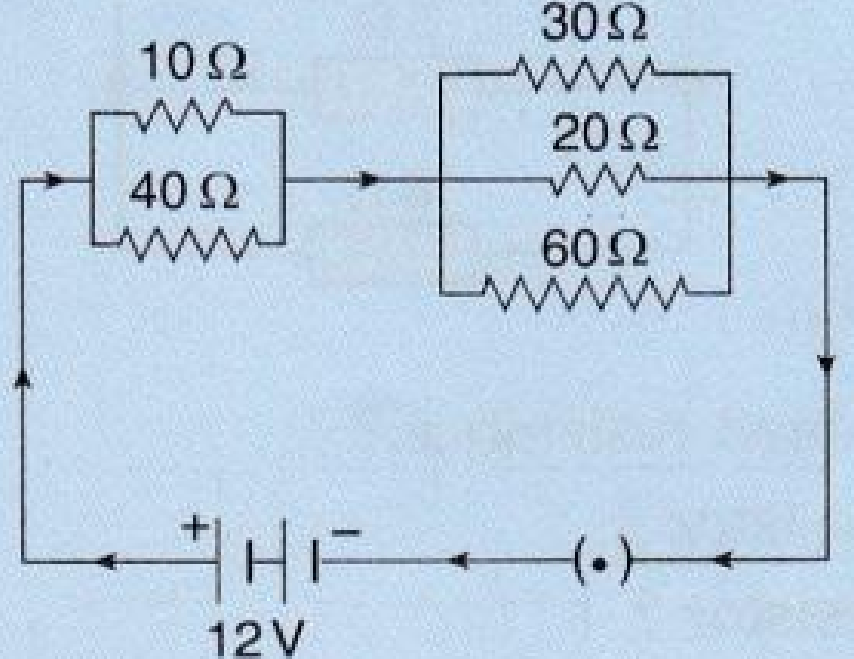
In the circuit diagram given below five resistances of $10 Ω, 40 Ω, 30 Ω, 20 Ω\ \text{and}\ 60 Ω$ are connected as shown to a 12V battery.
Calculate:
  1. Total resistance in the circuit.
  2. Total current flowing in the circuit.