Draw a labelled diagram of the human digestive system. With the help of this diagram, describe the process of digestion of food in man (humans).
Download our app for free and get started
Digestion of food in human beings: Digestion of food begins in the mouth. The mouth cavity contains teeth, tongue and salivary glands. The teeth cut the food into small pieces, chew and grind it. This is called physical digestion. Salivary glands produce saliva which mixes with the food. This involves chemical digestion of food. The saliva contains an enzyme called salivary amylase which digests the starch and converts it into maltose sugar. Mouth opens into a small funnel shaped area called pharynx which leads to a long tube called oesophagus. It carries the food down into the stomach.
The wall of oesophagus is muscular. When the slightly digested food enters the food pipe, the walls of the oesophagus starts contraction and expansion movements called peristaltic movements which push the food into the stomach. Digestion does not take place in the oesophagus. The glands present on the walls of the stomach secrete gastric juice that contains hydrochloric acid, the enzyme pepsin and mucus. A small amount of gastric lipase is also present that breaks down the fats present in the food. Gastric juice is acidic due to the presence of HCl which is necessary for the pepsin to become active and converts the proteins into peptones.
The mucus protects the stomach walls from HCl. From the stomach, the partially digested food goes into the small intestine through sphincter muscle. Small intestine is divided into two parts: Duodenum and Ileum.
Duodenum receives the secretions of two glands, liver and pancreas through a common duct. Liver secretes bile which is alkaline and contains salts to emulsify the fats (or lipids). The bile secreted by the liver is stored in the gall bladder. Pancreas secretes pancreatic juice which contains trypsin, lipase and pancreatic amylase. Trypsin digests the proteins, lipase emulsifies the fats and pancreatic amylase breaks down the starch. Thus, small intestine is the site of complete digestion of carbohydrates, proteins and fats. The walls of ileum secrete succus entericus which completes the digestion process.
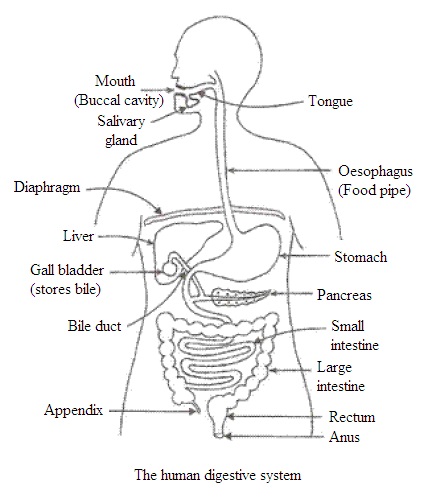
The wall of oesophagus is muscular. When the slightly digested food enters the food pipe, the walls of the oesophagus starts contraction and expansion movements called peristaltic movements which push the food into the stomach. Digestion does not take place in the oesophagus. The glands present on the walls of the stomach secrete gastric juice that contains hydrochloric acid, the enzyme pepsin and mucus. A small amount of gastric lipase is also present that breaks down the fats present in the food. Gastric juice is acidic due to the presence of HCl which is necessary for the pepsin to become active and converts the proteins into peptones.
The mucus protects the stomach walls from HCl. From the stomach, the partially digested food goes into the small intestine through sphincter muscle. Small intestine is divided into two parts: Duodenum and Ileum.
Duodenum receives the secretions of two glands, liver and pancreas through a common duct. Liver secretes bile which is alkaline and contains salts to emulsify the fats (or lipids). The bile secreted by the liver is stored in the gall bladder. Pancreas secretes pancreatic juice which contains trypsin, lipase and pancreatic amylase. Trypsin digests the proteins, lipase emulsifies the fats and pancreatic amylase breaks down the starch. Thus, small intestine is the site of complete digestion of carbohydrates, proteins and fats. The walls of ileum secrete succus entericus which completes the digestion process.

Download our appand get started for free
Experience the future of education. Simply download our apps or reach out to us for more information. Let's shape the future of learning together!No signup needed.*
Similar Questions
- 1View Solution
- Why is there a difference in the rate of breathing between aquatic organisms and terrestrial organisms? Explain.
- Draw a diagram of human respiratory system and label-pharynx, trachea, lungs, diaphragm and alveolar sac on it.
- 2View SolutionDescribe the alimentary canal of man.
- 3View SolutionEach and every respiration organ is structurally specialised in its function. Justify with examples.
- 4View SolutionDescribe the exchange of gases which takes place in the leaves of a plant:
- During daytime.
- At night.
- 5View SolutionDifferentiate between an autotroph and a heterotroph.
- 6View SolutionExplain the digestion of chapati in human beings. Draw a diagram depicting human alimentary canal.
- 7View Solution
- Draw a sectional view of the human heart and label on it: Aorta, Pulmonary arteries, Vena cava, Left ventricle.
- Why is double circulation of blood necessary in human beings?
- 8View SolutionExplain with a schematic representation the exchange of gases in tissues.
- 9View SolutionWhen a person eats sugary food, then organisms A present in his mouth act on sugar to produce a substance B. The substance B first dissolves the calcium salts from the top part C of the tooth and then from its middle part D forming holes E. These holes ultimately reach the part F in the lower part of tooth which contains nerves and blood vessels. The substance B irritates the nerve endings inside the tooth causing toothache.
- What are (i) organisms A, and (ii) substance B?
- What are (i) part C, and (ii) part D, of tooth known as?
- By what name are the holes E in the tooth known?
- Name the part F of the tooth.
- What will happen if organisms A reach part F of the tooth known?
- 10View SolutionDescribe the working of human blood circulatory system with the help of a suitable diagram which shows all the steps involved.