Question
Explain why cooking is faster in a pressure cooker.

Answer

As in pressure cooker liquid is changed in to vapors and they increase pressure inside cooker as we know pressure is directly proportional to temperature thus temperature increases along with pressure thus food is cooked faster.

Need a full question paper?

Generate a complete, print-ready paper with questions like this in minutes — across 16+ boards, with answer keys.
Start Generating Free

Similar questions

Write the name of optical instruments.
Draw the graph of variation of Coulomb force (F) with $(r)$. Where the distance between the two charges of each charge pair is ( $1 \mu C , 2 \mu C$ ) and ( $2 \mu C$, $-3 \mu C$ ). Analyse the graph obtained.
Explain emission lines and absorption lines.
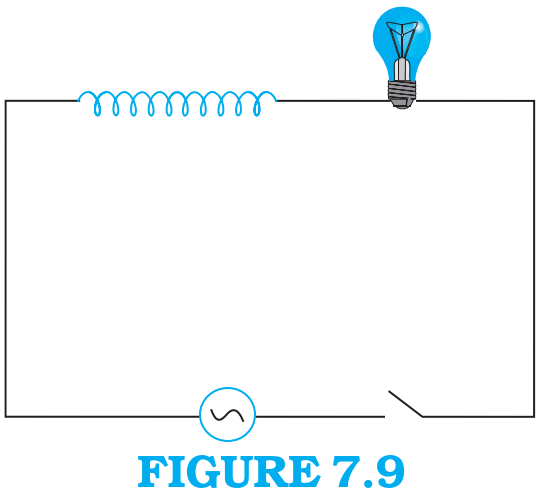
A light bulb and an open coil inductor are connected to an ac source through a key as shown in Fig. 7.9.
Image
The switch is closed and after sometime, an iron rod is inserted into the interior of the inductor. The glow of the light bulb (a) increases; (b) decreases; (c) is unchanged, as the iron rod is inserted. Give your answer with reasons.
The electric foree between two electric charges in a medium is F . The distance between them is $d$. At what distance were they placed from each other
so that the electric foree becomes (i) 3 F (ii) $\frac{ F }{4}$ ?
A spectroscopic instrument can resolve two nearby wavelengths $\lambda$ and $\lambda+\Delta\lambda$ if $\frac{\lambda}{\Delta\lambda}$ is smaller than 8000. This is used to study the spectral lines of the Balmer series of hydrogen. Approximately how many lines will be resolved by the instrument?
An alternating voltage of frequency f is applied across a series LCR circuit. Let $f_r$  be the resonance frequency for the circuit. Will the current in the circuit lag, lead or remain in phase with the applied voltage when $(i) f > f_r$, $(ii) f < f_r?$ Explain your answer in each case.
What is point electric charge?
Write the centripetal force formula for an electron moving in a stationary orbit in a hydrogen atom and derive the formula for the radius of the orbit.
(a) Calculate the potential at a point $P$ located at a distance of 9 cm due to the charge $4 \times 10^{-7} C$.(b) Now, find the work done in bringing the charge $2 \times 10^{-9} C$ from infinity to point P . Does the answer depend on the path along which the charge is brought?