Question
Explain why current is not formed in solid conductors in the absence of electric field.

Answer

In metals, current is carried by free electrons in the background of fixed positive ions.
In absence of electric field, the electrons will be moving due to thermal energy. During this, they collide with the fixed ions.
An electron colliding with an ion emerges with the same speed as before the collision but the direction of its velocity after the collision is completely random.
Thus on an average, the number of electrons travelling in any direction will be equal to the number of electrons travelling in the opposite direction.
So, there will be no net current inside the conductor in the absence of electric field.
Need a full question paper?

Generate a complete, print-ready paper with questions like this in minutes — across 16+ boards, with answer keys.

Start Generating Free

Similar questions

A man stands before a large wall at a distance of 50.0m and claps his hands at regular intervals. Initially, the interval is large. He gradually reduces the interval and fixes it at a value when the echo of a clap merges with the next clap. If he has to clap 10 times during every 3 seconds, find the velocity of sound in air.
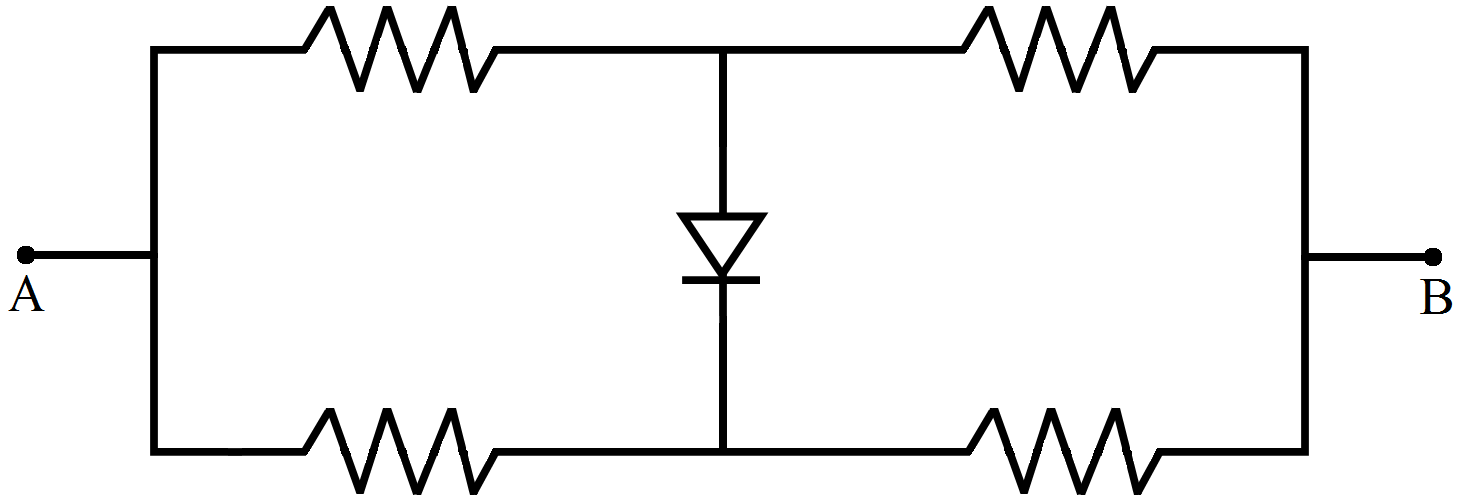
Each of the resistances shown in figure. has a value of $20\Omega.$ Find the equivalent resistance between A and B. Does it depend on whether the point A or B is at higher potential?
In a Young's double slit experiment, two narrow vertical slits placed 0.800mm apart are illuminated by the same source of yellow light of wavelength 589nm. How far are the adjacent bright bands in the interference pattern observed on a screen 2.00m away?
A positive charge q is placed in front of a conducting solid cube at a distance d from its centre. Find the electric field at the centre of the cube due to the charges appearing on its surface.
$50m^3$ of saturated vapour is cooled down from $30^\circ C$ to $20^\circ C.$ Find the mass of the water condensed. The absolute humidity of saturated water vapour is $30\ gm^{-3}$ at $30^\circ C$ and $16\ gm^{-3}$ at $20^\circ C.$
The mutual inductance between two coils is 2.5H. If the current in one coil is changed at the rate of 1A/s, what will be the emf induced in the other coil?
Two semiconductor materials X and Y shown in the given figure, are made by doping germanium crystal with indum and arsenic respectively. The two are joined end to end and connected to a battery as shown.
  1. Will the junction be forward biased or reverse biased?
  2. Sketch a V-I graph for this arrangement.
A pair of adjacent coils have a mutual inductance of 1.5 H. If the current in one coil changes from 0 to 20 A in 0.5 s, what is the change of the flux linkage with the other coil?
A bob suspended from the ceiling of a car which is accelerating on a horizontal road. The bob stays at rest with respect to the car with the string making an angle $\theta$ with the vertical. The linear momentum of the bob as seen from the road is increasing with time. Is it a violation of conservation of linear momentum? If not, where is the external force which changes the linear momentum?
The volume charge density in the space between two conocentric spheres of radii $a$ and $b$ is $\rho=\frac{A}{r}$, where $A$ is a constant and $r$ is the distance. There is a point charge $Q$ at the centre of the sphere. Find the value of A such that there is a uniform electric field in the space between the spheres.