Question
Two semiconductor materials X and Y shown in the given figure, are made by doping germanium crystal with indum and arsenic respectively. The two are joined end to end and connected to a battery as shown.
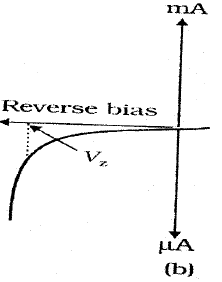
  1. Will the junction be forward biased or reverse biased?
  2. Sketch a V-I graph for this arrangement.

Answer

(If X and Y are correctly identified but the identification of biasing is incorrect or  not given at all, award.)
$(\text{X}\rightarrow\text{p} \text{Type})$
$(\text{Y}\rightarrow\text{n} \text{Type})$
  1. Reverse biased.
  2. Graph:

Need a full question paper?

Generate a complete, print-ready paper with questions like this in minutes — across 16+ boards, with answer keys.

Start Generating Free

Similar questions

A capacitor, made of two parallel plates each of plate area A and separation d, is being charged by an external ac source. Show that the displacement current inside the capacitor is the same as the current charging the capacitor.
Do two positively charged balls attract each other?
Distinguish between an intrinsic semiconductor and P-type semiconductor. Give reason, why, a P-type semiconductor crystal is electrically neutral, although$\text{n}_{h}>>\text{n}_{e}$.
Ultrasonic waves of frequency 4.5MHz are used to detect tumour in soft tissues. The speed of sound in tissue is 1.5km/s and that in air is 340m/s. Find the wavelength of this ultrasonic wave in air and in tissue.
Describe, with the help of a circuit diagram, the working of a photodiode.
Two crystals $C _1$ and $C _2$, made of pure silicon, are doped with arsenic and aluminium respectively.
a. Identify the extrinsic semiconductors so formed.
b. Why is doping of intrinsic semiconductors necessary?
Write a note on equipotential surface.
Write Einstein’s photoelectric equation. State clearly the three salient features observed in photoelectric effect, which can be explained on the basis of the above equation.
A curve is represented by $\text{y}=\sin\text{x}.$ If x is changed from $\frac{\pi}{3}$ to $\frac{\pi}{3}+\frac{\pi}{100},$ find approximately the change in y.
According to the classical electromagnetic theory, calculate the initial frequency of the light emitted by the electron revolving around a proton in hydrogen atom.