Question
Explain why elemental semiconductor cannot be used to make visible LEDs.
Answer

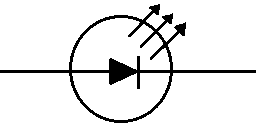
Specially designed diodes, which give out light rediations when forward biases. LED's are made of GaAsp, Gap etc.
There are forwad biased P-N junctions which emits spontaneous fadiation. In elemental semiconductor, the band gap is such that the emission are in infrared region and not in visible region. $\lambda=\frac{\text{hc}}{\text{E}_\text{g}}$ For Si; $\text{E}_\text{g}= 1.1\text{eV},\lambda=\frac{1242}{1.1}=1129\text{nm}$ For Ge; $\text{E}_\text{g}=0.7\text{eV},\lambda=\frac{1242}{0.7}=1725\text{nm}$

Need a full question paper?

Generate a complete, print-ready paper with questions like this in minutes — across 16+ boards, with answer keys.

Start Generating Free

Similar questions

$1MW$ power is to be delivered from a power station to a town $10\ km$ away. One uses a pair of $Cu$ wires of radius $0.5\ cm$ for this purpose. Calculate the fraction of ohmic losses to power transmitted if,
  1. Power is transmitted at $220V$. Comment on the feasibility of doing this.
  2. A step $-$ up transformer is used to boost the voltage to $11000V,$ power transmitted, then a step $-$ down transfomer is used to bring voltage to $220V$.
  3. $(\rho_\text{Cu}1.7\times10^{-8}\text{SI unit})$.
Write advantages and disadvantages of ac over dc and explain applied ac voltage over resistor.
The count rate of nuclear radiation coming from a radiation coming from a radioactive sample containing $^{128}I$ varies with time as follows.
Time $t($minute$)$ : $0$ $25$ $50$ $75$ $100$
Ctount rate $R(10^9s^{-1})$ : $30$ $16$ $8.0$ $3.8$ $2.0$
  1. Plot In $\Big(\frac{\text{R}_0}{\text{R}}\Big)$ against $t$.
  2. From the slope of the best straight line through the points, find the decay constant $\lambda.$
  3. Calculate the half$-$life $\text{t}_{\frac{1}{2}}.$
An adiabatic vessel of total volume $V$ is divided into two equal parts by a conducting separator. The separator is fixed in this position. The part on the left contains one mole of an ideal gas $(U = 1.5\ nRT)$ and the part on the right contains two moles of the same gas. Initially, the pressure on each side is $p$. The system is left for sufficient time so that a steady state is reached. Find,
  1. The work done by the gas in the left part during the process.
  2. The temperature on the two sides in the beginning.
  3. The final common temperature reached by the gases.
  4. The heat given to the gas in the right part.
  5. The increase in the internal energy of the gas in the left part.
A parallel$-$plate capacitor has plate area $100\ cm^2$ and plate separation $1.0\ cm.$ A glass plate $($dielectric constant $6.0)$ of thickness $6.0\ mm$ and an ebonite plate $($dielectric constant $4.0)$ are inserted one over the other to fill the space between the plates of the capacitor. Find the new capacitance.
A voltmeter coil has resistance $50.0\Omega$ and a resistor of $1.15\text{k}\Omega$ is connected in series. It can read potential differences up to 12 volts. If this same coil is used to construct an ammeter that can measure currents up to 2.0A, what should be the resistance of the shunt used?
A gas is initially at a pressure of $100\ kPa$ and its volume is $2.0m^3.$ Its pressure is kept constant and the volume is changed from $2.0m^3$ to $2.5m^3.$ Its volume is now kept constant and the pressure is increased from $100\ kPa$ to $200\ kPa.$ The gas is brought back to its initial state, the pressure varying linearly with its volume.
  1. Whether the heat is supplied to or extracted from the gas in the complete cycle?
  2. How much heat was supplied or extracted?

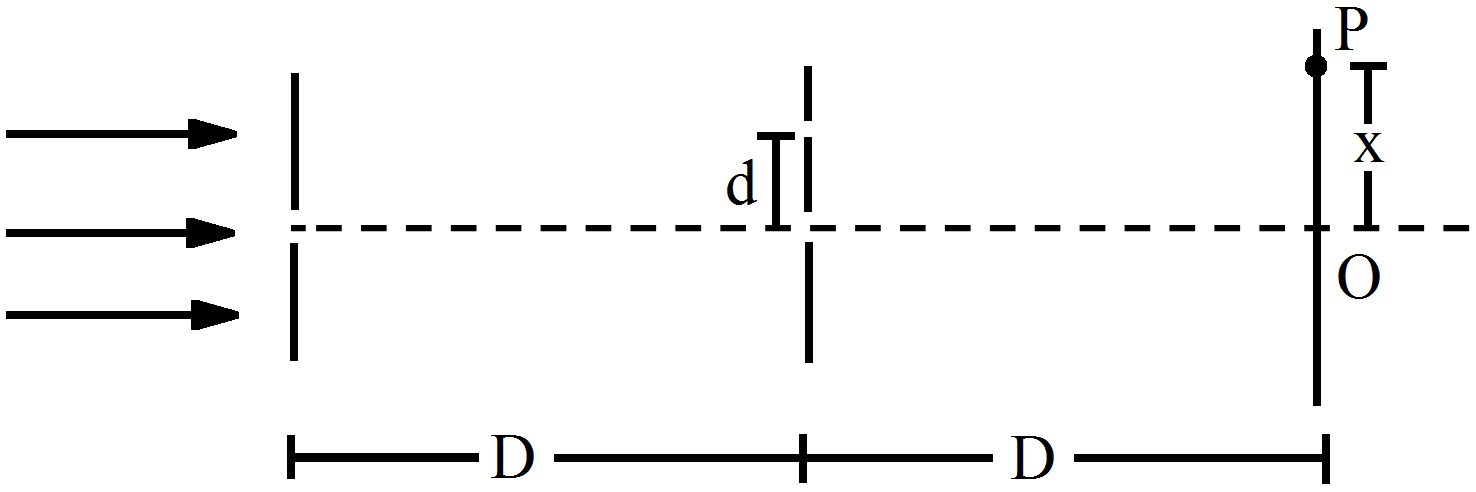
Consider the arrangement shown in figure (17-E4). The distance D is large compared to the separation d between the slits.
  1. Find the minimum value of d so that there is a dark fringe at 0.
  2. Suppose d has this value. Find the distance x at which the next bright fringe is formed.
  3. Find the fringe-width.
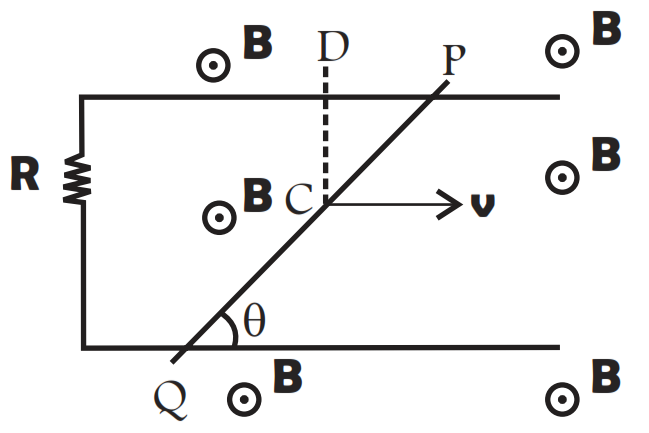
Find the current in the wire for the configuration shown in Fig. Wire $PQ$ has negligible resistance. $B,$ the magnetic field is coming out of the paper. $\theta$ is a fixed angle made by $PQ$ travelling smoothly over two conducting parallel wires seperated by $a$ distance $d$.
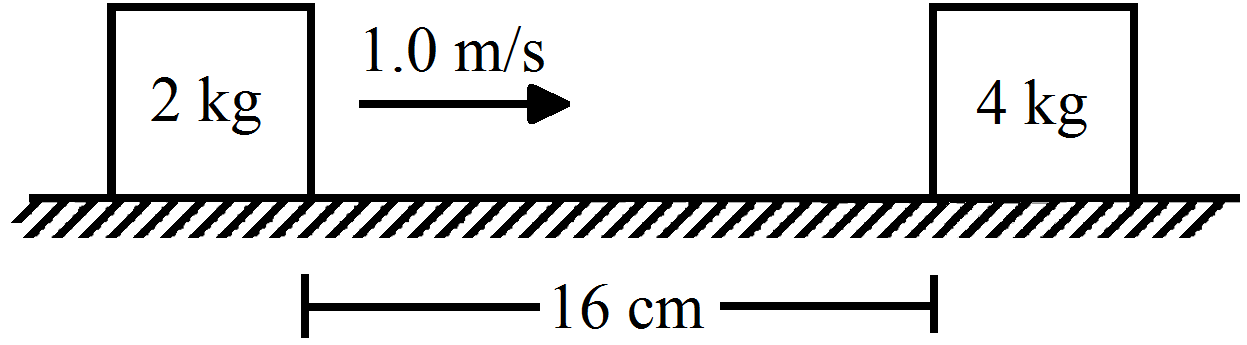
The friction coefficient between the horizontal surface and each of the blocks shown in figure is $0.20$. The collision between the blocks is perfectly elastic. Find the separation between the two blocks when they come $O$ rest. Take $g = 10 m/s^2$.