Two capacitors of capacitance $10\mu\text{F}$ and $20 \mu\text{F}$ are connected in series with a 6 V battery. After the capacitors are fully charged, a slab of dielectric constant (K) is inserted between the plates of the two capacitors. How will the following be affected after the slab is introduced:
- The electric field energy stored in the capacitors.
- The charges on the two capacitors.
- The potential difference between the plates of the capacitors.
CBSE OUTSIDE DELHI - SET 2 BHUBNESHWAR 2015
Download our app for free and get started
The capacitance of both the capacitors increases by a factor K.
Alternate Answer
- New Electric field energy values are: = $\frac{1}{2}\text{k}(\text{c}_{1}\text{v}^{2}_{1}) \text{ and}\frac{1}{2}\text{k}(\text{c}_{2}\text{v}^{2}_{1}).$
- New charges are: =$\frac{1}{2}\text{KC}_{1}\text{V}_{1}\text{ and }\frac{1}{2}\text{KC}_{2}\text{V}_{2}.$
- New P.D values are: $V_1$ and $V_2$
Alternate Answer
- New Electric field energy values are: $\frac{1}{2}\frac{\text{Q}^{2}}{\text{KC}_{1}} \text{and } \frac{1}{2}\frac{\text{Q}^{2}}{\text{KC}_{2}}.$
- New charges are: Q and Q as before.
- New P.D values are: $\frac{\text{Q}}{\text{KC}_{1}} \text{and }\frac{\text{Q}}{\text{KC}_{2}}.$

Download our appand get started for free
Experience the future of education. Simply download our apps or reach out to us for more information. Let's shape the future of learning together!No signup needed.*
Similar Questions
- 1View SolutionDraw a labelled diagram of an a.c. generator. Explain briefly its principle and working.
- 2What is the power dissipated in an ac circuit in which voltage and current are given by $\text{V}=230\sin(\omega\text{t}+\frac{\pi}{2})$ and $\text{I}=10\sin\omega\text{t}?$View Solution
- 3A voltage $V = V_o$ sin $\omega\text{t}$ is applied to a series LCR circuit. Derive the expression for the average power dissipated over a cycle. Under what condition is (i) no power dissipated even though the current flows through the circuit, (ii) maximum power dissipated in the circuit?View Solution
- 4View SolutionExplain with the help of a labelled diagram the underlying principle and working of a step-up transformer. Why cannot such a device be used to step-up d.c. voltage?
- 5View Solution
- Define the term intensity of radiation' in photon picture.
- Plot a graph showing the variation of photo current vs collector potential for three different intensities $I_1 > I_2 > I_3$, two of which $(I_1$ and $I_2)$ have the same frequency v and the third has frequency $v_1 > v.$
- Explain the nature of the curves on the basis of Einstein's equation.
- 6A sinusoidal voltage of peak value $283 V$ and frequency $50 Hz$ is applied to a series $L C R$ circuit in which $R =3 \Omega, L=25.48 mH$, and $C =796 \mu F$. Find (a) the impedance of the circuit; (b) the phase difference between the voltage across the source and the current; (c) the power dissipated in the circuit; and (d) the power factor.View Solution
- 7Two identical cells of emf 1.5 V each joined in parallel supply energy to an external circuit consisting of two resistances of 7 $\Omega$ each joined in parallel. A very high resistance voltmeter reads the terminal voltage of cells to be 1.4 V. Calculate the internal resistance of each cell.View Solution
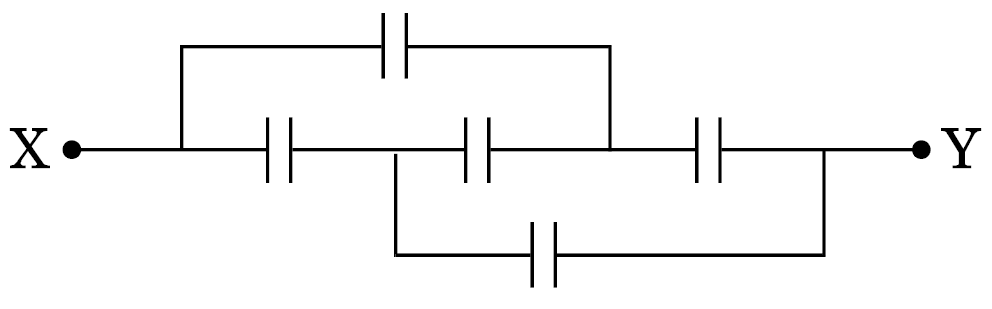
- 8Find the equivalent capacitance of the network shown in the figure, when each capacitor is of $1\mu\text{F}$. When the ends X and Y are connected to a 6 V battery, find out (i) The charge and (ii) The energy stored in the network.View Solution
- 9The voltage and current in a series AC circuit are given by, $\text{V}=\text{V}_0\cos\omega\text{t}$ and $\text{i}=\text{i}_0\sin\omega\text{t}.$ What is the power dissipated in the circuit?View Solution
- 10View SolutionAn inductor 200 mH, capacitor 500 µF, resistor 10Ω are connected in series with a100 V, variable frequency a.c. source. Calculate the
- Frequency at which the power factor of the circuit is unity.
- Current amplitude at this frequency.
- Q-factor.