State Ampere's circuital law. Use this law to find magnetic field due to straight infinite current carrying wire. How are the magnetic field lines different from the electrostatic field lines?
CBSE OUTSIDE DELHI - SET 2 NORTH 2016
Download our app for free and get started
According to Ampers’s circuital law, “ The line integral of the magnetic field, around a closed loop, equals $\mu_{o}$ times the total current passing through the surface enclosed by that loop.”
Alternate Answer
$\oint\overrightarrow{\text{B}}.\overrightarrow{\text{d}l} = \mu_{o}\text{I}$
For the infinite current carrying wire, we get
$\text{B}.\oint\text{d}l = \mu_{o}\text{I}$
or $\text{B} 2 \pi\text{r} = \mu_{o}\text{I}$
or $\text{B} = \frac{\mu_{o}\text{I}}{2\pi\text{I}}$
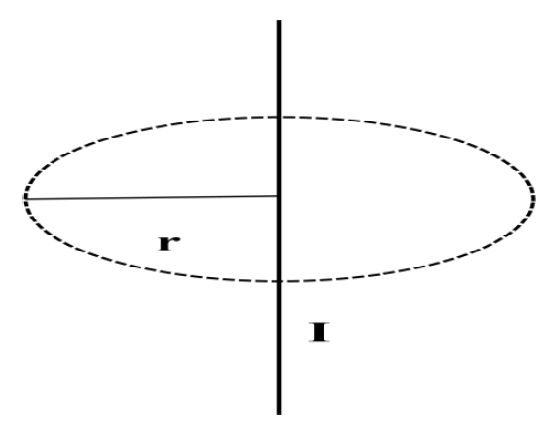
The magnetic field lines form closed loops while the electric field lines originate from positive charges and end at negative charges.
Alternate Answer
$\oint\overrightarrow{\text{B}}.\overrightarrow{\text{d}l} = \mu_{o}\text{I}$
For the infinite current carrying wire, we get
$\text{B}.\oint\text{d}l = \mu_{o}\text{I}$
or $\text{B} 2 \pi\text{r} = \mu_{o}\text{I}$
or $\text{B} = \frac{\mu_{o}\text{I}}{2\pi\text{I}}$
The magnetic field lines form closed loops while the electric field lines originate from positive charges and end at negative charges.

Download our appand get started for free
Experience the future of education. Simply download our apps or reach out to us for more information. Let's shape the future of learning together!No signup needed.*
Similar Questions
- 1View SolutionA transformer has 50 turns in the primary and 100 in the secondary. If the primary is connected to a 220V DC supply, what will be the voltage across the secondary?
- 2View SolutionObtain the resonant frequency ωr of a series LCR circuit with L = 2.0H, C = 32μF and R = 10Ω. What is the Q-value of this circuit?
- 3View Solution
- When an AC source is connected to an ideal capacitor, show that the average power supplied by the source over a complete cycle is zero.
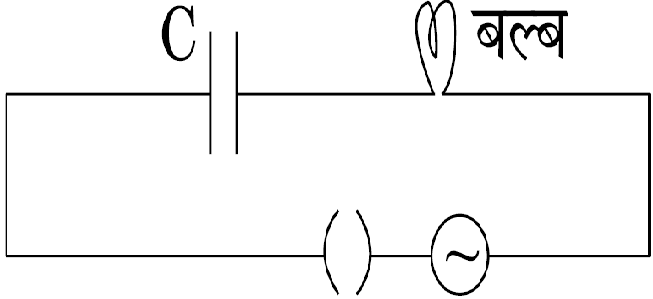
- A bulb is connected in series with a variable capacitor and an A.C. source as shown. What happens to the brightness of the bulb when the key is the capacitor is gradually reduced?
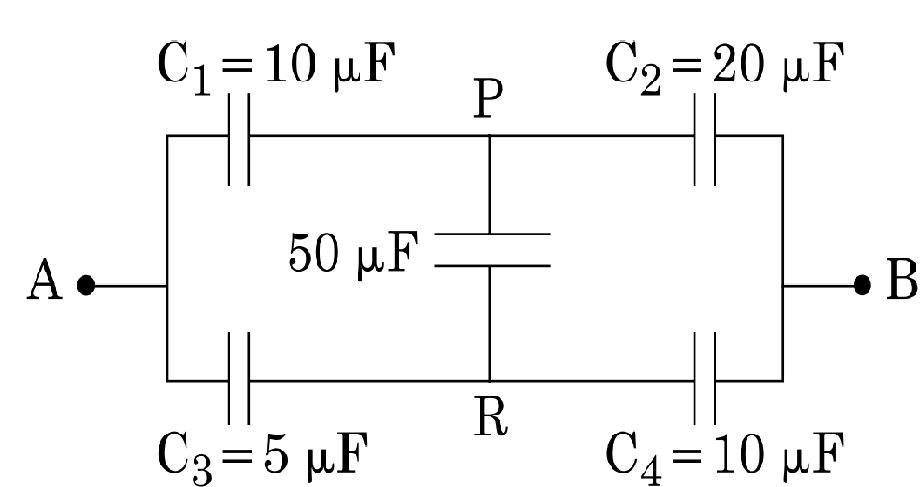
- 4View SolutionCalculate the equivalent capacitance between points A and B in the circuit below. If a battery of 10 V is connected across A and B, calculate the charge drawn from the battery by the circuit.
- 5View SolutionAnswer the following:
- In what way is diffraction from each slit related to the interference pattern in a double slit experiment?
- When a tiny circular obstacle is placed in the path of light from a distant source, a bright spot is seen at the centre of the shadow of the obstacle. Explain, why.
- How does the resolving power of a microscope depend on (i) the wavelength of the light used and (ii) the medium used between the object and the objective lens?
- 6View SolutionWhen a capacitor is connected in series LR circuit, the alternating current flowing in the circuit increases. Explain why.
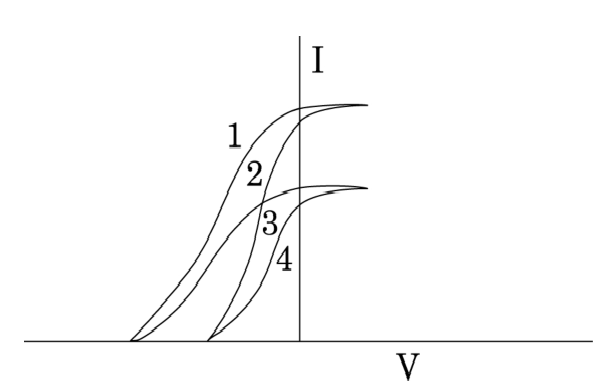
- 7View SolutionThe given graph shows the variation of photo-electric currently) with the applied voltage(V) for two different materials and for two different intensities of the incident radiations. Identify and explain using Einstein's photo electric equation the pair of curves that correspond to (i) different materials but same intensity of incident radiation (ii) different intensities but same materials.
- 8View SolutionAn object is placed 15 cm in front of a convex lens of focal length 10 cm. Find the nature and position of the image formed. Where should a concave mirror of radius of curvature 20 cm be placed so that the final image is formed at the position of the object itself?
- 9Write symbolically the nuclear $\beta^{+}$decay process of $^{11}_{6}\text{C}$ . Is the decayed product X an isotope or isobar of $^{11}_{6}\text{C}$?View Solution
Given the mass values m $(^{11}_{6}\text{C})$ = 11·011434 u and m (X) = 11·009305 u. Estimate the Q-value in this process. - 10View SolutionIn the given circuit, the potential difference across the inductor L and resistor R are 200V and 150V respectively and the rms. value of current is 5A. Calculate (i) the impedance of the circuit and (ii) the phase angle between the voltage and the current.