Question
Explain why the reactance provided by a capacitor to an alternating current decreases with increasing frequency.

Answer

A capacitor does not allow flow of direct current through it as the resistance across the gap is infinite. When an alternating voltage is applied across the capacitor plates, the plates are alternately charged and discharged. The current through the capacitor is a result of this changing voltage (or charge). Thus, a capacitor will pass more current through it if the voltage is changing at a faster rate, i.e. if the frequency of supply is higher. This implies that the reactance offered by a capacitor is less with increasing frequency; it is given by $\frac{1}{\omega\text{C}}$.

Need a full question paper?

Generate a complete, print-ready paper with questions like this in minutes — across 16+ boards, with answer keys.
Start Generating Free

Similar questions

Suppose, one wishes to construct a 1.0 farad capacitor using circular discs. If the separation between the discs be kept at 1.0mm, what would be the radius of the discs?
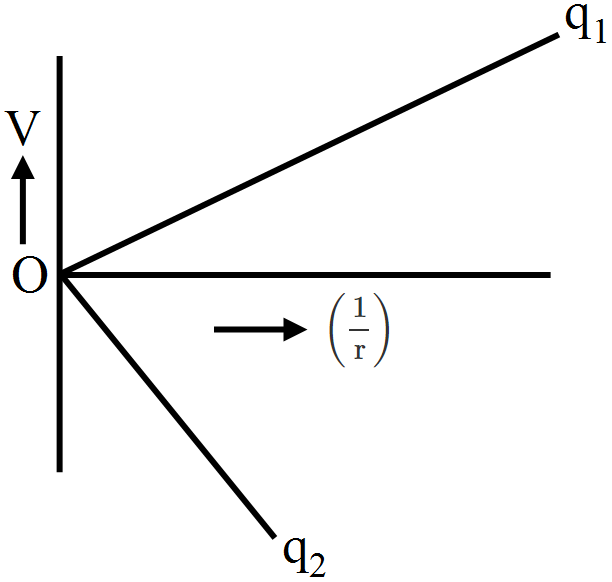
The two graphs are drawn below, show the variations of electrostatic potential $(V) \frac{1}{\text{r}} (r$ being the distance of field point from the point charge$)$ for two point charges $q_1$ and $q_2.$
  1. What are the signs of the two charges?
  2. Which of the two charges has the larger magnitude and why?
​​​​​​​​​​​​​​

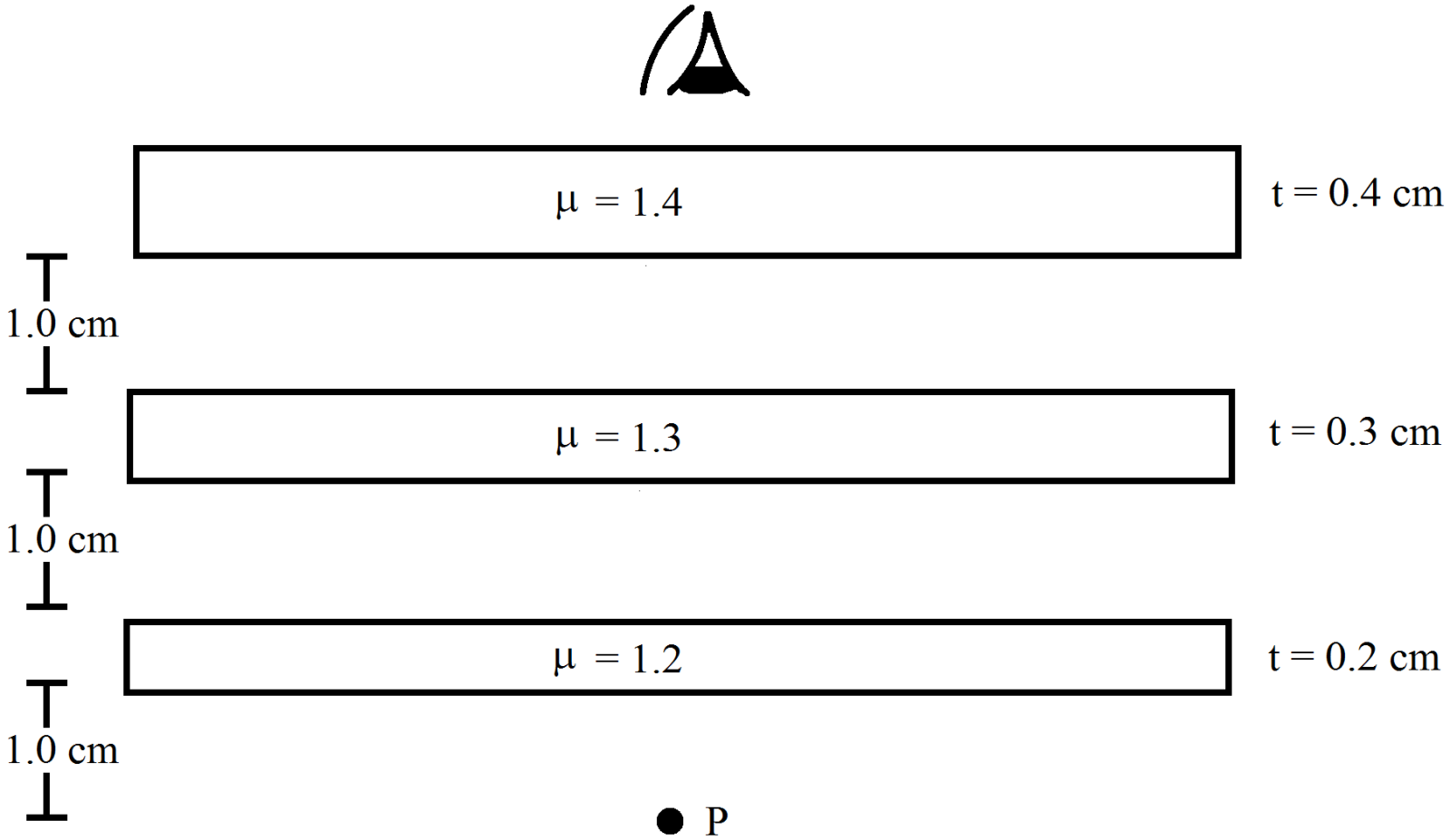
Locate the image of the point P as seen by the eye in the figure.
A charge Q is distributed uniformly over a metallic sphere of radius R. Obtain the expressions for the electric field (E) and electric potential (V) at a point 0 < x < R.
Show on a plot the variation of E and V with x for 0 < x < 2R.
Derive the formula for the force acting on current carrying rod placed in a magnetic field.
Power factor of a coil in an ac circuit at 60 hertz frequency is 0.707 . If frequency of ac source becomes 120 hertz, then what will be power factor?
An ideal gas expands from 100\ cm^3 to $200\ cm^3$ at a constant pressure of $2.0 \times 10^5$ Pa when $50J$ of heat is supplied to it. Calculate,
A point source emitting light uniformly in all directions is placed 60cm above a table-top. The illuminance at a point on the table-top, directly below the source, is 15 lux. Find the illuminance at a point on the table-top 80cm away from the first point.
Can X-rays be used for photoelectric effect?
Iron emits $\text{K}_\alpha \ X-$ray of energy $6.4 \ \text{keV}$ and calcium emits $\text{K}_\alpha \ X-$rays of energy $3.69 \ \text{keV}.$ Calculate the times taken by an iron $\text{K}_\alpha$ photon to cross through a distance of $3\ km.$