Question
The two graphs are drawn below, show the variations of electrostatic potential $(V) \frac{1}{\text{r}} (r$ being the distance of field point from the point charge$)$ for two point charges $q_1$ and $q_2.$
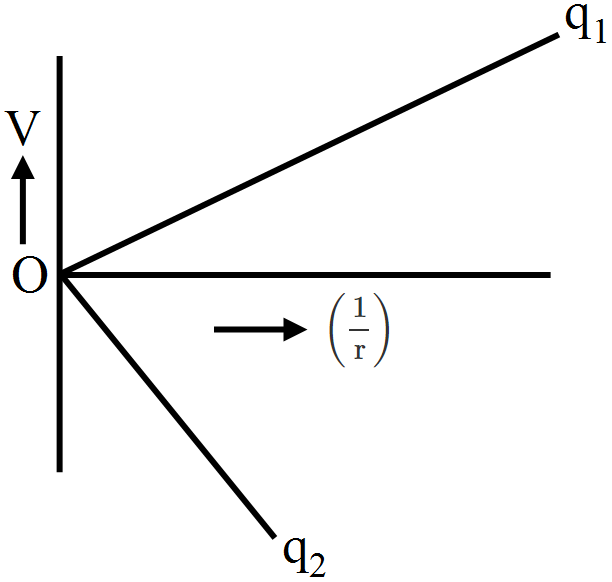
  1. What are the signs of the two charges?
  2. Which of the two charges has the larger magnitude and why?
​​​​​​​​​​​​​​

Answer

  1. The potential due to positive charge is positive and due to negative charge, it is negative, so, is $q_1$ positive and $q_2$ is negative.
$\text{V}=\frac{1}{4\pi\varepsilon_0}\frac{\text{q}}{\text{r}}$
  1. The graph between $V$ and $\frac{1}{\text{r}}$ is a straight line passing through the origin with slope $\frac{\text{q}}{4\pi\varepsilon_0},$
As the magnitude of slope of the line due to charge $q_2$ is greater than that due to $q_1, q_2$ has larger magnitude.

Need a full question paper?

Generate a complete, print-ready paper with questions like this in minutes — across 16+ boards, with answer keys.

Start Generating Free

Similar questions

A closely wound solenoid of $2000$ turns and area of cross$-$section $1.6 \times 10^{–4} m2$, carrying a current of $4.0 A,$ is suspended through its centre allowing it to turn in a horizontal plane.
  1. What is the magnetic moment associated with the solenoid?
  2. What is the force and torque on the solenoid if a uniform horizontal magnetic field of $7.5 \times 10^{–2}\ T$ is set up at an angle of $30^\circ$ with the axis of the solenoid?
Can two particles be in equilibrium under the action of their mutual gravitational force? Can three particles be? Can one of the three particles be?
Define the term self-inductance. Write its SI unit. Give two factors on which self inductance of an air-core coil depends.
Use the mirror equation to show that.
  1. An object placed between f and 2f of a concave mirror produces a real image beyond 2f.
  2. A convex mirror always produces a virtual image independent of the location of the object.
  3. An object placed between the pole and focus of a concave mirror produces a virtual and enlarged image.
Can an electromagnetic wave be deflected by an electric field or a magnetic field?
The wavelength of a probe is roughly a measure of the size of a structure that it can probe in some detail. The quark structure of protons and neutrons appears at the minute length$-$scale of $10^{–15} m$ or less. This structure was first probed in early $1970’s$ using high energy electron beams produced by a linear accelerator at Stanford, $\text{USA.}$ Guess what might have been the order of energy of these electron beams. $($Rest mass energy of electron $= 0.511\ MeV.)$
A point source emitting light uniformly in all directions is placed 60cm above a table-top. The illuminance at a point on the table-top, directly below the source, is 15 lux. Find the illuminance at a point on the table-top 80cm away from the first point.
State Gauss᾿s theorem in electrostatics. Using this theorem, derive an expression for the electric field due to an infinitely long straight wire of linear charge density $\lambda$.
  1. State the condition under which a charged particle moving with velocity v goes undeflected in a magnetic field B.
  2. An electron, after being accelerated through a potential difference of 104 V, enters a uniform magnetic field of 0.04 T, perpendicular to its direction of motion. Calculate the radius of curvature of its trajectory.
The equation of a wave travelling on a string is:$\text{y}=(0.10\text{mm})\sin\big[(31.4\text{m}^{-1})\text{x}+(314\text{s}^{-1})\text{t}\big].$
  1. In which direction does the wave travel?
  2. Find the wave speed, the wavelength and the frequency of the wave.
  3. What is the maximum displacement and the maximum speed of a portion of the string?