Question
Explain why. There is no atmosphere on moon.

Answer

As acceleration due to gravity on moon is 1/6th of g on earth. So the escape velocity on moon $\text{V}_{\text{es}}=\sqrt{2\text{gR}}=2.38\text{km}/\text{s}$ M = Mass of hydrogen, As $H_2$ is lightest gas $m = 1.67 \times 10^{-24}kg$$\text{v}_\text{rms}=\sqrt{\frac{3\text{K}_\text{B}\text{T}}{\text{m}}}=\sqrt{\frac{3\times1.38\times10^{-23}\times300}{1.67\times10^{-24}}}$
= 2.72 km/s Due to small gravitational force and $v_{rms}$ is greater than escape velocity so molecule of air can escape out. As the distance of moon from sun is approximately equal to that of earth so the intensity of energy of sun reaches to moon is larger due to lower density of atmosphere, distance become smaller than earth when moon is towards sun during its rotation around earth. Due to this (sun light), rms speed of molecule increase and some of them can speed up more than escape velocity and so probability of escaping out increased. Hence over a long time moon has lost most of its atmosphere.

Need a full question paper?

Generate a complete, print-ready paper with questions like this in minutes — across 16+ boards, with answer keys.
Start Generating Free

Similar questions

You are riding in an automatic vehicle of mass 3000 kg . Assume that you are testing the oscillatory characteristics of the suspension system of this vechicle when the entire vehicle is placed on it, the suspended is inclined by 15 cm . Also, the amplitude of oscillation decreases by $50 \%$ in the period of one complete oscillation. Estimate the value of the following
(a) spring constant, and
(b) for the shock absorber system of a spring and $a$ wheel damping constant $b$.
Assume that each wheel carries a mass of 750 kg is.
A metre long narrow bore held horizontally (and closed at one end) contains a $76cm$ long mercury thread, which traps a $15cm$ column of air. What happens if the tube is held vertically with the open end at the bottom?
An object starts from rest and covers a total distance X in the following manner: It first has a uniform acceleration $a_1$ for some time $t_1$, moves with the speed acquired at the end of $t_1$ for some distance and is then given a uniform retardation $a_2$ so that it is again at rest at the end of the journey. Show that the journey is covered in least time if the body is accelerated for a time of $\Big[\frac{2\text{X a}_2}{\text{a}_1(\text{a}_1+\text{a}_2)}\Big]^{\frac{1}{2}}$ and this minimum time is $\Bigg[2\text{X}\Big(\frac{1}{\text{a}_1}+\frac{1}{\text{a}_2}\Big)\Bigg]^{\frac{1}{2}}.$
A capacitor having a capacitance of $100\mu\text{F}$ is charged to a potential difference of $50V$.
  1. What is the magnitude of the charge on each plate?
  2. The charging battery is disconnected and a dielectric of dielectric constant $2.5$ is inserted. Calculate the new potential difference between the plates.
  3. What charge would have produced this potential difference in absence of the dielectric slab.
  4. Find the charge induced at a surface of the dielectric slab.
Why does blowing over a spoonful of hot tea cools it? Does evaporation play a role? Does radiation play a role?
Explain how Carnot's cycle works with the heat flow diagram. Using the same, explain the working of a refrigerator. Also, give its coefficient of performance.
A neutron (um/ s) collides with a nucleus at rest of mass number A. How muchenergy is transferred to the nucleus by the neutron?
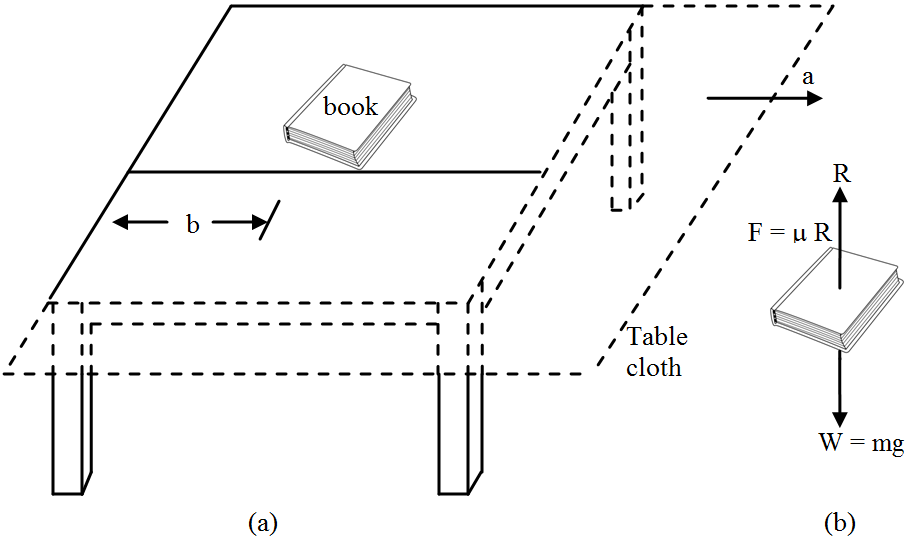
A book rests on a table cloth spread over a table as shown in Fig. The centre of the book is at a distance of b from the edge of the table at time t = 0; the table cloth is suddenly pulled at this instant with an acceleration a. Show that the cloth will slip from under the book if a > µ g, where u is the coefficient of sliding friction between the table cloth and the book. Assuming this condition to be satisfied. calculate:
  1. Time instant.
  2. The velocity.
  3. The distance of the centre of the book from the edge of the table when the edge of the table cloth passes over the centre of the book.
Explain the concept of internal energy.
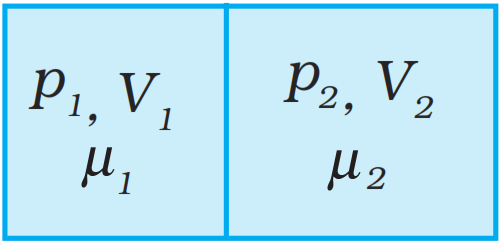
The container shown in Fig. has two chambers, separated by a partition, of volumes $\mathrm{V}_1=2.0$ litre and $\mathrm{V}_2=3.0$ litre. The chambers contain $\mu_1=4.0$ and $\mu_2=5.0$ moles of a gas at pressures $\mathrm{p}_1=1.00 \mathrm{~atm}$ and $\mathrm{p}_2=2.00 \mathrm{~atm}$. Calculate the pressure after the partition is removed and the mixture attains equilibrium.