Question
Explain how Carnot's cycle works with the heat flow diagram. Using the same, explain the working of a refrigerator. Also, give its coefficient of performance.
Answer

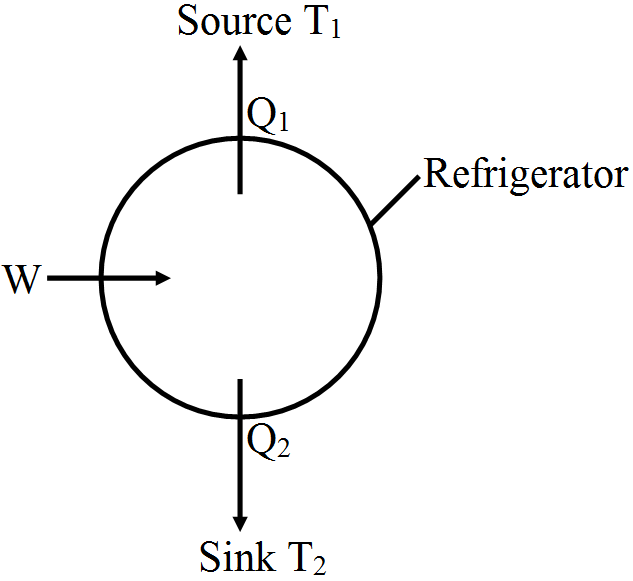
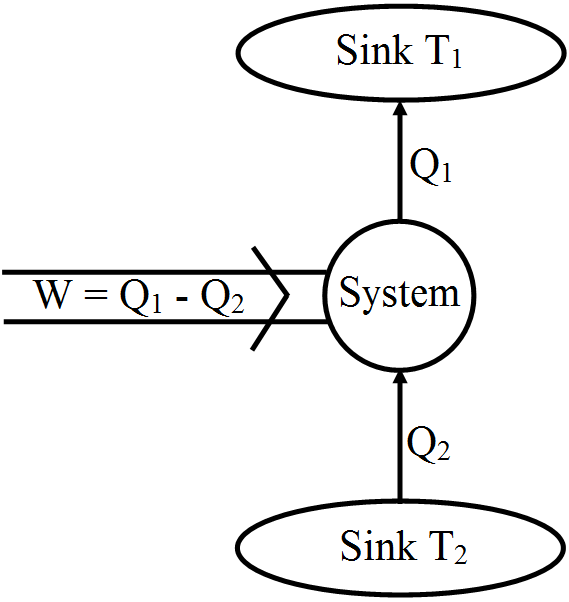
Refrigerator absorbs heat from the body at a low temperature and liberates it to a body at a high temperature by doing work. It can be shown by the given diagram. $Q_2 \rightarrow$ Energy absorbed from sink. $Q_1 \rightarrow$ Energy liberated to source. $W \rightarrow$  Work done on the system.

 Coefficient of performance $=\frac{\text{Q}_2}{\text{Q}_1-\text{Q}_2}$
$Q_1 – Q_2$ refers to the work done on the system/refrigerator. Coefficient of performance (COP) $=\frac{\text{Q}_2}{\text{Q}_1-\text{Q}_2}=\frac{\text{T}_2}{\text{T}_1-\text{T}_2}$ Refrigerator: It works in the reverse Carnot's cycle. Heat is absorbed from sink at low temperature $T_2$ and given to the source at higher temperature $T_1$ with the help of an external agency doing work on the system. $(W = Q_1 - Q_2)$.

 The compressor in the refrigerator uses electrical energy and does work on the system. The coefficient of performance is defined as the heat energy absorbed from low temperature sink $Q_2$ to the amount of work done. $\text{W}=\text{Q}_1-\text{Q}_2$ $\text{COP}=\frac{\text{Q}_2}{\text{Q}_1-\text{T}_2}=\frac{\text{T}_2}{\text{T}_1-\text{T}_2}$

Need a full question paper?

Generate a complete, print-ready paper with questions like this in minutes — across 16+ boards, with answer keys.
Start Generating Free

Similar questions

Consider a straight piece of length x of a wire carrying a current i. Let P be a point on the perpendicular bisector of the piece, situated at a distance d from its middle point. Show that for d >> x, the magnetic field at P varies as $\frac{1}{\text{d}^2}$ whereas ford d << x, it varies as $\frac{1}{\text{d}}.$
A long, straight wire is fixed horizontally and carries a current of $50.0A$. A second wire having linear mass density $1.0 \times 10^{-4}kg/m$ is placed parallel to and directly above this wire at a separation of $5.0mm$. What current should this second wire carry such that the magnetic repulsion can balance its weight?
An object starts from rest and covers a total distance X in the following manner: It first has a uniform acceleration $a_1$ for some time $t_1$, moves with the speed acquired at the end of $t_1$ for some distance and is then given a uniform retardation $a_2$ so that it is again at rest at the end of the journey. Show that the journey is covered in least time if the body is accelerated for a time of $\Big[\frac{2\text{X a}_2}{\text{a}_1(\text{a}_1+\text{a}_2)}\Big]^{\frac{1}{2}}$ and this minimum time is $\Bigg[2\text{X}\Big(\frac{1}{\text{a}_1}+\frac{1}{\text{a}_2}\Big)\Bigg]^{\frac{1}{2}}.$
An adiabatic cylindrical tube of cross-sectional area $1cm^2$ is closed at one end and fitted with a piston at the other end. The tube contains $0.03g$ of an ideal gas. At 1atm pressure and at the temperature of the surrounding, the length of the gas column is $40cm$. The piston is suddenly pulled out to double the length of the column. The pressure of the gas falls to $0.355atm$. Find the speed of sound in the gas at atmospheric temperature.
Three particles of masses 1.0kg, 2.0kg and 3.0kg are placed at the corners A, B and C respectively of an equilateral triangle ABC of edge 1m. Locate the centre of mass of the system.
Consider the situation shown in figure. The switch S is open for a long time and then closed:
  1. Find the charge flown through the battery when the switch S is closed.
  2. Find the work done by the battery.
  3. Find the change in energy stored in the capacitors.
  4. Find the heat developed in the system.
State Kepler's laws on planetary motion. Explain the way the three laws can be proved.
What is the moment of inertia? Explain its physical importance.
Define the work done by a constant force on an object and describe their specific situations.
The nearest star to our solar system is $4.29$ light years away. How much is this distance in terms of parsecs? How much parallax would this star (named Alpha Centauri) show when viewed from two locations of the Earth six months apart in its orbit around the Sun?