Question
Explain why
Water on a clean glass surface tends to spread out while mercury on the same surface tends to form drops. (Put differently, water wets glass while mercury does not.)
Answer

Mercury molecules (which make an obtuse angle with glass) have a strong force of attraction between themselves and a weak force of attraction toward solids. Hence, they tend to form drops.
On the other hand, water molecules make acute angles with glass. They have a weak force of attraction between themselves and a strong force of attraction toward solids. Hence, they tend to spread out.

Need a full question paper?

Generate a complete, print-ready paper with questions like this in minutes — across 16+ boards, with answer keys.

Start Generating Free

Similar questions

A voltmeter consists of a $25\Omega$ coil connected in series with a $575\Omega$ resistor. The coil takes 10mA for full scale deflection. What maximum potential difference can be measured by this voltmeter?
The Young’s modulus for steel is much more than that for rubber. For the same longitudinal strain, which one will have greater tensile stress?
Is viscosity a vector?
In Exercise, let us take the position of mass when the spring is unstreched as x = 0, and the direction from left to right as the positive direction of x-axis. Give x as a function of time t for the oscillating mass if at the moment we start the stopwatch (t = 0), the mass is:

At the maximum compressed position.

In what way do these functions for SHM differ from each other, in frequency, in amplitude or the initial phase?

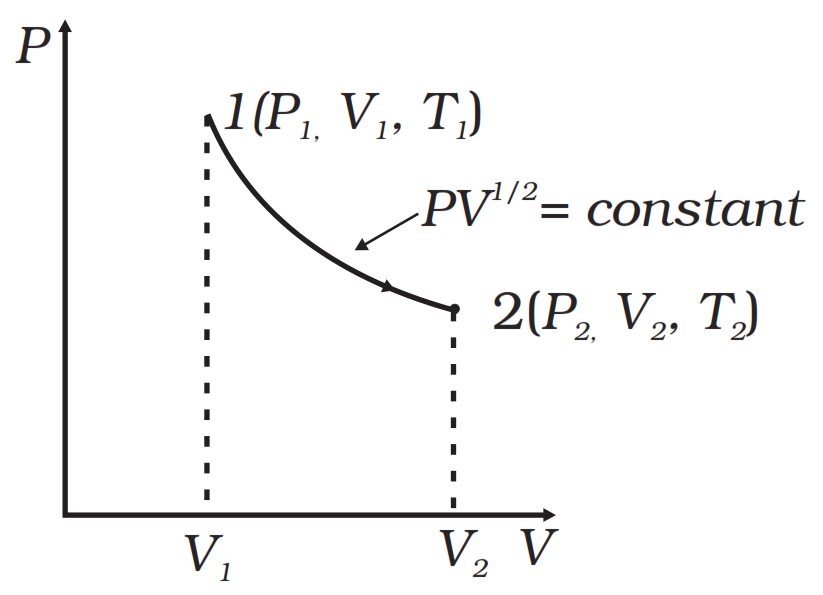
Consider a P-V diagram in which the path followed by one mole of perfect gas in a cylindrical container is shown in Fig.
What is the ratio of temperature $\frac{\text{T}_1}{\text{T}_2},\text{if}\text{V}_2=2\text{V}_1?$
A nucleus is at rest in the laboratory frame of reference. Show that if it disintegrates into two smaller nuclei, the products must be emitted in opposite directions.
Answer the following:
You can shield a charge from electrical forces by putting it inside a hollow conductor. Can you shield a body from the gravitational influence of nearby matter by putting it inside a hollow sphere or by some other means?
A block of mass M is held against a rough vertical wall by pressing it with a finger. If the coefficient of friction between the block and the wall is $\mu$ and the acceleration due to gravity is g, calculate the minimum force required to be applied by the finger to hold the block against the wall?
Give one example each of central force and non - central force.
Under what condition, an ideal Carnot engine has 100% efficiency?