Question
Explain with diagrams $: i. sp^3$ hybridization  $ii. sp^2$ hybridization  $iii. sp$ hybridization

Answer

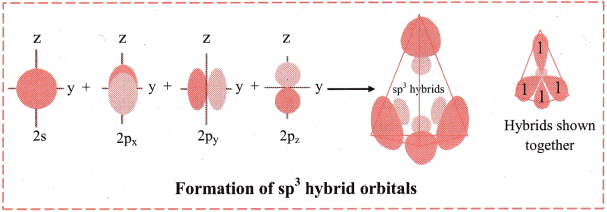
$i. sp^3$ hybridization:
In this type, one $s$ and three $p$ orbitals having comparable energy mix and recast to form four $sp^3$ hybrid orbitals, $‘s \ ’$ orbital is spherically symmetrical while the $p_x, p_y, p_z,$ orbitals have two lobes and are directed along $x, y \ and \ z$ axes, respectively.
The four $sp^3$ hybrid orbitals formed are equivalent in energy and shape. They have one large lobe and one small lobe. They are at an angle of $109^\circ 28′$ with each other in space and point towards the comers of a tetrahedron. $CH_4, NH_3, H_2O$ are examples where the orbitals on central atom undergo $sp^3$ hybridization.
Diagram:
Image
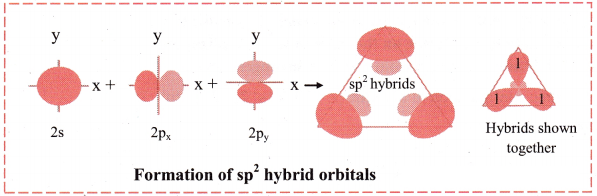
$ii. sp^2$ hybridization:
This hybridization involves the mixing of one $s$ and two $p$ orbitals to give three $sp^2$ hybrid orbitals of same energy and shape. The three orbitals are maximum apart and oriented at an angle of $120^\circ$ and are in one plane. The third $p$ orbital does not participate in hybridization and remains at right angles to the plane of the $sp^2$ hybrid orbitals. $BF_3, C_2H_4$ molecules are examples of $sp^2$ hybridization.
Diagram:
Image
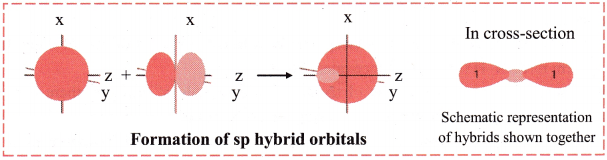
$iii. sp$ hybridization:
In this type, one $s$ and one $p$ orbital undergo mixing and recasting to form two $sp$ hybrid orbitals of same energy and shape. The two hybrid orbitals are placed at an angle of $180^\circ.$ Other two $p$ orbitals do not participate in hybridization and are at right angles to the hybrid orbitals. For example, $BeCl_2$ and acetylene molecule $(HC ≡ CH).$
Diagram:
Image

Need a full question paper?

Generate a complete, print-ready paper with questions like this in minutes — across 16+ boards, with answer keys.

Start Generating Free