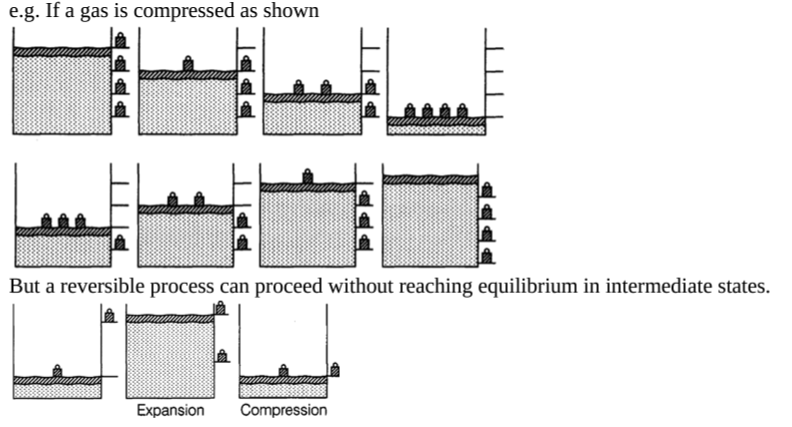
Question
Explain with the suitable example that a reversible process must be carried slowly and a fast process is necessarily irreversible.

Need a full question paper?

Generate a complete, print-ready paper with questions like this in minutes — across 16+ boards, with answer keys.

Start Generating Free

Similar questions

Pressure decreases as one ascends the atmosphere. If the density of air is $\rho,$ what is the change in pressure dp over a differential height dh?
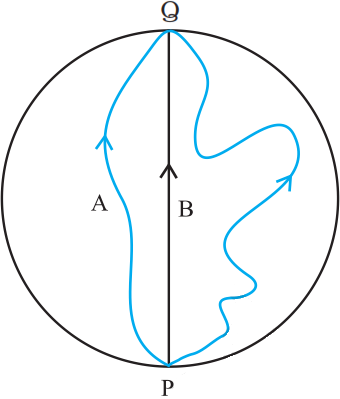
Three girls skating on a circular ice ground of radius 200m start from a point P on the edge of the ground and reach a point Q diametrically opposite to P following different paths as shown in Fig. What is the magnitude of the displacement vector for each? For which girl is this equal to the actual length of path skate?
A clever strategy in a snowball fight is to throw two snowballs at your opponent in quick succession. The first one with a high trajectory and the second one with a lower trajectory and shorter time of flight, so that they both reach the target at the same instant. Suppose your opponent is $20.0m$ away. You throw both snowballs with the same initial speed vo but $\theta _0$ is $60.0°$ for the first snowball and $30.0°$ for the second. If they are both to reach their target at the same instant, how much time must elapse between the release of the two snowballs?
The radius of the Earth is $6.37 \times 10^6\ m$ and its mass is $5.975 \times 10^{24}\ kg$. Find the Earth's average density to appropriate significant figures.
Give three important characteristics of displacement.
Consider Galileo's method of measuring the speed of light using two lanterns. To get an accuracy of about 10%, the time taken by the experimenter in closing or opening the shutter should be about one tenth of the time taken by the light in going from one experimenter to the other. Assume that it takes $\frac{1}{100}$ second for an experimenter to close or open the shutter. How far should the two experimenters be to get a 10% accuracy? What are the difficulties in having this separation?
Define a Rigid Body. Name two kinds of motion which a rigid body can execute. What is the meant by the term Equilibrium? For the equilibrium of a body, two conditions need to be satisfied. State them.
A transverse wave described by$\text{y}=(0.02\text{m})\sin\Big[(1.0\text{m}^{-1})\text{x}+(30\text{s}^{-1})\text{t}\Big]$
propagates on a stretched string having a linear mass density of $1.2 \times 10^{-4}kg/m$. Find the tension in the string.
Displacement versus time curve for a particle executing $\text{S.H.M}$. is shown in Fig. Identify the points marked at which,
  1. Velocity of the oscillator is zero,
  2. Speed of the oscillator is maximum.
Figure, shows an aluminium rod joined to a copper rod. Each of the rods has a length of 20 cm and area of cross section $0.20 \mathrm{~cm}^2$. The junction is maintained at a constant temperature $40^{\circ} \mathrm{C}$ and the two ends are maintained at $80^{\circ} \mathrm{C}$. Calculate the amount of heat taken out from the cold junction in one minute after the steady state is reached. The conductivities are $\mathrm{KAI}=200 \mathrm{wm}^{-1{ }^{\circ}} \mathrm{C}^{-1}$ and $\mathrm{K}_{\mathrm{Cu}}=400 \mathrm{wm}^{-1^{\circ}} \mathrm{C}^{-1}$.