Question
Explain with the suitable example that a reversible process must be carried slowly and a fast process is necessarily irreversible.

Answer

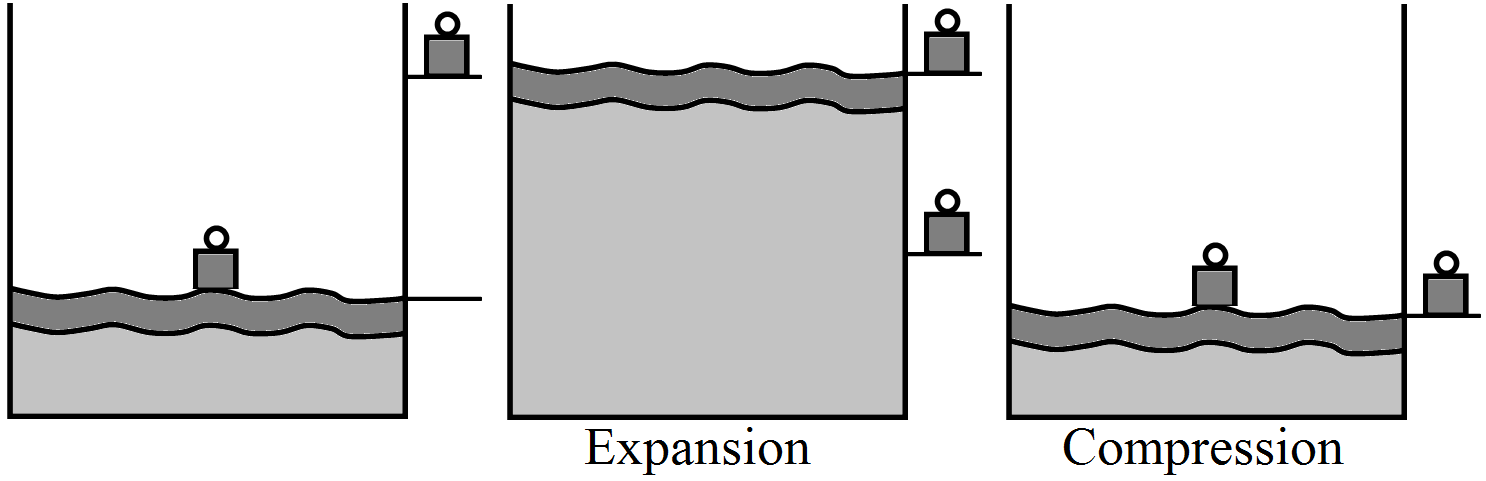
A reversible process must pass through equilibrium states which are very close to each other so that when process is reversed, it passes back through these equilibrium states.
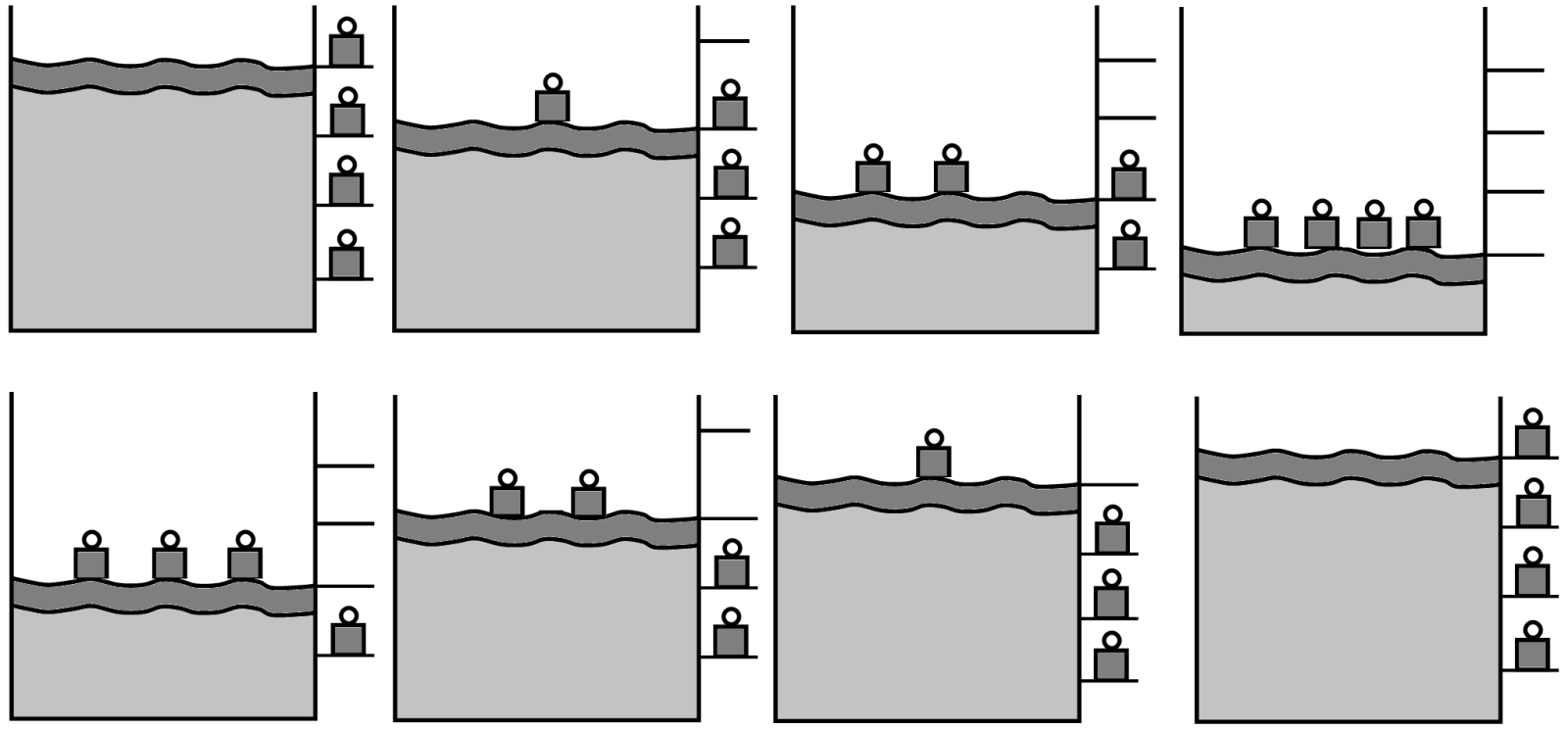
Then, it is again decompressed or it passes through same equilibrium states, system can be restored to its initial state without any change in surroundings. e.g. If a gas is compressed as shown

But a reversible process can proceeds without reaching equilibrium in intermediate states.

Need a full question paper?

Generate a complete, print-ready paper with questions like this in minutes — across 16+ boards, with answer keys.

Start Generating Free

Similar questions

Explain gravitational potential at a point in gravitational field. Give relation between gravitational field intensity and gravitational potential.
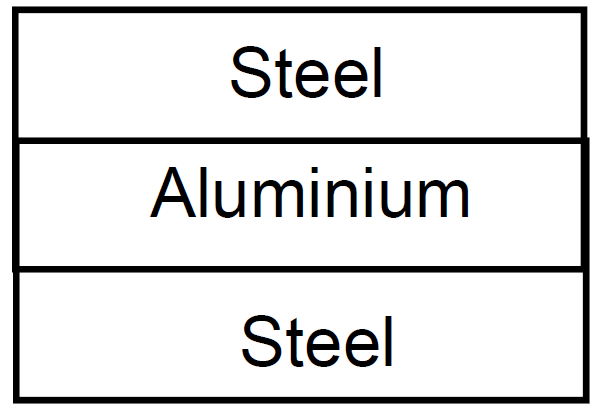
Two steel rods and an aluminium rod of equal length l0 and equal cross section are joined rigidly at their ends as shown in the figure below. All the rods are in a state of zero tension at 0°C. Find the length of the system when the temperature is raised to $\theta$. Coefficient of linear expanaion of aluminium and steel are $\alpha_\text{a}$ and $\alpha_\text{s}$respectively. Young's modulus of aluminium is Ya and of steel is Ys.

The bob of a pendulum is released from a horizontal position. If the length of the pendulum is 1.5m, what is the speed with which the bob arrives at the lowermost point, given that it dissipated 5% of its initial energy against air resistance?
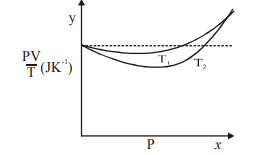
In the figure, graphs of PV/T and P for $1.00 \times 10^{-3} kg$ mass of oxygen at two different temperature are shown.
Image
(a) What does the dotted line show?
(b) What is true : $T _1> T _2$ or $T _1< T _2$ ?
(c) What is the value of PV/T where the curves meet on the $y$-axis?
(d) If we make a similar graph for $1.00 \times 10^{-3} kg$ hydrogen, will the value of PV/T be same at the point where the curves meet the $y$-axis?
If not, for what mass of hydrogen will the value of PV/T be the same as for the region of low pressure and high temperature? (Molecular mass of $H _2=2.02$ $u$, Mass of $O_2=32.04 u, R=8.31 J mol ^{-1} K^{-1}$ )
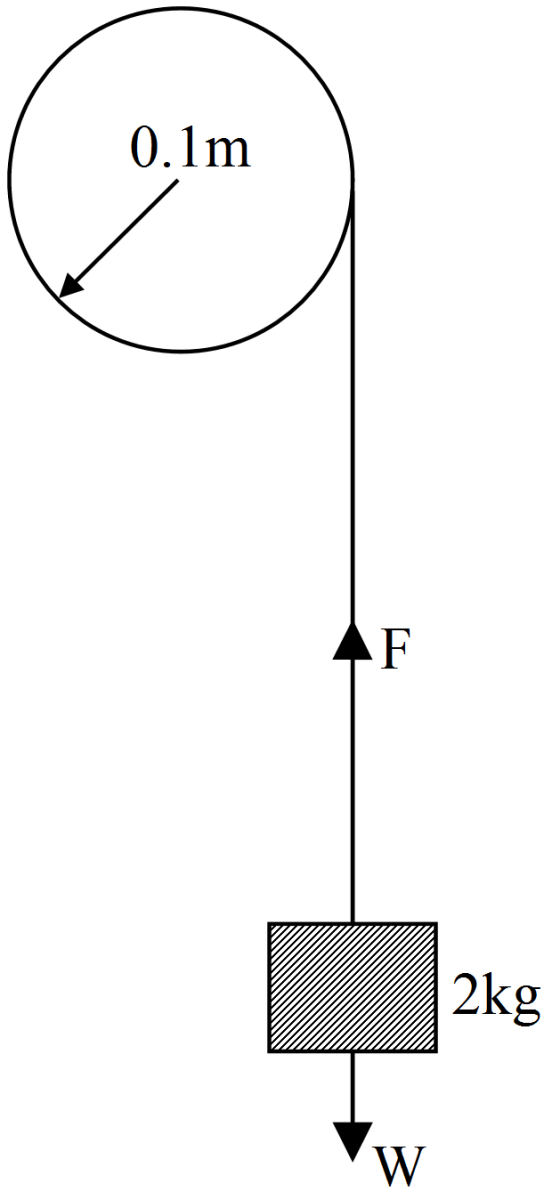
The moment of inertia of a solid flywheel about its axis is 0.1kg-m2. A tangential force of 2kg/ wt is applied round the circumference of the flywheel with the help of a string and mass arrangement as shown in Fig. If the radius of the wheel is 0.1m, find the acceleration of the mass.

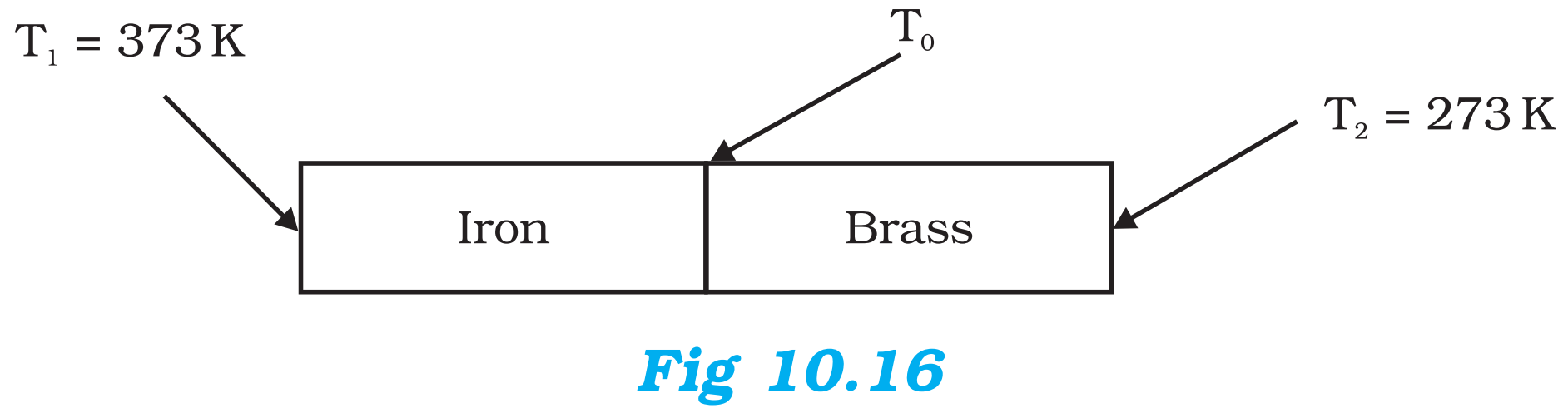
An iron bar $\left(L_1=0.1 m , A_1=\right.$ $\left.0.02 m ^2, K_1=79 W m ^{-1} K ^{-1}\right)$ and a brass bar $\left(L_2=0.1 m , A_2=0.02 m ^2\right.$, $K_2=109 W m ^{-1} K ^{-1}$ ) are soldered end to end as shown in Fig. 10.16. The free ends of the iron bar and brass bar are maintained at $373 K$ and $273 K$ respectively. Obtain expressions for and hence compute (i) the temperature of the junction of the two bars, (ii) the equivalent thermal conductivity of the compound bar, and (iii) the heat current through the compound bar.
Image
In an experiment on the specific heat of a metal, a 0.20kg block of the metal at 150°C is dropped in a copper calorimeter (of water equivalent 0.025kg) containing 150 c.c. of water at 27°C. The final temperature is 40°C. Calculate the specific heat of the metal. If heat losses to the surroundings are not negligible, is your answer greater or smaller than the actual value of specific heat of the metal?
An inductance of 2.0H, a capacitance of $18\mu\text{F}$ and a resistance of $10\text{K}\Omega$ are connected to an AC source of 20V with adjustable frequency.
  1. What frequency should be chosen to maximise the current in the circuit?
  2. What is the value of this maximum current?
A great physicist of this century (P.A.M. Dirac) loved playing with numerical values of Fundamental constants of nature. This led him to an interesting observation. Dirac found that from the basic constants of atomic physics (c, e, mass of electron, mass of proton) and the gravitational constant G, he could arrive at a number with the dimension of time. Further, it was a very large number, its magnitude being close to the present estimate on the age of the universe (~15 billion years). From the table of fundamental constants in this book, try to see if you too can construct this number (or any other interesting number you can think of). If its coincidence with the age of the universe were significant, what would this imply for the constancy of fundamental constants?
The coefficient of volume expansion of glycerine is $49 \times 10^{-5} K^{-1}$. What is the fractional change in its density for a $30^{\circ} C$ rise in temperature?