Question

Predict the reagents or the products in the following reaction sequence:
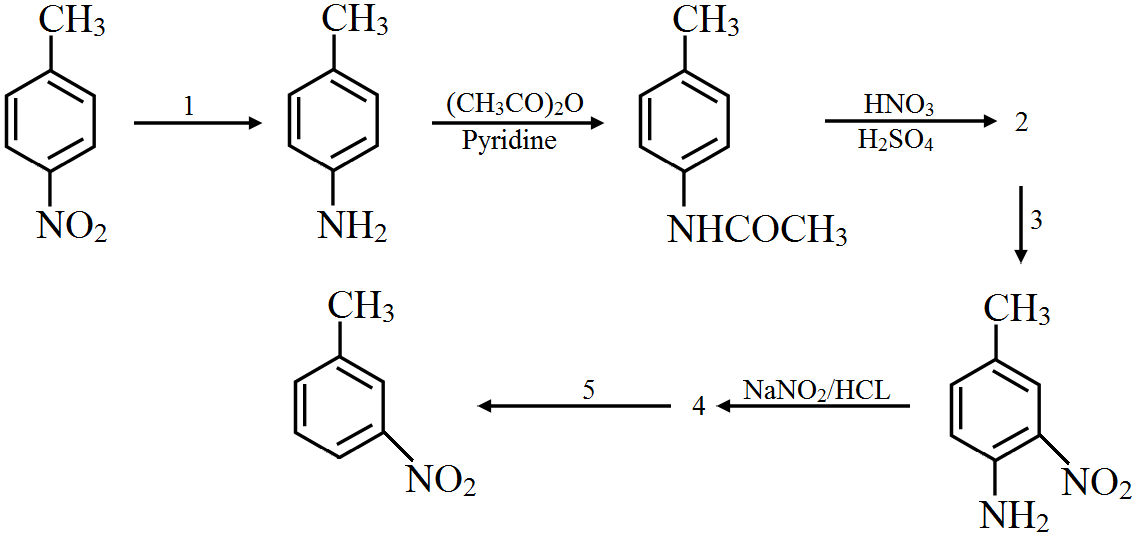
Answer

Get the step-by-step solution for this question inside the Vidyadip app.

Get the answer in the app

Need a full question paper?

Generate a complete, print-ready paper with questions like this in minutes — across 16+ boards, with answer keys.

Start Generating Free

Similar questions

(a) Differentiate between
a. Nucleotide and Nucleoside
b. Amylose and Amylopectin
(b) Write a reaction which shows that all the carbon atoms in glucose are linked in a straight chain.
(c) Write two differences between DNA and RNA.
(d) Amino acids can be classified as $\alpha-, \beta-, \gamma-, \delta-$ and so on depending upon the relative position of the amino group with respect to the carboxyl group. Which type of amino acids forms a polypeptide chain in proteins?
(e) What are any two good sources of vitamin A?
(f) What is anomeric carbon?
(g) What is the difference between a glycosidic linkage and a peptide linkage?
Describe the differences in the properties of lanthanoids and actinoids.
Primary alkyl halide C4H9Br (a) reacted with alcoholic KOH to give compound (b). Compound (b) is reacted with HBr to give (c) which is an isomer of (a). When (a) is reacted with sodium metal it gives compound (d), C8H18 which is different from the compound formed when n-butyl bromide is reacted with sodium. Give the structural formula of (a) and write the equations for all the reactions.
(a) Draw the structure of a galvanic cell and also describe the reaction taking place in it.
(b) What happens when opposite external potential is applied in the galvanic cell system? Explain.
Explain the properties of vitamins and also classify them.
Match the items of Column I with items of Column II and assign the correct code:
 
Column I
 
Column II
(A)
Coloured bands
(1)
Zone refining
(B)
LImpure matal to volatie complex
(2)
Fractional distillation
(C)
Purification of Ge and Si
(3)
Mond process
(D)
Purification of mercury
(4)
Chromatophy
 
 
(5)
Liquation
  1. A (1) B (2) C (4) D (5)
  2. A (4) B (3) C (1) D (2)
  3. A (3) B (4) C (2) D (1)
  4. A (5) B (4) C (3) D (2)
List various types of isomerism possible for coordination compounds, giving an example of each.
Attempt any five of the following:
(a) Aldopentoses named ribose and 2-deoxyribose are found in nucleic acids. What is their relative configuration?
(b) What are the three components of nucleic acids?
(c) Name the sugar present in milk. How many monosaccharide units are present in it? What are such oligosaccharides called?
(d) Is nucleotide and nucleoside the same? What are their roles?
(e) Why cannot vitamin C be stored in our body?
(f) During curdling of milk, what happens to sugar present in it?
(g) Account for the following:
a. There are 5-OH groups in glucose.
b. Glucose is a reducing sugar
i. Name the element of 3d transition series which shows maximum number of oxidation states. Why does it show so?
ii. which transition metal of 3 d series has positive $E ^{\circ}\left( M ^{2+} / M \right)$ value and why?
iii. Out of $Cr ^{3+}$ and $Mn ^{3+}$, which is a stronger oxidizing agent and why?
iv. Name a member of the lanthanoid series which is well known to exhibit +2 oxidation state.
v. Complete the following equation:
$MnO_4^{-}+8 H^{+}+5 e^{-} \rightarrow$
Describe the reactions of carboxylic acids in which C-OH bond is broken.
