Question
Explain
(1) free vibrations
(2) forced vibrations.

Answer


(1) Free vibrations : A body capable of vibrations is said to perform free vibrations when it is disturbed from its equilibrium position and left to itself.
In the absence of dissipative forces such as friction due to surrounding air and internal forces, the total energy and hence the amplitude of vibrations of the body remains constant. The frequencies of the free vibrations of a body are called its natural frequencies and depend on the body itself.
In the absence of a maintaining force, in practice, the total energy and hence the amplitude decreases due to dissipative forces and the vibration is said to be damped. The frequency of damped vibrations is less than the natural frequency.
(2) Forced vibrations: The vibrations of a body in response to an external periodic force are called forced vibrations.
The external force supplies the necessary energy to make up for the dissipative losses. The frequency of the forced vibrations is equal to the frequency of the external periodic force.
The amplitude of the forced vibrations depends upon the mass of the vibrating body, the amplitude of the external force, the difference between the natural frequency and the frequency of the periodic force, and the extent of damping.
Need a full question paper?

Generate a complete, print-ready paper with questions like this in minutes — across 16+ boards, with answer keys.

Start Generating Free

Similar questions

Draw a neat labelled energy flow diagram of a heat engine.
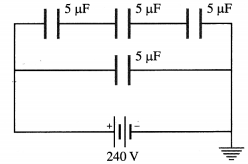
A network of four capacitors, 5 µF each, are connected to a 240 V supply. Determine the equivalent capacitance of the network and the charge on each capacitor.
Image
Why is it useful to define radius of gyration?
Explain the concept of electric potential difference and electric potential.
How does an air conditioner differ from a refrigerator? Define the coefficient of performance of an air conditioner and express it in terms of heat current.
Potential energy of a particle performing linear S.H.M is $0.1 \pi ^2 x^2$ joule. If mass of the particle is $20\ g$, find the frequency of S.H.M.
When $100 V$ dc is applied across a coil, a current of $1 A$ flows through it. When $100 V \ ac$ of frequency $50 Hz$ is applied to the same coil, only $0.5 A$ current flows through it. Calculate the resistance, impedance and self $-$ inductance of the coil.
Water is flowing through a horizontal pipe of varying cross section. At a certain point where the velocity is $0.12 \mathrm{~m} / \mathrm{s}$, the pressure of water is $0.010 \mathrm{~m}$ of mercury. What is the pressure at a point where the velocity is $0.24 \mathrm{~m} / \mathrm{s}$ ?
With the help of a neat diagram, describe the construction and working of van de Graff generator.
In a biprism experiment, the wavelength of red light used is $6000 A$ and the nth bright band is obtained at a point $P$ on the screen. Keeping the same setting, the source is replaced by a source of green light of wavelength $5000 A$ and the $( n +1)$ th bright band of green light coincides with point P. Find $n$.