Question
Factorize: $7(x - 2y)^2 - 25(x - 2y) + 12$

Answer

Let $x - 2y = P = 7P^2 - 25P + 12$
Splitting the middle term, $= 7P^2 - 21P - 4P + 12$
$= 7P(P - 3) - 4(P - 3) = (P - 3)(7P - 4)$
Substituting $P = x - 2y = (x - 2y - 3)(7(x - 2y) - 4) $
$= (x - 2y - 3)(7x - 14y - 4)$
$\therefore$$ 7(x - 2y)^2 - 25(x - 2y) + 12$
$ = (x - 2y - 3)(7x - 14y - 4)$

Need a full question paper?

Generate a complete, print-ready paper with questions like this in minutes — across 16+ boards, with answer keys.
Start Generating Free

Similar questions

Three angles of a quadrilateral are respectively equal to $110^\circ , 50^\circ $ and $40^\circ $. Find its fourth angle.
Show that a diagonal divides a parallelogram into two triangles of equal area.
Find the volume of a sphere whose surface area is $154cm2.$
Find solutions of the form $x = a, y = 0$ and $x = 0, y = b$ for the following pairs of equations. Do they have any common such solution$?\ 3x + 2y = 6$ and $5x + 2y = 10$
The following table shows the blood groups of $40$ students of a class.
Blood group $A$ $B$ $O$ $AB$
Number of students $11$ $9$ $14$ $6$
One student of the class is chosen at random. What is the probability that the chosen students blood group is:
$i. O?$
$ii. AB?$
The following observation s have been arranged in ascending order. If the median of the data is $63$, find the value of $x: 29, 32, 48, 50, x, x + 2, 72, 78, 84, 95.$
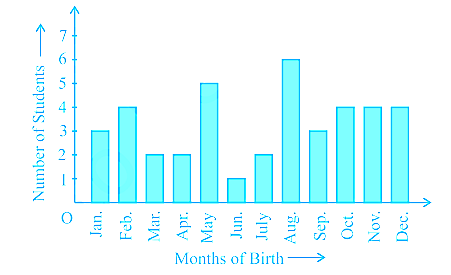
In a particular section of Class $IX, 40$ students were asked about the months of their birth and the following graph was prepared for the data so obtained:

Observe the bar graph given above and answer the following questions:
$i.$ How many students were born in the month of November?
$ii.$ In which month were the maximum number of students born?
$ABCD$ is a quadrilateral such that diagonal AC bisects the angles $\angle\text{A}$ and $\angle\text{C}.$ Prove that $AB = AD$ and $CB = CD.$
Find the cost of digging a cuboidal pit $8m$ long, $6m$ broad and $3m$ deep at the rate of $₹ 30$ per $\mathrm{m}^3$
How many lead balls, each of radius $1\ cm$, can be made from a sphere of radius $8\ cm$? $\big(\text{Take}\ \pi=\frac{22}{7}\big).$