Question
Factorize the following expressions:
$1029-3 x^3$
 

Answer

$1029-3 x^3$
$=3\left(343-x^3\right)$
$=3\left((7)^3-x^3\right)$
$=3(7-x)\left(72+7 x+x^2\right)$
${\left[\therefore a^3-b^3=(a-b)\left(a^2+a b+b^2\right)\right]}$
$=3(7-x)\left(49+7 x+x^2\right)$
$\therefore 1029-3 x^3=3(7-x)\left(49+7 x+x^2\right)$

Need a full question paper?

Generate a complete, print-ready paper with questions like this in minutes — across 16+ boards, with answer keys.
Start Generating Free

Similar questions

Factorise: $x^3 - 6x^2 + 11x - 6$
A shopkeeper has one laddoo of radius $5\ cm$. With the same material, how many laddoos of radius $2.5\ cm$ can be made?
A rectangular container, whose base is a square of side $5\ cm$, stands on a horizontal table, and holds water up to $1\ cm$ from the top.
When a solid cube is placed in the water it is completely submerged, the water rises to the top and $2$ cubic cm of water overflows.
Calculate the volume of the cube and also the length of its edge.
You know that $\frac{1}{7}=0 . \overline{142857}$. Can you predict what the decimal expansions of $\frac{2}{7}, \frac{3}{7}, \frac{4}{7}, \frac{5}{7}, \frac{6}{7}$ are, without actually doing the long division? If so, how?
From a solid right circular cylinder with height $10\ cm$ and radius of the base $6\ cm$, a right circular cone of the same height and base is removed. Find the volume of the remaining solid. $\big(\text{Take}\ \pi=3.14\big).$
The radius of a cone is $7\ cm$ and area of curved surface is $176cm^2.$ Find the slant height.
Find solutions of the form $x = a, y = 0$ and $x = 0, y = b$ for the following pairs of equations. Do they have any common such solution$?\ 3x + 2y = 6$ and $5x + 2y = 10$
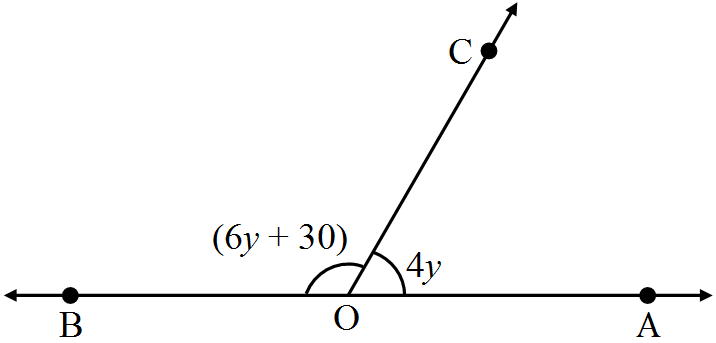
What value of $y$ would make $AOB$ a line in the below figure, If $\angle\text{AOC}=4\text{y}$ and $\angle\text{BOC}=(6\text{y}+30)?$
Prove that: $\frac{1}{1+\text{x}^{\text{b}-\text{a}}+\text{x}^{\text{c}-\text{a}}}+\frac{1}{1+\text{x}^{\text{a}-\text{b}}+\text{x}^{\text{c}-\text{b}}}+\frac{1}{1+\text{x}^{\text{b}-\text{c}}+\text{x}^{\text{a}-\text{c}}}=1$
Express the following decimals in the form $\frac{\text{p}}{\text{q}},$ where $p, q$ are integers and $\text{q}\neq0.$
$18.\overline{48}$