MCQ
${F_g}$ and ${F_e}$ represents gravitational and electrostatic force respectively between electrons situated at a distance $10\, cm$. The ratio of ${F_g}/{F_e}$ is of the order of
  • A
    ${10^{42}}$
  • B
    $10$
  • C
    $1$
  • ${10^{ - 43}}$

Answer

Correct option: D.
${10^{ - 43}}$
d
(d) Gravitational force between electrons ${F_G} = \frac{{G{{({m_e})}^2}}}{{{r^2}}}$
Electrostatics force between electrons ${F_e} = k.\frac{{{e^2}}}{{{r^2}}}$
$\frac{{{F_G}}}{{{F_e}}} = \frac{{G{{({m_e})}^2}}}{{k.{e^2}}} = \frac{{6.67 \times {{10}^{ - 11}} \times {{(9.1 \times {{10}^{ - 31}})}^2}}}{{9 \times {{10}^9} \times {{(1.6 \times {{10}^{ - 19}})}^2}}}$$ = 2.39 \times {10^{ - 43}}$

Need a full question paper?

Generate a complete, print-ready paper with questions like this in minutes — across 16+ boards, with answer keys.
Start Generating Free

Similar questions

A spherical drop of capacitance $1\,\,\mu F$ is broken into eight drops of equal radius. Then, the capacitance of each small drop is ......$\mu F$
An electron beam of energy $'10\,KeV'$ is incident on metallic foil. If the interatomic distance is $0.2454\,\mathop A\limits^o $ ; then find the angle of diffaction ................. $^o$ $\left( {\sqrt {150}  = 12.27} \right)$
Suppose an electron is attracted towards the origin by a force $\frac{k}{r}$ where $'k'$ is a constant and $'r'$' is the distance of the electron from the origin. By applying Bohr model to this system, the radius of the $n^{th}$ orbital of the electron is found to be $r_n$ and the kinetic energy of the electron to be $'K_n'$ Then which of the following is true?
The electric field inside a spherical shell of uniform surface charge density is
$Ph-C{{H}_{2}}-CN\xrightarrow[\begin{smallmatrix} 
 \begin{matrix}
   \,\,\,\,\,\,\,\,\,\,\,\,\,\,\,\,\,\,O  \\
   \,\,\,\,\,\,\,\,\,\,\,\,\,\,\,\,\,\,||  \\
   (2)\,C{{H}_{3}}-C-Cl  \\
\end{matrix} \\ 
 (3)\,{{H}_{3}}{{O}^{\oplus }}/\Delta  
\end{smallmatrix}]{(1)\,EtONa}(P);$ Product $(P)$ of the reaction will be
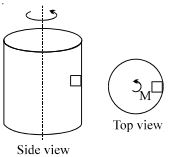
A hollow vertical cylinder of radius $R$ is rotated with angular velocity $\omega$ about an axis through its center. What is the minimum coefficient of static friction necessary to keep the mass $M$ suspended on the inside of the cylinder as it rotates?
At a specific instant emission of radioactive compound is deflected in a magnetic field. The compound can emit

$(i)$ Electrons              $(ii)$ Protons                 $(iii)$ $H{e^{2 + }}$                  $(iv)$ Neutrons

The emission at the instant can be

Given below are two statements: one is labelled as Assertion $A$ and the other is labelled as Reason $R$.

Assertion $A:$ A pendulum clock when taken to Mount Everest becomes fast.

Reason $R:$ The value of $g$ (acceleration due to gravity) is less at Mount Everest than its value on the surface of earth.

In the light of the above statements, choose the most appropriate answer from the options given below
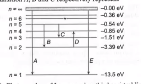
In the above figure $D$ and $E$ respectively represent
The position $x$ of a particle with respect to time $t$ along $x-$ axis is given by $x = 9{t^2} - {t^3}$ where $x$ is in metres and $t$ in seconds. What will be the position of this particle when it achieves maximum speed along the $x$ direction ? $..........\ m$