Question
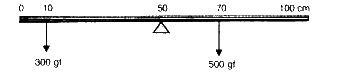
Fig. shows a uniform meter scale weighing 200 gf. Provided at its centre. Two weights 300 gf and 500 gf are suspended from the ruler as shown in the diagram. Calculate the resultant torque of the ruler and hence calculate the distance from mid-point where a 100 gf should be suspended to balance the meter scale.
Answer

Resultant torque = sum of clockwise moments - sum of anticlockwise moments

Taking, moments about the mid point

Resulttant torque = (300 x 40) - (500 x 20)

or, Resultant torque = 12000 - 10000 = 2000 gf-cm

Let a mass of 100 gf be suspended at a distance 'd' from the mid point towards the right side,

so as to balance the metre scale.

Then, in balanced condition:

sum of clockwise moments = sum of anticlockwise moments

(300 x 40) = (500 x 20) + (100 x d)

or, 12000 = 10000 + 100d

or, 100d = 2000

or,d = 20cm to the right of the mid-point

Need a full question paper?

Generate a complete, print-ready paper with questions like this in minutes — across 16+ boards, with answer keys.

Start Generating Free

Similar questions

Illustrate-combination of cells e.g., three cells, in parallel, explaining the combination briefly. Obtain an expression for current ‘i’ in the combination.
What is the relation between the mechanical advantage and the number of strands of string used to support the load, in a ‘block and tackle’ set-up?
The diagram in Fig. 9.27 shows a three pin plug. Label the three pins.
(a) why if the top pin thicker and longer than the other two?
(b) why are the pins splitted at the ends?
What is the purpose of a switch in a circuit? Why is the switch put in the live wire? What
precaution do you take while handling a switch?
The figure shows a uniform metre rule placed on a function at its mid-point O and having a weight 40 gf at the 10 cm mark and a weight of 20 gf at the 9.0 cm mark.Is the metre rule in equilibrium?
If not how will the rule turn?
A transformer is designed to work from a 240 V a.c. mains and to give a supply of 8 V to ring
a house–bell. The primary coil has 4800 turns. How many turns will be in the secondary coil?
Why does the sun appear red at sunrises and sunset?
(i) (a) What is a machine?
(b) In reference to machine define effort and actual mechanical advantage.
(ii) Prove that efficiency of a machine is the ratio between mechanical advantage and the velocity ratio,
(iii) A machine displaces a load of 125 kgf through a distance 0.30 m, when an effort of 12.5 kgf acts through a distance of 4.0 m.
Calculate the (a) velocity ratio (b) mechanical advantage (c) % age efficiency of the machine
A pendulum is oscillating on either side of its rest position. Explain the energy changes that takes place in the oscillating pendulum. How does the mechanical energy remains constant in it? Draw the necessary diagram.
How does the action of a convex lens differ from that of a concave lens on a parallel beam of light incident on them? Draw diagram to illustrate your answer.