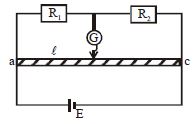
Fig. shows rough sketch of meter bridge. $(G)$ deflects zero at length $\ell \, cm$. Now $R_1$ and $R_2$ are interchanged then balancing length increases by $25\, cm$. Find $R_1/R_2$
Medium


Download our appand get started for free
Experience the future of education. Simply download our apps or reach out to us for more information. Let's shape the future of learning together!No signup needed.*
Similar Questions
- 1An electric bulb is rated $60\,W$, $220\,V$. The resistance of its filament is ............. $\Omega$View Solution
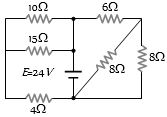
- 2Find the equivalent resistance across the terminals of source of $e.m.f$. $24\, V$ for the circuit shown in figure .............. $\Omega$View Solution
- 3If a copper wire is stretched to increase its length by $20 \% $. The percentage increase in resistance of the wire is $..........\%$View Solution
- 4View SolutionA potential difference is applied across the ends of a metallic wire. If the potential difference is doubled, then the drift velocity
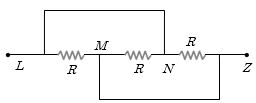
- 5Three equal resistances each of value $R$ are joined as shown in the figure. The equivalent resistance between $M$ and $N$ isView Solution
- 6View SolutionThe fact that the conductance of some metals rises to infinity at some temperature below a few Kelvin is called
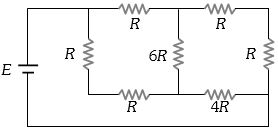
- 7A battery of internal resistance $4$ $\Omega$ is connected to the network of resistances as shown. In order to give the maximum power to the network, the value of $R$ (in $\Omega $) should beView Solution
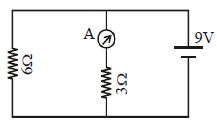
- 8In the figure shown, if the internal resistance of the battery is $1\, ohm$ , the reading of the ammeter will be ................. $\mathrm{A}$View Solution
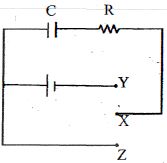
- 9The capacitor $C$ is initially without charge.$X$ is now j oined to $Y$ for a long time, during which $H_1$ heat is produced in the resistance $R$. $X-Y$ connection is removed and $X$ is now joined to $Z$ for a long time, during which heat $H_2$ is produced in $R$.View Solution
- 10Two wires of same length and thickness having specific resistances $6\, \Omega \,cm$ and $3 \,\Omega\, cm$ respectively are connected in parallel. The effective resistivity is $\rho\, \Omega \,cm$. The value of $\rho$ to the nearest integer, is ..... .View Solution