If a copper wire is stretched to increase its length by $20 \% $. The percentage increase in resistance of the wire is $..........\%$
JEE MAIN 2023, Medium


Download our appand get started for free
Experience the future of education. Simply download our apps or reach out to us for more information. Let's shape the future of learning together!No signup needed.*
Similar Questions
- 1An electric bulb is designed to draw power $P_0$ at voltage $V_0$. If the voltage is $V$ it draws a power $P$. ThenView Solution
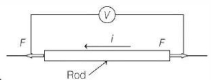
- 2As shown in the schematic below, a rod of uniform cross-sectional area $A$ and length $l$ is carrying a constant current $i$ through it and voltage across the rod is measured using an ideal voltmeter. The rod is stretched by the application of a force $F$. Which of the following graphs would show the variation in the voltage across the rod as function of the strain $\varepsilon$ when the strain is small. Neglect Joule heating.View Solution
- 3For a metallic wire, the ratio $V/i$ ($V = $ the applied potential difference, $i$ = current flowing) isView Solution
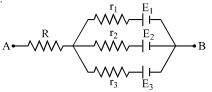
- 4In the network shown the potential difference between $A$ and $B$ is ................. $V$ $(R = r_1 = r_2 = r_3 = 1 \Omega$ ,$ E_1 = 3\, V, E_2 = 2\, V, E_3 = 1\, V)$View Solution
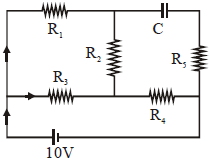
- 5An ideal cell of emf $10\, V$ is connected in circuit shown in figure. Each resistance is $2\, \Omega .$ The potential difference (in $V$) across the capacitor when it is fully charged isView Solution
- 6Four equal capacitors are connected to a battery as shown in the adjoining figure. The potential of $A$ and $B$ areView Solution
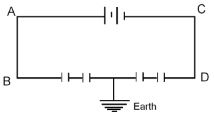
- 7View SolutionPotential gradient is defined as
- 8The resistance of a wire of iron is $10\, ohms$ and temp. coefficient of resistivity is $5 \times {10^{ - 3}}\,^oC$. At $20\,^oC$ it carries $30$ milliamperes of current. Keeping constant potential difference between its ends, the temperature of the wire is raised to $120\,^oC$. The current in milliamperes that flows in the wire isView Solution
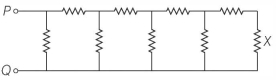
- 9What is the equivalent resistance of the circuit ............. $\Omega$View Solution
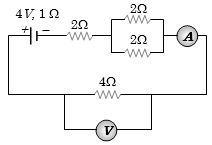
- 10Consider the circuit shown below where all resistors are $1 \,k \Omega$. If a current of magnitude $1 \,mA$ flows through the resistor marked $X$, the potential difference measured between points $P$ and $Q$ are ..............$V$View Solution