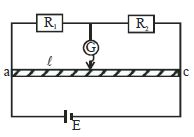
Fig. shows rough sketch of meter bridge. $(G)$ deflects zero at length $l\, cm$. Now $R_1$ and $R_2$ are interchanged then balancing length increases by $25\, cm$. Find $R_1/R_2$
Medium
Download our app for free and get started
$\frac{\mathrm{R}_{1}}{\mathrm{R}_{2}}=\frac{\ell}{100-\ell}$ and $\frac{\mathrm{R}_{2}}{\mathrm{R}_{1}}=\frac{\ell+25}{75-\ell}$
So $\frac{\ell}{100-\ell}=\frac{\ell+25}{75-\ell}$ or $\ell=\frac{75}{2} \mathrm{\,cm}$

Download our appand get started for free
Experience the future of education. Simply download our apps or reach out to us for more information. Let's shape the future of learning together!No signup needed.*
Similar Questions
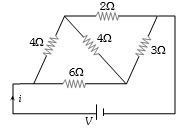
- 1For the network shown in the figure the value of the current $i$ isView Solution
- 2If a $30\, V$, $90\, W$ bulb is to be worked on a $120\, V$ line, a resistance of how many ohms should be connected in series with the bulb ............... $ohm$View Solution
- 3A heating element has a resistance of $100\,\Omega $ at room temperature. When it is connected to a supply of $220\,V,$ a steady current of $2\,A$ passes in it and temperature is $500\,^oC$ more than room temperature. What is the temperature coefficient resistance of the heating element?View Solution
- 4Two wires of equal diameters, of resistivities ${\rho _1}$ and ${\rho _2}$ and lengths $l_1$ and $l_2$, respectively, are joined in series. The equivalent resistivity of the combination isView Solution
- 5A wire of resistance $160\,\Omega$ is melted and drawn in wire of one-fourth of its length. The new resistance of the wire will be $......\Omega$View Solution
- 6If $400\; \Omega$ of resistance is made by adding four $100\; \Omega$ resistance of tolerance $5 \%$ then the tolerance of the combination is .....$\%$View Solution
- 7A wire of $1 \,\Omega$ has a length of $1\, m$. It is stetched till its length increases by $25\, \%$. The percentage change in resistance to the neartest integer is .....$\%$View Solution
- 8A current i passes through a wire of length $l$, radius of cross-section $r$ and resistivity $\rho$. The rate of heat generation isView Solution
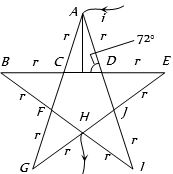
- 9In the following star circuit diagram (figure), the equivalent resistance between the points $A$ and $H$ will be ..............$r$View Solution
- 10View SolutionIf an electric current is passed through a nerve of a man, then man