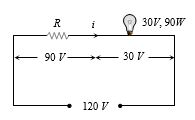
If a $30\, V$, $90\, W$ bulb is to be worked on a $120\, V$ line, a resistance of how many ohms should be connected in series with the bulb ............... $ohm$
Medium


Download our appand get started for free
Experience the future of education. Simply download our apps or reach out to us for more information. Let's shape the future of learning together!No signup needed.*
Similar Questions
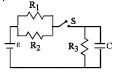
- 1The circuit shown in the figure consists of a battery of $emf$ $\varepsilon = 10 \,V$ ; a capacitor of capacitance $C = 1.0$ $ \mu F$ and three resistor of values $R_1 = 2$ $\Omega$ , $R_2 = 2$ $\Omega$ and $R_3 = 1$ $\Omega$ . Initially the capacitor is completely uncharged and the switch $S$ is open. The switch $S$ is closed at $t = 0.$View Solution
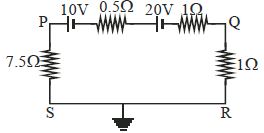
- 2View SolutionIn the circuit shown in figure, which of the statement is incorrect ?
- 3The total momentum of electrons in a straight wire of copper of length $1\, metre$ carrying a current of $16\, A$ isView Solution
- 4An electric iron draws $5\, amp$, a $TV$ set draws $3\, amp$ and refrigerator draws $2\, amp$ from a $220\, volt$ main line. The three appliances are connected in parallel. If all the three are operating at the same time, the fuse used may be of ............. $amp$View Solution
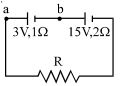
- 5Two batteries one of the $\mathrm{emf}$ $3\,V$, internal resistance $1$ ohm and the other of $\mathrm{emf}$ $15\, V$, internal resistance $2$ $\mathrm{ohm}$ are connected in series with a resistance $R$ as shown. If the potential difference between $a$ and $b$ is zero the resistance of $R$ in $\mathrm{ohm}$ isView Solution
- 6If you are provided a set of resistances $2\, \Omega, 4\, \Omega$ $6\, \Omega$ and $8\, \Omega$. Connect these resistances so as to obtain an equivalent resistance of $\frac{46}{3}\, \Omega$.View Solution
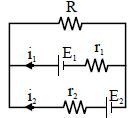
- 7View SolutionSee the electrical circuit shown in the adjoining figure. Which of the following equation is a correct equation for it
- 8$A$. The drift velocity of electrons decreases with the increase in the temperature of conductor.View Solution
$B$. The drift velocity is inversely proportional to the area of cross-section of given conductor.
$C$. The drift velocity does not depend on the applied potential difference to the conductor.
$D$. The drift velocity of electron is inversely proportional to the length of the conductor.
$E$. The drift velocity increases with the increase in the temperature of conductor.
Choose the correct answer from the options given below:
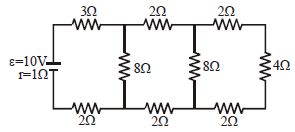
- 9In the circuit shown, the cell has $emf = 10\,V$ and internal resistance $= 1\, \Omega$ :-View Solution
- 10Eight copper wire of length $l$ and diameter $d$ are joined in parallel to form a single composite conductor of resistance $R$. If a single copper wire of length $2\,l$ have the same resistance $(R)$ then its diameter will be $.....d$.View Solution