Question
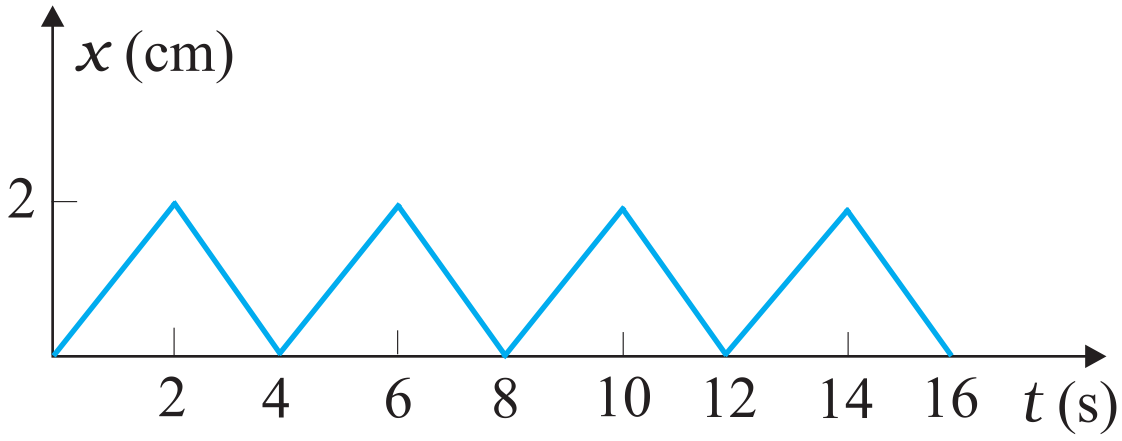
Figure $5.17$ shows the position-time graph of a body of mass $0.04kg$. Suggest a suitable physical context for this motion. What is the time between two consecutive impulses received by the body? What is the magnitude of each impulse?
Answer

A ball rebounding between two walls located between at x = 0 and x = 2cm; after every 2s, the ball receives an impulse of magnitude $0.08 \times 10^{-2}kgm/s$ from the walls The given graph shows that a body changes its direction of motion after every 2s. Physically, this situation can be visualized as a ball rebounding to and fro between two stationary walls situated between positions x = 0 and x = 2cm. Since the slope of the x - t graph reverses after every 2s, the ball collides with a wall after every 2s. Therefore, ball receives an impulse after every 2s. Mass of the ball, m = 0.04kg The slope of the graph gives the velocity of the ball. Using the graph, we can calculate initial velocity (u) as: $\text{u}=\frac{(2-0)\times10^{-2}}{(2-0)}=10^{-2}\text{m/s}$ Velocity of the ball before collision, $u = 10^{-2}m/s$ Velocity of the ball after collision, $v = -10^{-2}m/s$ (Here, the negative sign arises as the ball reverses its direction of motion.) Magnitude of impulse = Change in momentum $= |mv - mu| = |0.04 (v - u)| = |0.04(-10^{-2} - 10^{-2})| = 0.08 \times 10^{-2}kgm/s$

Need a full question paper?

Generate a complete, print-ready paper with questions like this in minutes — across 16+ boards, with answer keys.
Start Generating Free

Similar questions

Two spherical bodies, each of mass 50kg, are placed at a separation of 20cm. Equal charges are placed on the bodies and it is found that the force of Coulomb repulsion equals the gravitational attraction in magnitude. Find the magnitude of the charge placed on either body.
Define escape speed and derive the expression for escape velocity on earth's surface.
A bullet of mass m moving with a velocity v is embedded into a block of mass M suspended by a thread. As a result of this collision, the block along with the bullet rises to a height h. Prove that velocity of bullet was $\big(\frac{\text{m}+\text{M}}{\text{m}}\big)\sqrt{2\text{gh}}$.
A car goes on a horizontal circular road of radius R, the speed increasing at a constant rate $\frac{\text{d}\nu}{\text{dt}}=\text{a}.$ The friction dt coefficient between the road and the tyre is $\mu.$ Find the speed at which the car will skid.
A solid aluminium sphere and a solid copper sphere of twice the radius are heated to the same temperature and are allowed to cool under identical surrounding temperatures. Assume that the emissivity of both the spheres is the same. Find the ratio of:
  1. The rate of heat loss from the aluminium sphere to the rate of heat loss from the copper sphere.
  2. The rate of fall of temperature of the aluminium sphere to the rate of fall of temperature of the copper sphere. The specific heat capacity of aluminium = $900Jkg^{-1^\circ}C^{-1}$ and that of copper= $390Jkg^{-1^\circ}C^{-1}$. The density of copper = $3.4$ times the density of aluminium.
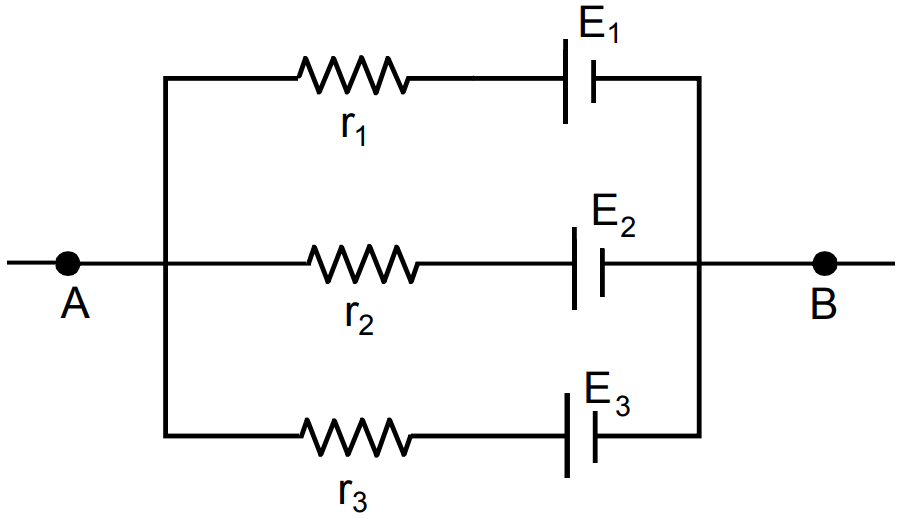
In the circuit shown in the figure. $\in_1=3\text{V},\in_2=2\text{V},\in_3=1\text{V}$ and $\text{r}_1=\text{r}_2=\text{r}_3=1\Omega.$ Find the potential difference between the points A and B and the current through each branch.
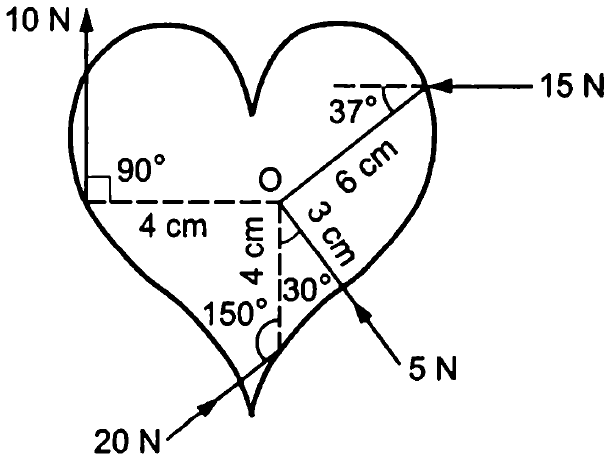
Calculate the total torque acting on the body shown in figure about the point O.
A stone of mass m tied to the end of a string revolves in a vertical circle of radius R. The net forces at the lowest and highest points of the circle directed vertically downwards are: [Choose the correct alternative]
 
Lowest Point
Highest Point
(a)
$mg - T_1$
$mg + T_2$
(b)
$mg + T_1$
$mg - T_2$
(c)
$mg + T_1 - (mv_1^2)/R$
$mg - T_2 + (mv_1^2)/R$
(d)
$mg - T_1 - (mv_1^2)/R$
$mg + T_2 + (mv_1^2)/R$
$T_1$ and $v_1$ denote the tension and speed at the lowest point. $T_2$ and $v_2$ denote corresponding values at the highest point.
A block is resting on a piston which is moving vertically with a simple harmonic motion of period 1sec. At what amplitude of motion will the block and the piston seperate? What is the maximum velocity of the piston at this amplitude?
A truck is pulling a car out of a ditch by means of a steel cable that is $9.1m$ long and has a radius of $5mm$. When the car just begins to move, the tension in the cable is $800N$. How much has the cable stretched?
(Young’s modulus for steel is $2 \times 10^{11}N m^{–2}$.)