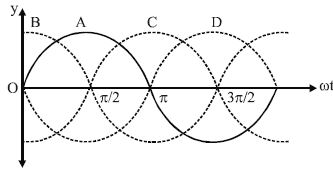
Figure given below shows four progressive waves $A, B, C$ and $D$ with their phases expressed with respect to the wave $A$ . It can be calculated from the figure that
Athe wave $C$ is ahead by a phase angle of $\pi /2$ and the wave $B$ lags behind by a phase angle of $\pi /2$
Bthe wave $C$ lags behind by a phase angle of $\pi /2$ and the wave $B$ ahead by a phase angle of $\pi /2$
Cthe wave $C$ is ahead by a phase angle of $\pi $ and the wave $B$ lags behind by a phase angle of $\pi $
Dthe wave $C$ lags behind by a phase angle of $\pi $ and the wave $B$ is ahead by a phase angle of $\pi $
Medium
Download our app for free and get started
Bthe wave $C$ lags behind by a phase angle of $\pi /2$ and the wave $B$ ahead by a phase angle of $\pi /2$
b It is clear from figure that the wave $A$ attains its mean position $T/4\,times$ earlier than $C$ , i.e., $C$ lags behind $A$ by phase angle $\pi /2$ . Further, $B$ attains the mean position $T/4\,times$ earlier than $A$ , i.e., $B$ is ahead by a phase angle of $\pi /2$
Download our app
and get started for free
Experience the future of education. Simply download our apps or reach out to us for more information. Let's shape the future of learning together!No signup needed.*
A tuning fork of frequency $512\, Hz$ makes $4$ beats per second with the vibrating string of a piano. The beat frequency decreases to $2$ beats per sec when the tension in the piano string is slightly increased. The frequency of the piano string before increasing the tension was .... $Hz$
The given diagram shows a detector placed between a transmitter of sound waves and a metal plate. At three adjacent points, $ R, S$ and $T$ , the meter shows zero intensity. Which of the following is the frequency of the emitted wave ... $Hz$ ? (Take the velocity of sound as $ = 300\ m/s$ )
There is a destructive interference between the two waves of wavelength $\lambda$ coming from two different paths at a point. To get maximum sound or constructive interference at that point, the path of one wave is to be increased by
The speed of sound in hydrogen at $NTP$ is $1270\,m/s$ . Then, the speed in a mixture of hydrogen and oxygen in the ratio $4 : 1$ by volume will be ..... $m/s$
The end correction of a resonance column is $1\,cm.$ If the shortest length resonating with the tuning fork is $10\,cm,$ the next resonating length should be ..... $cm$
A plane wave of sound traveling in air is incident upon a plane surface of a liquid. The angle of incidence is $60^o.$ The speed of sound in air is $300 \,m /s$ and in the liquid it is $600\, m /s .$ Assume Snell’s law to be valid for sound waves.
A tuning fork vibrating with a sonometer having $20 cm$ wire produces $5$ beats per second. The beat frequency does not change if the length of the wire is changed to $21 cm.$ the frequency of the tuning fork (in Hertz) must be
The path difference between the two waves ${y_1} = {a_1}\sin \,\left( {\omega t - \frac{{2\pi x}}{\lambda }} \right)$ and ${y_2} = {a_2}\cos \,\left( {\omega t - \frac{{2\pi x}}{\lambda } + \phi } \right)$ is