Question
Figure represents two simple harmonic motions. The parameter which has different values in the two motions is:

  1. Amplitude.
  2. Frequency.
  3. Phase.
  4. Maximum velocity.

Answer

  1. Phase.

Explanation:

Because the direction of motion of particles A and B is just opposite to each other.

Need a full question paper?

Generate a complete, print-ready paper with questions like this in minutes — across 16+ boards, with answer keys.

Start Generating Free

Similar questions

$A$ block of mass $M$ is placed on $a$ horizontal surface and it is tied with an inextensible string to $a$ block of mass, as shown in figure. A block of mass $m_0$ is also placed on $M$ The minimum value of $\mu$ between the block $M$ and $m_0$ (taking horizontal surface frictionless) for which all the three blocks move together, is
Intensity level of a sound of intensity $I$ is $30\, dB$. The ratio $\frac{I}{{{I_0}}}$ is (Where ${I_0}$ is the threshold of hearing)
The magnitude of torque on a particle of mass $1\,kg$ is $2.5\, Nm$ about the origin. If the force acting on it is $1\,N$, and the distance of the particle from the origin is $5\,m$, the angle between the force and the position vector is (in radians)
The first operation involved in a Carnot cycle is
If mass of a satellite is doubled and time period remain constant the ratio of orbit in the two cases will be
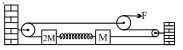
In the diagram shown, no friction at any contact surface. Initially, the spring has no deformation. What will be the maximum deformation in the spring? Consider all the strings to be sufficiency large. Consider the spring constant to be $K$.
A particle has initial velocity $(2\hat i + 3\hat j ) $ and has acceleration $(0.3\,\hat i + 0.2\,\hat j)$ . Its speed after $10\,s$ is
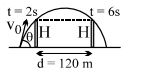
A projectile crosses two walls of equal height $H$ symmetrically as shown The angle of projection of the projectile is
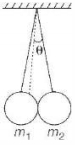
Two spherical objects each of radii $R$ and masses $m_1$ and $m_2$ are suspended using two strings of equal length $L$ as shown in the figure $(R << L)$. The angle $\theta$ which mass $m_2$ makes with the vertical is approximately
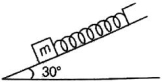
A body of mass $5\,kg$ is suspended by a spring balance on an inclined plane as shown in figure. (in $N$)