Question

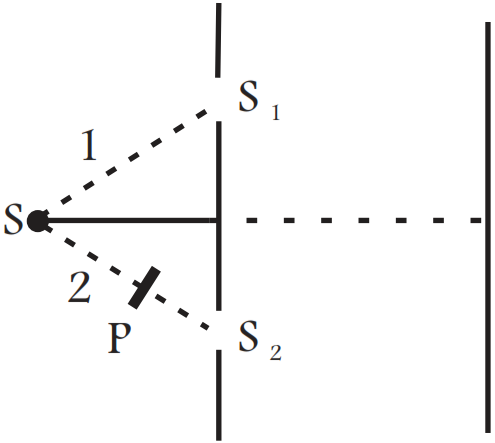
Figure shown a two slit arrangement with a source which emits unpolarised light. P is a polariser with axis whose direction is not given. If I0 is the intensity of the principal maxima when no polariser is present, calculate in the present case, the intensity of the principal maxima as well as of the first minima.
Answer

The resultant amplitude of wave reaching on screen will be the sum of amplitude of either wave in perpendicular and parallel polarisation.
Amplitude of the wave in perpendicular polarisation
$\text{A}_\bot=\text{A}_\bot^1+\text{A}_\bot^2=\text{A}_\bot^0\sin(\text{kx}-\omega\text{t})+\text{A}_\bot^2\sin(\text{kx}-\omega\text{t}+\phi)$
$\Rightarrow\ \text{A}_\bot=\text{A}_\bot^0(\sin(\text{kx}-\omega\text{t})+\sin(\text{kx}-\omega\text{t}+\phi))$
Amplitude of the wave in parallel polarisation
$\text{A}_{||}=\text{A}_{||}^{(1)}+\text{A}_{||}^{(2)}$
$\Rightarrow\ \text{A}_\bot=\text{A}_\bot^0[\sin(\text{kx}-\omega\text{t})+\sin(\text{kx}-\omega\text{t}+\phi)]$
$\therefore$ Average Intensity on the screen
$\text{I}=\begin{Bmatrix} \Big|\text{A}_\bot^0\Big|^2+\Big|\text{A}_\bot^0\Big|^2\end{Bmatrix}\big[\sin(\text{kx}-\omega\text{t})(1+\cos^2\phi+2\sin\phi)+\sin^2(\text{kx}-\omega\text{t})\sin^2\phi\big]_\text{average}$
$=\begin{Bmatrix} \Big|\text{A}_\bot^0\Big|^2+\Big|\text{A}_\bot^0\Big|^2\end{Bmatrix}\Big(\frac{1}{2}\Big)2(1+\cos\phi)$
$\Rightarrow\ \text{I}=2\Big|\text{A}_{||}^0\Big|^2(1+\cos\phi)\text{ since},\Big|\text{A}_\bot^0\Big|_\text{av}+\Big|\text{A}_\bot^0\Big|_\text{av}$
With polariser P,
Assume $\text{A}_\bot^2$ is blocked
Intensity $=(\text{A}_{||}^1+\text{A}_{||}^2)^2+({\text{A}_{||}^2})^2$
$=\Big|\text{A}_{\bot}^0\Big|(1+\cos\phi)+\Big|\text{A}_{\bot}^0\Big|.\frac{1}{2}$
Given, $\text{I}_0=4\Big|\text{A}_{\bot}^0\Big|=$ Intensity without polariser at principal maxima.
Intensity at first minima with polariser
$=\Big|\text{A}_{\bot}^0\Big|(1-1)+\frac{\Big|\text{A}_{\bot}^0\Big|}{2}=\frac{\text{I}_0}{8}.$

Need a full question paper?

Generate a complete, print-ready paper with questions like this in minutes — across 16+ boards, with answer keys.

Start Generating Free

Similar questions

Four equal charges 2.0 × 10-6C each are fixed at the four corners of a square of side 5cm. Find the Coulomb force experienced by one of the charges due to the rest three.
The property of diamagnetism is said to be present in all materials. Then, why are some materials paramagnetic or ferromagnetic?
The plates of a capacitor are 2.00cm apart. An electronproton pair is released somewhere in the gap between the plates and it is found that the proton reaches the negative plate at the same time as the electron reaches the positive plate. At what distance from the negative plate was the pair released?
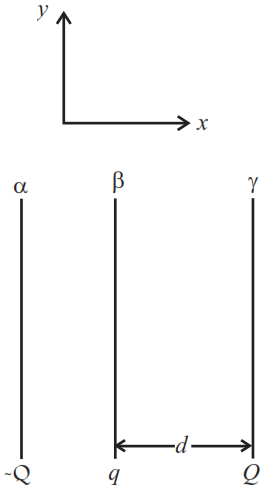
Two fixed, identical conducting plates $(\alpha\ \&\ \beta)$, each of surface area S are charged to -Q and q, respectively, where Q > q > 0. A third identical plate $(\gamma)$, free to move is located on the other side of the plate with charge q at a distance d (Fig.). The third plate is released and collides with the plate $\beta$. Assume the collision is elastic and the time of collision is sufficient to redistribute charge amongst $\beta\ \&\ \gamma$.

Find the electric field acting on the plate $\gamma$ before collision.
Find the maximum magnitude of the linear momentum of a photoelectron emitted when light of wavelength 400 run falls on a metal having work function 2.5eV.
An electrical technician requires a capacitance of 2μF in a circuitacross a potential difference of 1kV. A large number of 1μF capacitors are available to him each of which can withstand a potential difference of not more than 400V. Suggest a possible arrangement that requires the minimum number of capacitors.
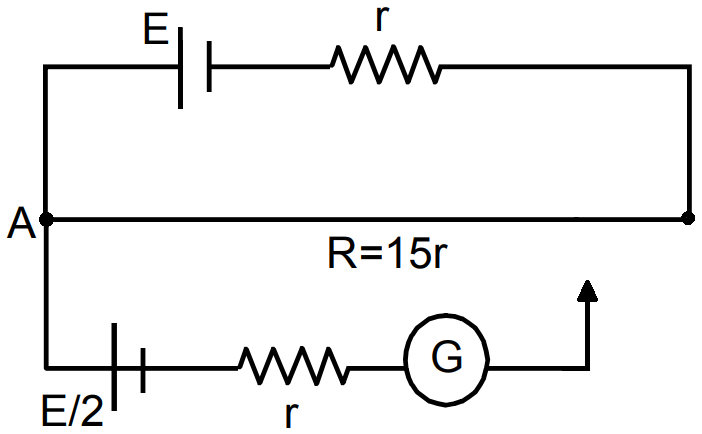
Consider the potentiometer circuit as arranged in the figure. The potentiometer wire is 600cm long. (a) At what distance from the point A should the jockey touch the wire to get zero deflection in the galvanometer? (b) If the jockey touches the wire at a distance of 560cm from A, what will be the current in the galvanometer?

A light beam of wavelength 400 run is incident on a metal plate of work function 2.2eV.
  1. A particular electron absorbs a photon and makes two collisions before coming out of the metal. Assuming that 10% of the extra energy is lost to the metal in each collision, find the kinetic energy of this electron as it comes out of the metal.
  2. Under the same assumptions, find the maximum number of collisions the electron can suffer before it becomes unable to come out of the metal.
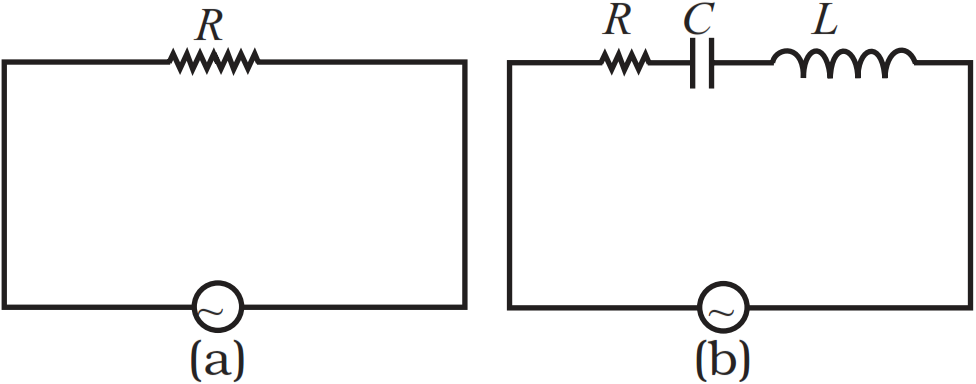
Study the circuits (a) and (b) shown in Fig. and answer the following questions.

  1. Under which conditions would the rms currents in the two circuits be the same?
  2. Can the rms current in circuit (b) be larger than that in (a)?
Consider the situation of the previous problem. Consider the fastest electron emitted parallel to the large metal plate. Find the displacement of this electron parallel to its initial velocity before it strikes the large metal plate.