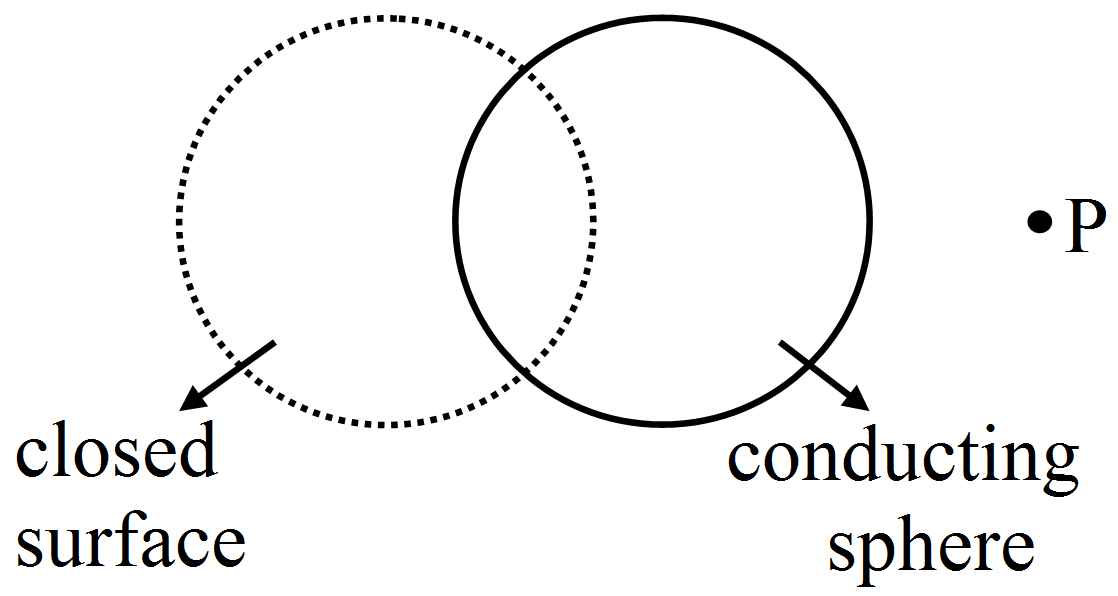
- AWill remain zero.
- BWill become positive.
- CWill become neagative.
- DWill become undefined.

Explanation:
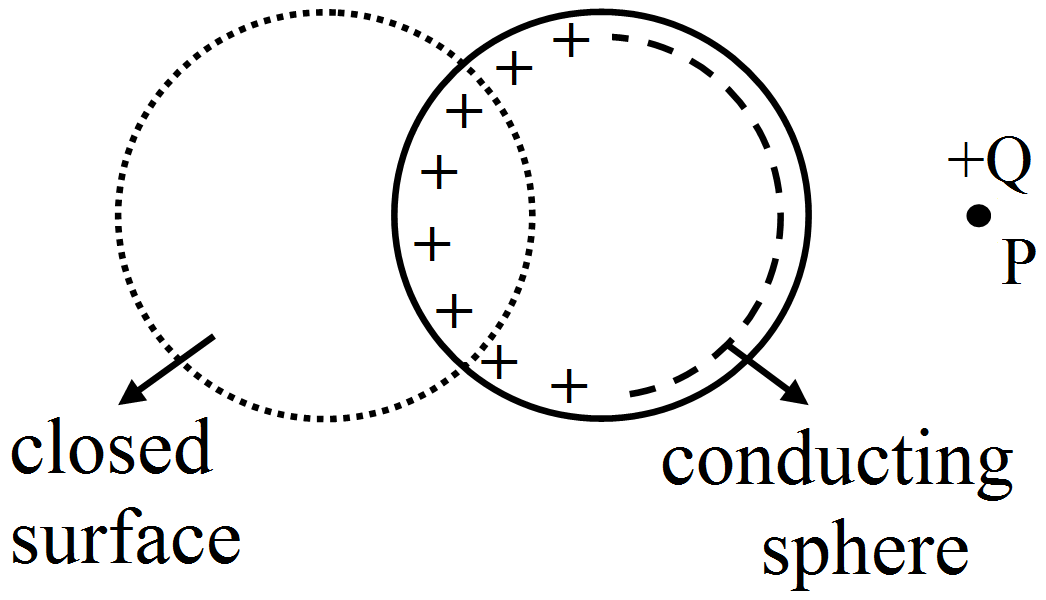
Charge distribution:

Due to charge distribution, intersection by the closed surface of conducting sphere containing the positive charge. So we can say that the flux of the electric field through the closed surface will become positive.
$\therefore\phi=\frac{\text{q}_{\text{in}}}{\in_0}\Rightarrow+\text{ve}$
Generate a complete, print-ready paper with questions like this in minutes — across 16+ boards, with answer keys.
Select the right option in the following
|
(a) Christian Huygens a contemporary of Newton established the wave theory of light by assuming that light waves were transverse |
|
(b) Maxwell provided the compelling theoretical evidence that light is transverse wave |
|
(c) Thomas Young experimentally proved the wave behaviour of light and Huygens assumption |
|
(d) All the statements give above, correctly answers the question “what is light” |
A logic gate is an electronic circuit which
|
(a) Makes logic decisions |
|
(b) Allows electrons flow only in one direction |
|
(c) Works binary algebra |
|
(d) Alternates between 0 and 1 values |
The ozone layer absorbs
|
(a) Infrared radiations |
(b) Ultraviolet radiations |
(c) X-rays |
(d) g-rays |
It is desired to photograph the image of an object placed at a distance of 3m from the plane mirror. The camera which is at a distance of 4.5 m from the mirror should be focussed for a distance of
| (a) 3m | (b) 4.5m | (c) 6m | (d) 7.5 m |
A double convex lens (
having focal length equal to the focal length of a concave mirror. The radius of curvature of the concave mirror is
|
(a) 10 cm |
(b) 20 cm |
(c) 40 cm |
(d) 15 cm |
An elastic circular wire of length l carries a current I. It is placed in a uniform magnetic field (Out of paper) such that its plane is perpendicular to the direction of
. The wire will experience
|
(a) No force |
(b) A stretching force |
|
(c) A compressive force |
(d) A torque |
A capacitor of capacity
is charged upto V volt and then connected to an uncharged capacitor of capacity
. Then final potential difference across each will be
|
(a) |
(b) |
(c) |
(d) |