Question
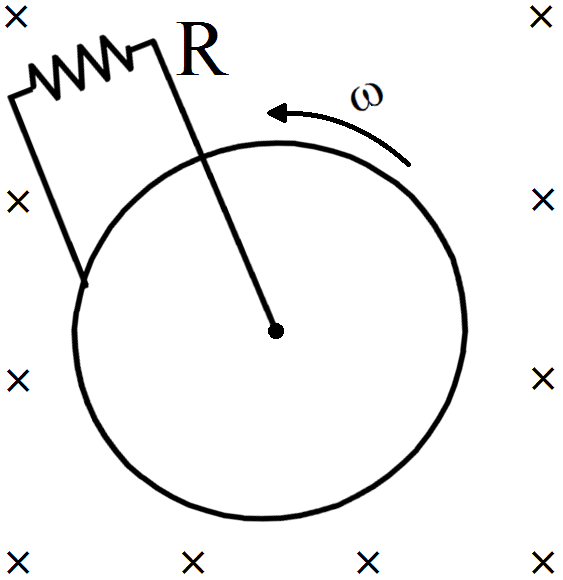
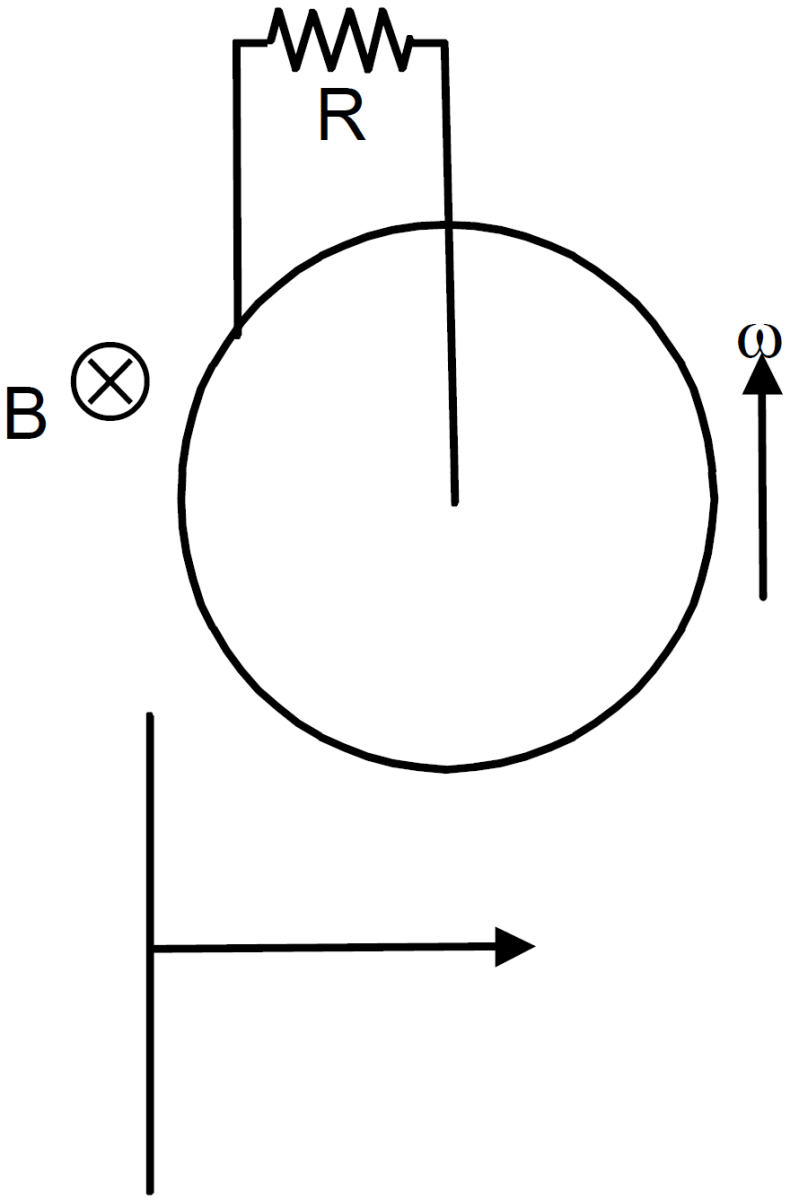
Figure shows a conducting disc rotating about its axis in a perpendicular magnetic field B. A resistor of resistance R is connected between the centre and the rim. Calculate the current in the resistor. Does it enter the disc or leave it at the centre? The radius of the disc is 5.0cm, angular speed $\omega=10 \ \text{rad/s}, \ \text{B}=0.40\text{T}$ and $\text{R}=10\Omega.$
Answer


$\text{B}=0.40\text{T},\omega=10 \ \text{rad}/',\text{r}=10\Omega$
$\text{r}=5\text{cm}=0.05\text{m}$
Considering a rod of length 0.05m affixed at the centre and rotating with the same $\omega$.
$\text{V}=\frac{\text{L}}{2}\times\omega=\frac{0.05}{2}\times10$
$\text{e}=\text{BLV}=0.40\times\frac{0.05}{2}\times10\times0.05=5\times10^{-3}\text{V}$
$\text{L}=\frac{\text{e}}{\text{R}}=\frac{5\times10^{-3}}{10}=0.5 \ \text{mA}$
It leaves from the centre.

Need a full question paper?

Generate a complete, print-ready paper with questions like this in minutes — across 16+ boards, with answer keys.

Start Generating Free

Similar questions

Precise measurements of physical quantities are a need of science. For example, to ascertain the speed of an aircraft, one must have an accurate method to find its positions at closely separated instants of time. This was the actual motivation behind the discovery of radar in World War II. Think of different examples in modern science where precise measurements of length, time, mass etc. are needed. Also, wherever you can, give a quantitative idea of the precision needed.
Two identically charged particles are fastened to the two ends of a spring of spring constant $100 \mathrm{Nm}^{-1}$ and natural length 10 cm . The system rests on a smooth horizontal table. If the charge on each particle is $2.0 \times 10^{-8} \mathrm{C}$, find the extension in the length of the spring. Assume that the extension is small as compared to the natural length. Justify this assumption after you solve the problem.
A person travelling by a car moving at 100km/h finds that his wristwatch agrees with the clock on a tower A. By what amount will his wristwatch lag or lead the clock on another tower B, 1000km (in the earth's frame) from the tower A when the car reaches there?
If earth contracts to half its radius. What would be the length of the day?
What is the coefficient of performance $(\beta)$ of a Carnot refrigerator working between 30°C and 0°C?
A mass m displaces in a straight line, guided by a machine delivering constant power. Prove that the displacement (x) is proportional to $\text{t}^\frac{3}{2}$
Light from a massive star suffers 'gravitational red shift' i.e., its wavelength changes towards the red end due to the gravitational attraction of the star. Obtain the formula for this gravitational red shift using the simple consideration that a photon of frequency v has energy $\text{h}\nu$ (h=planck's constant) and mass $\frac{\text{h}\nu}{\text{c}^2}.$ Estimate the magnitude of the red-shift for light of wavelength $5000\mathring{\text{A}}$ from a star of mass $10^{32}kg$ and radius $10^6km. G = 6.67 \times 10^{-11}Nm^2 kg^{-2}$ and $C = 3 \times 108m s^{-1}$.
At a time when the displacement is half the amplitude, what fraction of the total energy is kinetic and what fraction is the potential in S.H.M?
The parallax of a heavenly body measured from two points diametrically opposite on earth's equator is 60 second. If the radius of earth is $6.4 \times 10^6 \mathrm{~m}$, determine the distance of the heavenly body from the centre of earth. Convert this distance in A.U. Given $1 \mathrm{~A} . \mathrm{U} .=1.5 \times 10^{11} \mathrm{~m}$.
Explain the concepts of ideal gas.