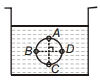
Figure shows a container filled with a liquid of density $\rho$. Four points $A, B, C$ and $D$ lie on the diametrically opposite points of a circle as shown. Points $A$ and $C$ lie on vertical line and points $B$ and $D$ lie on horizontal line. The incorrect statement is $\left(p_A, p_B, p_C, p_D\right.$ are absolute pressure at the respective points)
Diffcult
Download our app for free and get started
(c)
Points at same height have same pressure, points with height difference say ' $h$ ' will have difference of $\rho g h$.
Let radius of circle is $r$
$p_A=p_0+h \rho g$
$p_B=p_D=p_0+(h+r) \rho g$
$p_C=p_0+(h+2 r) \rho g$
Then,
$p_C+p_A=\left[p_0+(h+2 r) \rho g\right]-\left[p_0+h \rho g\right]$
$=p_0+h \rho g+2 r \rho g+p_0+h \rho g$
$=2\left[p_0+(h+r) \rho g\right]$
$\frac{p_C+p_A}{2}=p_0+(h+r) \rho g$
$\frac{p_C+p_A}{2}=p_B=p_D$
i.e., option $(a), (b)$ and $(d)$ gives correct statement but incorrect statement is $(c)$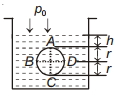

Download our appand get started for free
Experience the future of education. Simply download our apps or reach out to us for more information. Let's shape the future of learning together!No signup needed.*
Similar Questions
- 1Three liquids of densities $d,\,2d$ and $3d$ are mixed in equal proportions of weights. The relative density of the mixture isView Solution
- 2A cube of wood supporting $200\,gm$ mass just floats in water. When the mass is removed, the cube rises by $2\, cm$. ............ $cm$ is the side of cube .View Solution
- 3$Assertion :$ The velocity of flow of a liquid is smaller when pressure is larger and vice-versa.View Solution
$Reason :$ According to Bernoulli’s theorem, for the stream line flow of an ideal liquid, the total energy per unit mass remains constant. - 4The terminal velocity of a copper ball of radius $2.0 \;mm$ falling through a tank of oll at $20\,^{\circ} C$ is $6.5 \;cm s ^{-1} .$ Compute the viscosity of the oil at $20\,^{\circ} C .$ Density of oil is $1.5 \times 10^{3} \;kg m ^{-3},$ density of copper is $8.9 \times 10^{3} \;kg m ^{-3}$View Solution
- 5View SolutionTwo pieces of metal when immersed in a liquid have equal upthrust on them; then
- 6In Millikan's oil drop experiment, what is viscous force acting on an uncharged drop of radius $2.0 \times 10^{-5}\, {m}$ and density $1.2 \times 10^{3} \,{kgm}^{-3}$ ? Take viscosity of liquid $=1.8 \times 10^{-5}\, {Nsm}^{-2} .$ (Neglect buoyancy due to air).View Solution
- 7A water drop of radius $1\,\mu m$ falls in a situation where the effect of buoyant force is negligible. Coefficient of viscosity of air is $1.8 \times 10^{-5}\,Nsm ^{-2}$ and its density is negligible as compared to that of water $10^{6}\,gm ^{-3}$. Terminal velocity of the water drop is________ $\times 10^{-6}\,ms ^{-1}$View Solution
(Take acceleration due to gravity $=10\,ms ^{-2}$ )
- 8A sphere of relative density $\sigma$ and diameter $D$ has concentric cavity of diameter $d$. The ratio of $\frac{D}{d}$, if it just floats on water in a tank is:View Solution
- 9View SolutionWater coming out of the mouth of a tap and falling vertically in streamline flow forms a tapering column, i.e., the area of cross-section of the liquid column decreases as it moves down. Which of the following is the most accurate explanation for this
- 10The volume of an air bubble is doubled as it rises from the bottom of lake to its surface. The atmospheric pressure is $75 \,cm$ of mercury. The ratio of density of mercury to that of lake water is $\frac{40}{3}$. The depth of the lake in metre is .........View Solution