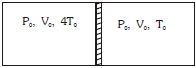
Figure shows a cylindrical adiabatic container of total volume $2V_0$ divided into two equal parts by a conducting piston (which is free to move). Each part containing identical gas at pressure $P_0$ . Initially temperature of left and right part is $4T_0$ and $T_0$ respectively. An external force is applied on the piston to keep the piston at rest. Find the value of external force required when thermal equilibrium is reached. ( $A =$ Area of piston)
Diffcult
Download our app for free and get started
If final temp is $T.$
$\frac{\mathrm{P}_{0} \mathrm{V}_{0}}{\mathrm{R} 4 \mathrm{T}_{0}} \mathrm{C}_{\mathrm{V}}\left(4 \mathrm{T}_{0}-\mathrm{T}\right)=\frac{\mathrm{P}_{0} \mathrm{V}_{0}}{\mathrm{RT}_{0}} \mathrm{C}_{\mathrm{V}}\left(\mathrm{T}-\mathrm{T}_{0}\right)$
$\frac{4 \mathrm{T}_{0}-\mathrm{T}}{4}=\mathrm{T}-\mathrm{T}_{0}$
$4 \mathrm{T}_{0}-\mathrm{T}=4 \mathrm{T}-4 \mathrm{T}_{0}$
$8 \mathrm{T}_{0}=5 \mathrm{T}$
$\mathrm{T}=\frac{8 \mathrm{T}_{0}}{5}$
Final pressure
In left $\quad \mathrm{P}_{\mathrm{f}}=\frac{\mathrm{T}_{\mathrm{f}}}{\mathrm{T}_{0}} \mathrm{P}_{1}=\frac{\frac{8}{5} \mathrm{T}_{0}}{4 \mathrm{T}_{0}}=\frac{2}{5} \mathrm{P}_{0}$
In right $\quad \mathrm{P}_{\mathrm{f}}=\frac{\frac{8}{5} \mathrm{T}_{0}}{\mathrm{T}_{0}}=\mathrm{P}_{0}=\frac{8}{5} \mathrm{P}_{0}$
Force $=\left(\frac{8 \mathrm{P}_{0}}{5}-\frac{2 \mathrm{P}_{0}}{5}\right) \mathrm{A}=\frac{6 \mathrm{P}_{0} \mathrm{A}}{5}$

Download our appand get started for free
Experience the future of education. Simply download our apps or reach out to us for more information. Let's shape the future of learning together!No signup needed.*
Similar Questions
- 1In a certain thermodynamical process, the pressure of a gas depends on its volume as $kV ^{3}$. The work done when the temperature changes from $100^{\circ} C$ to $300^{\circ} C$ will be .......... $nR$, where $n$ denotes number of moles of a gas.View Solution
- 2View SolutionWhich of the following can not determine the state of a thermodynamic system
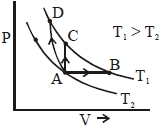
- 3Three different processes that can occur in an ideal monoatomic gas are shown in the $P$ vs $V$ diagram. The paths are labelled as $A \rightarrow B, A \rightarrow C$ and $A \rightarrow D .$ The change in internal energies during these process are taken as $E _{ AB }, E _{ AC }$ and $E _{ AD }$ and the work done as $W _{ AB }$ $W _{ AC }$ and $W _{ AD }$View Solution
The correct relation between these parameters are
- 4One mole of a monatomic ideal gas is taken through a cycle $ABCDA$ as shown in the $P-V$ diagram. Column $II$ gives the characteristics involved in the cycle. Match them with each of the processes qiven in Column $I$View Solution
Column $I$ Column $II$ $(A)$ Process $A \rightarrow B$ $(p)$ Internal energy decreases. $(B)$ Process $B \rightarrow C$ $(q)$ Internal energy increases. $(C)$ Process $C \rightarrow D$ $(r)$ Heat is lost. $(D)$ Process $D \rightarrow A$ $(s)$ Heat is gained. $(t)$ Work is done on the gas. 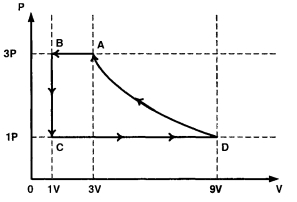
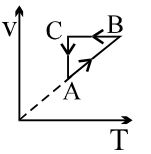
- 5View SolutionAn ideal gas undergoes a thermodynamics cycle as shown in figure. Which of the following graphs represents the same cycle?
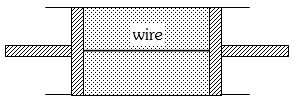
- 6A cylindrical tube of uniform cross-sectional area $A$ is fitted with two air tight frictionless pistons. The pistons are connected to each other by a metallic wire. Initially the pressure of the gas is $P_0$ and temperature is $T_0$, atmospheric pressure is also $P_0$. Now the temperature of the gas is increased to $2T_0$, the tension in the wire will beView Solution
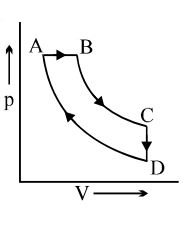
- 7A cyclic process $ABCD$ is shown in the $p-V$ diagram. Which of the following curves represents the same process if $BC \& DA$ are isothermal processesView Solution
- 8A heat engine is involved with exchange of heat of $1915\, J,$ $-40\, J ,+125\, J$ and $-Q\,J$, during one cycle achieving an efficiency of $50.0 \%$. The value of $Q$ is.......$J$View Solution
- 9An engine operating between the boiling and freezing points of water will haveView Solution
$1.$ efficiency more than $27 \%$
$2.$ efficiency less than the efficiency a Carnot engine operating between the same two temperatures.
$3.$ efficiency equal to $27 \%$
$4.$ efficiency less than $27 \%$
- 10A thermodynamic process in which temperature $T$ of the system remains constant though other variable $P$ and $V$ may change, is calledView Solution