Question
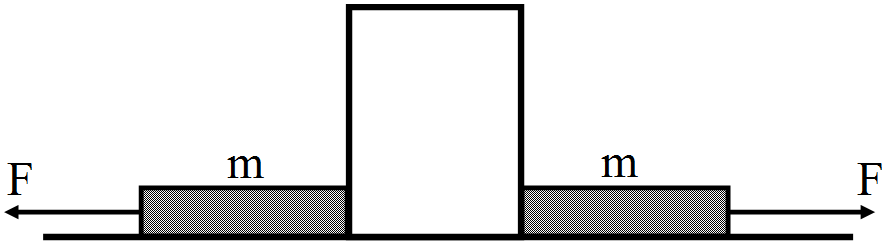
Figure shows a heavy block kept on a frictionless surface and being pulled by two ropes of equal mass m. At t = 0, the force on the left rope is withdrawn but the
force on the right end continues to act. Let F1 and F2 be the magnitudes of the forces by the right rope and the left rope on the block respectively:
  1. F= F2 = F for t < 0.
  2. F1 = F2 = F + mg for t < 0.
  3. F1 = F, F2 = F for t > 0.
  4. F1< F, F2 = F for t > 0.

Answer

  1. F= F2 = F for t < 0.

Explanation:

At t < 0, the block is in equilibrium in the horizontal direction.

So, F1 = F2 = F

At t > 0, F2 = 0 and F1 = F.

Need a full question paper?

Generate a complete, print-ready paper with questions like this in minutes — across 16+ boards, with answer keys.

Start Generating Free

Similar questions

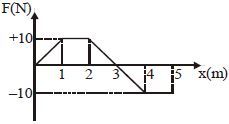
A position dependent force $F$ acting on a particle and its force-position curve is shown in the figure. Work done on the particle, when its displacement $0$ to $5\,m$ is ............. $\mathrm{J}$
A balloon is at a height of $81\, m$ and is ascending upwards with a velocity of $12 \,m/s$. A body of $2\,kg$ weight is dropped from it. If $g = 10\,m/{s^2}$, the body will reach the surface of the earth in.........$s$
A thin uniform rod of length $2 l$ and mass M is acted upon a constant torque. The angular velocity changes from zero to $\omega$ in time $t$. The value of torque is:
A ball of mass m moving with velocity in collides elastically with wall and rebounds. The change in momentum of the ball will be:
A body is rotating with angular velocity $\omega=(3\hat{\text{i}}-4\hat{\text{j}}-\hat{\text{k}})$ The linear velocity of a point having position vector $\text{r}=(5\hat{\text{i}}-6\hat{\text{j}}+6\hat{\text{k}})$ is:
A unit scale is to be prepared whose length does not change with temperature and remains $20\,cm$, using a bimetallic strip made of brass and iron each of different length. The length of both components would change in such a way that difference between their lengths remains constant. If length of brass is $40\,cm$ and length of iron will be$...cm$

$\left(\alpha_{\text {iron }}=1.2 \times 10^{-5} K ^{-1}\right.$ and $\left.\alpha_{\text {brass }}=1.8 \times 10^{-5} K ^{-1}\right)$.

When a wire is compressed, the potential energy of its molecules:
A hollow sphere of mass $m$ and radius $R$ is rolling downward on a rough inclined plane of inclination $\theta$. If the coefficient of friction between the hollow sphere and incline is $\mu$, then ........
The cylindrical tube of a spray pump has radius $R,$ one end of which has $n$ fine holes, each of radius $r.$ If the speed of the liquid in the tube is $v,$ the speed of the ejection of the liquid through the holes is
If M is the mass of the earth and R its radius, the ratio of the gravitational acceleration and the gravitational constant is: