MCQ
A thin uniform rod of length $2 l$ and mass M is acted upon a constant torque. The angular velocity changes from zero to $\omega$ in time $t$. The value of torque is:
  • A
    $\frac{M l^2 \omega}{3 t}$
  • B
    $\frac{2 M l^2 \omega}{3 t}$
  • C
    $\frac{M l^2 \omega}{12 t}$
  • D
    $\frac{M l^2 \omega}{t}$

Answer

(a) $\frac{M 2^2 \omega}{3 t}$
Explanation:
As Torque $(\tau)$ is equal to the product of Moment of Inertia (I) and Angular acceleration ( $\alpha$ )
$
\begin{aligned}
\tau & =I \alpha \\
\tau & =I \frac{\Delta \omega}{\Delta t} \\
\tau & =\left[\frac{M(2 l)^2}{12}\right]\left[\frac{\omega}{t}\right] \\
\tau & =\frac{M l^2 \omega}{3 t}
\end{aligned}
$

Need a full question paper?

Generate a complete, print-ready paper with questions like this in minutes — across 16+ boards, with answer keys.

Start Generating Free

Similar questions

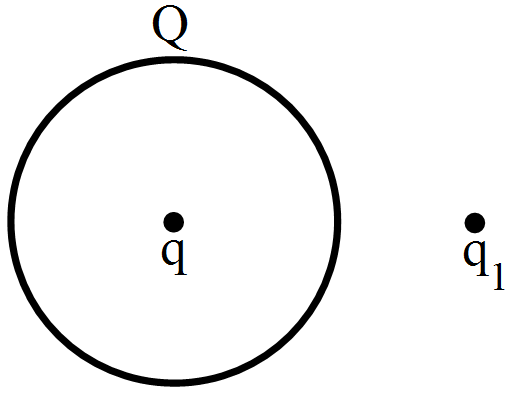
A thin, metallic spherical shell contains a charge Q on it. A point charge q is placed at the centre of the shell and another charge q1 is placed outside it as shown in figure. All the three charges are positive. The force on the charge at the centre is:

  1. Towards left.
  2. Towards right.
  3. Upward.
  4. Zero.
The position vector of a particle is given as $\vec r\, = \,({t^2}\, - \,8t\, + \,12)\,\hat i\,\, + \,\,{t^2}\hat j$ The time after which velocity vector and acceleration vector becomes perpendicular to each other is equal to........$sec$
If $\overrightarrow{ a }= a _{ x } \hat{ i }+ a _{ y } \hat{ j }+ a _{ z } \hat{ k }$ and $\overrightarrow{ b }= b _{ x } \hat{ i }+ b _{ y } \hat{ j }+ b _{ z } \hat{ k }$ then the cross product $\overrightarrow{ a } \times \overrightarrow{ b }$ is given by:
A cylinder rolls without slipping down an inclined plane, the number of degrees of freedom it has, is
An unloaded bus can be stopped by applying brakes on straight road after covering a distance $x$. Suppose, the passenger add $50 \%$ of its weight as the load and the braking force remains unchanged, how far will the bus go after the application of the brakes? (Velocity of bus in both case is same)
The dimensions of Planck's constant and angular momentum are respectively
A neutron having mass of $1.67 \times {10^{ - 27}}kg$ and moving at ${10^8}m/s$ collides with a deutron at rest and sticks to it. If the mass of the deutron is$3.34 \times {10^{ - 27}}kg$then the speed of the combination is
A body is thrown with a velocity of 10ms-1 at an angle of 60° with the horizontal. Its velocity at the highest point is:
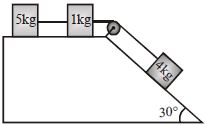
What will be the acceleration of the system and tension in the rope connecting $5\,kg$ and  $1\,kg$ :-
When an object is in equilibrium state, then