Question
Figure shows a series LCR circuit connected to a variable frequency 230V source. L = 5.0H, C = 80μF, R = 40Ω.
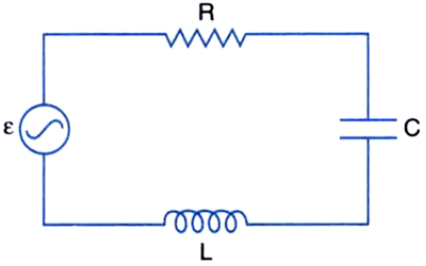
  1. Determine the source frequency which drives the circuit in resonance
  2. Obtain the impedance of the circuit and the amplitude of current at the resonating frequency.
  3. Determine the rms potential drops across the three elements of the circuit. Show that the potential drop across the LC combination is zero at the resonating frequency.
Answer

Here, we are given a LCR circuit.
Inductance, $L = 5.0H$
Resistance, $\text{R}=40\Omega$
Capacitance, $C = 80\mu F = 80 \times 10^{-6}F$
Effective voltage, $E_v = 230$volt
$\Rightarrow\ \text{Peak voltage},\ \text{E}_0=\sqrt{2}\text{E}_{\text{v}}=\sqrt{2}\times230\text{V}$
  1. Resonance angular frequency is given by
$\omega_{\text{r}}=\frac{1}{\sqrt{\text{LC}}}$
$=\frac{1}{\sqrt{5\times80\times10^{-6}}}$
$=\frac{1}{2\times10^{-2}}$
= 50rad/sec.
  1. Impedance of the circuit,
$\text{Z}=\sqrt{\text{R}^2+\big(\omega\text{L}-\frac{1}{\omega\text{C}}\big)^2}$
At resonance, $\omega\text{L}=\frac{1}{\omega\text{C}}$
Therefore,
$\text{Z}=\sqrt{\text{R}^2}=\text{R}=40\Omega$
Amplitude of current at resonating frequency
Peak value of current, $\text{I}_0=\frac{\text{E}_0}{\text{z}}=\frac{\sqrt{2}\times230}{40}=8.13\text{A}$
Rms value of current, $\text{I}_{\text{v}}=\frac{\text{I}_0}{\sqrt{2}}=\frac{8.13}{\sqrt{2}}=5.75\text{A}$
  1. Potential drop across L
$\text{V}_{\text{L rms}}=\text{I}_\text{v}\omega_{\text{r}}\text{L}$
$= 5.75 × 50 × 5.0$
$= 1437.5V$
Potential drop across R
$\mathrm{V_{R\ rms} = I_v \times\ R}$
$= 5.75 × 40$
$= 230$volts
Potential drop across C
$\text{V}_{\text{C rms}}=\text{I}_{\text{v}}\Big(\frac{1}{\omega_{\text{r}}\text{C}}\Big)$
$=5.75\times\frac{1}{50\times80\times10^{-6}}$
$=\frac{5.75}{4}\times10^3$
= 1437.5V
Therefore,
Potential drop across LC circuit
$\mathrm{V_{LC\  rms} = V_{L\ rms} - V_{C\ rms} = 0}$
Thus, the potential drop across the LC combination is zero at the resonating frequency.

Need a full question paper?

Generate a complete, print-ready paper with questions like this in minutes — across 16+ boards, with answer keys.

Start Generating Free

Similar questions

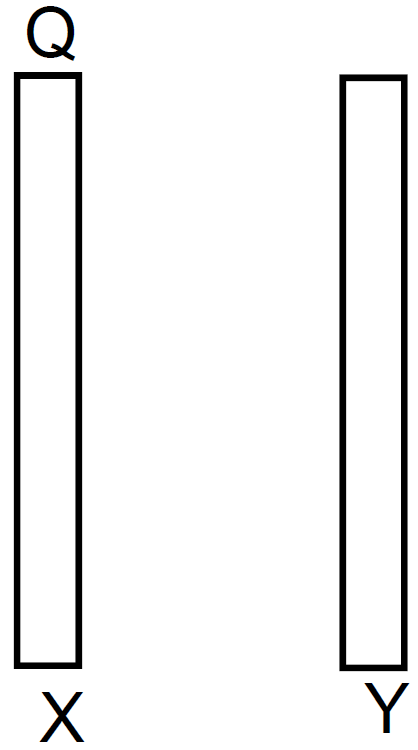
Two conducting plates X and Y, each having large surface area A (on one side), are placed parallel to each other as shown in figure. The plate X is given a charge Q whereas the other is neutral. Find:
  1. The surface charge density at the inner surface of the plate X.
  2. The electric field at a point to the left of the plates.
  3. The electric field at a point in between the plates.
  4. The electric field at a point to the right of the plates.
Consider a neutron and an electron bound to each other due to gravitational force. Assuming Bohr's quantization rule for angular momentum to be valid in this case, derive an expression for the energy of the neutron-electron system.
Answer the following Questions.
  1. Find expressions for the force and torque on an electric dipole kept in a uniform electric field.
OR

An electric dipole is held in a uniform electric field. (i) Using suitable diagram show that it does not undergo any translatory motion, and (ii) derive an expression for torque acting on it and specify its direction.
  1. Derive an expression for the work done in rotating a dipole from the angle $\theta_0$ to $\theta_1$ in a uniform electric field E.
​​​​​​​OR
  1. Define torque acting on a dipole of dipole moment $\vec{\text{p}}$ placed in a uniform electric field $\vec{\text{E}}.$ Express it in the vector form and point out the direction along which it acts.
  2. What happens if the field is non-uniform?
  3. What would happen if the external field $\vec{\text{E}}$ is increasing (i) parallel to $\vec{\text{p}}$ and (ii) anti-parallel to $\vec{\text{p}}?$
A boy riding on a bicycle going at 12km/h towards a vertical wall whistles at his dog on the ground. If the frequency of the whistle is 1600Hz and the speed of sound in air is 330m/s, find
  1. The frequency of the whistle as received by the wall.
  2. The frequency of the reflected whistle as received by the boy.
A compound microscope consists of an objective lens of focal length $2.0 \ cm$ and an eyepiece of focal length $6.25 \ cm$ separated by a distance of $15 \ cm$. How far from the objective should an object be placed in order to obtain the final image at
$a$ .the least distance of distinct vision $(25 \ cm),$ and
$b$. at infinity?
What is the magnifying power of the microscope in each case?
During a thunderstorm the ‘live' wire of the transmission line fell down on the ground. A group of boys passing through noticed it and some of them wanted to place the wire by the side. As they were approaching the wire and trying to lift it, Bari noticed it and immediately pushed them away to prevent them from touching the wire. Two of them got hunt in the process. Bari took them to a doctor to get medical aid.
Based on the above paragraph, answer the following:
  1. Write two values which Bari displayed during the incident.
  2. Why is it that a bird can sit over a suspended ‘live' wire without any harm whereas touching it on the ground can give a fatal shock?
  3. The electric power from a power plant is set up to a very high voltage before transmitting it to distant consumers. Write the reason for it.
Radiation coming from transition n = 2 to n = 1 of hydrogen atoms falls on helium ions in n = 1 and n = 2 states. What are the possible transitions of helium ions as they absorbs energy from the radiation?
Two conductors are made of the same material and have the same length. Conductor A is a solid wire of diameter 1mm. Conductor B is a hollow tube of outer diameter 2mm and inner diameter 1mm. Find the ratio of resistance $R_A$ to $R_B.$
Two identical metal balls one at $\text{T}_1=300\text{K}$ and the other at $\text{T}_2=600\text{K}$ are kept at a distance of 1m in vacuum. Will the temperatures equalise by radiation? Will the rate of heat gained by the colder sphere be proportional to $\text{T}_2^4-\text{T}_1^4$ as may be expected from the Stefan's law?
A capacitor of capacitance C is given a charge Q. At t = 0, it is connected to an uncharged capacitor of equal capacitance through a resistance R. Find the charge on the second capacitor as a function of time.