Figure shows a siphon. Choose the wrong statement : ( $P_0 =$ atmospheric pressure)
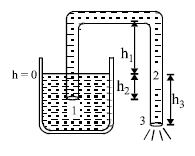
Medium
Download our app for free and get started
Download our app
and get started for free
Experience the future of education. Simply download our apps or reach out to us for more information. Let's shape the future of learning together!No signup needed.*
In a $U-$ tube, the liquid level stands at same level when it is at rest. When $U-$ tube is accelerated towards right, as shown in figure, the difference $h$ between level of two arms will be
Alaminar stream is flowing vertically down from a tap of cross-section area $1$ $cm^2$. At a distance $10 $ $cm$ below the tap, the cross-section area of the stream has reduced to $1/2$ $cm^2$. The volumetric flow rate of water from the tap must be about ........ $litre/\min$
The terminal velocity of a copper ball of radius $2.0 \;mm$ falling through a tank of oll at $20\,^{\circ} C$ is $6.5 \;cm s ^{-1} .$ Compute the viscosity of the oil at $20\,^{\circ} C .$ Density of oil is $1.5 \times 10^{3} \;kg m ^{-3},$ density of copper is $8.9 \times 10^{3} \;kg m ^{-3}$
Figure below shows a liquid being pushed out of the tube by a piston having area of cross section $2.0\,cm ^2$. The area of cross section at the outlet is $10\,mm ^2$. If the piston is pushed at a speed of $4\,cm s ^{-1}$, the speed of outgoing fluidis $.........\,cm s ^{-1}$.
A body of density $\rho'$ is dropped from rest at a height $h$ into a lake of density $\rho$ , where $\rho > \rho '$ . Neglecting all dissipative forces, calculate the maximum depth to which the body sinks before returning to float on the surface.
A tiny spherical oil drop carrying a net charge $q$ is balanced in still air with a vertical uniform electric field of strength $\frac{81 \pi}{7} \times 10^5 \mathrm{Vm}^{-1}$. When the field is switched off, the drop is observed to fall with terminal velocity $2 \times 10^{-3} \mathrm{~ms}^{-1}$. Given $\mathrm{g}=9.8 \mathrm{~ms}^{-2}$, viscosity of the air $=1.8 \times 10^{-5} \mathrm{Ns} \mathrm{m}^{-2}$ and the density of oil $=$ $900 \mathrm{~kg} \mathrm{~m}^{-3}$, the magnitude of $\mathrm{q}$ is
An ideal fluid of density $800 \; kgm ^{-3}$, flows smoothly through a bent pipe (as shown in figure) that tapers in cross-sectional area from $a$ to $\frac{ a }{2}$. The pressure difference between the wide and narrow sections of pipe is $4100 \; Pa$. At wider section, the velocity of fluid is $\frac{\sqrt{x}}{6} \; ms ^{-1}$ for $x = \dots$ $\left(\right.$ Given $g =10 \; m ^{-2}$ )
At shallow depth $h$, the pressure in the ocean is simply given by $P = P_0 + \rho gh$, in which $\rho$ is the density of water and $P_0$ is the air pressure. As we go deeper, the high pressure causes the water to compress and become denser. Which of the following sketches illustrates the correct dependence of the pressure on the depth $h$ ?